Off with a bang: International Fireworks Championship comes to Vegas


Turns out it’s tricky business, blowing up the sky.
Bruce Tyree’s on the phone from his native Michigan, explaining the intricacies of synchronized explosions that go boom in the night, speaking with the enthusiasm of a man whose company name comes outfitted with an exclamation point.
“It’s a big, long process designing one of these choreographed fireworks displays,” the head of Blast! Events explains. “You know, these people spend hours and hours and hours putting these things together — it’s generally over an hour-and-a-half to two hours per minute that they spend designing these shows.
“These displays are very technical,” he continues. “The effects are designed and put into these choreographed shows to hit exactly on the beat by the fraction of a second. This isn’t your grandpa’s fireworks display.”
What is it, then? Tyree’s used to this line of questioning by now, and he fires off his response like one of the rockets that comprise his stock-in-trade.
“I get asked that a lot, ‘What’s a fireworks competition?’” he says. “’Who can put on the most fireworks or blow up the most things the fastest? How does that work?’”
Well, Tyree’s headed here to show us when the International Fireworks Championship comes to the Las Vegas Motor Speedway on Saturday.
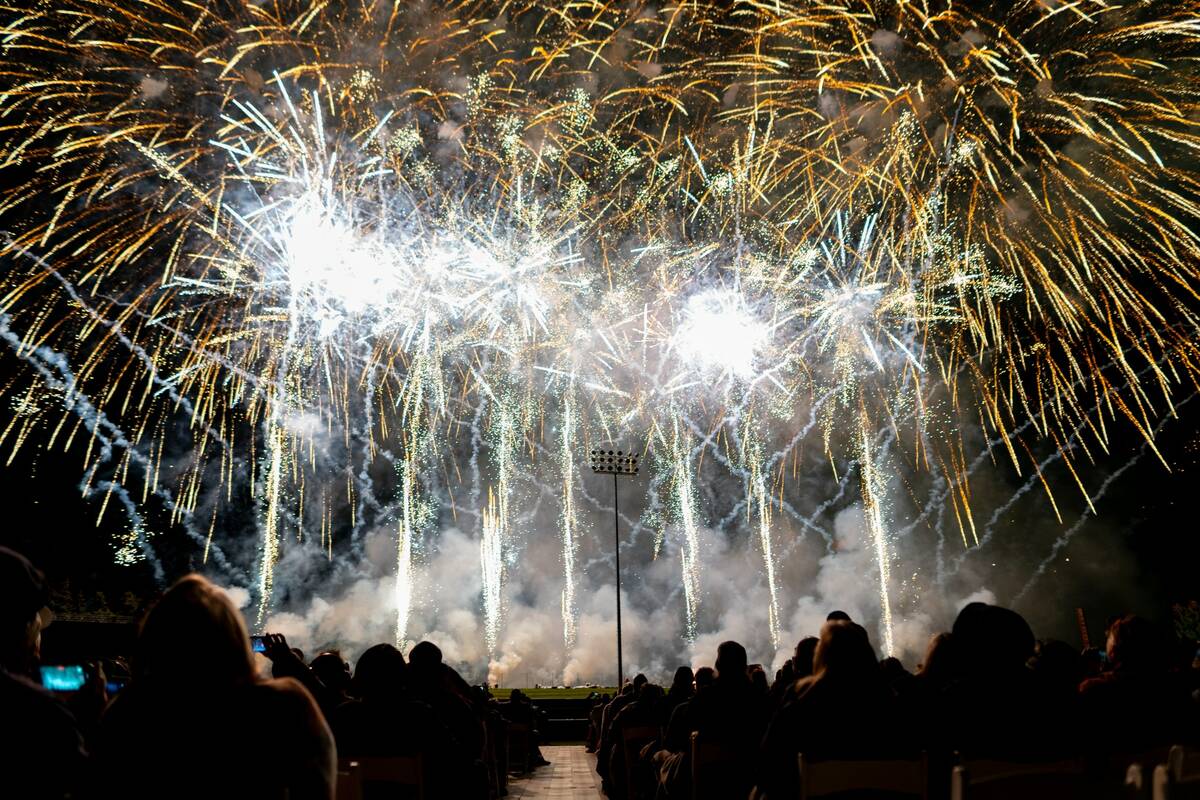
A four-nation competition featuring teams from the United States, the United Kingdom, Germany and Japan, the event pits some of the world’s best pyrotechnic designers against one another in what organizers call “the ultimate global showdown in the sky.”
Each squad will put together a 12-15 minute display containing 5,000 shots with a $40,000 retail value that requires six days to set up. Expert judges pick the technical winner; the audience anoints the ”People’s Choice” champ.
For Tyree, a longtime industry veteran who owned the Michigan-based Great Lakes Fireworks for 35 years, it’s the culmination of a lifetime’s work.
“Throughout my career, I’ve had the ability to take part in a lot of huge events around the world, and I’ve also competed myself in international competitions in Russia, Spain, China,” he says. “I’ve seen these events around the world and how well they’re received — they’re just really a lot of fun and super exciting.
“You come back to the U.S.,” he continues, “and you’re wondering, ‘Why doesn’t the U.S. have something like this taking place?’”
It does now.
The birth of the boom
Bruce Tyree’s career began as a hobby when he first joined his brother-in-law in putting on small 4th of July displays for rural towns in Northern Michigan, using wares sourced in nearby Ohio. (Fireworks sales didn’t become legal in their home state until 2011).
Word spread; a business was born.
“Next thing I knew, we were on a plane to China, visiting factories and bringing in containers full of fireworks,” Tyree recalls. “That’s how it all came about, and how it grew into the monster that it did.”
After more than three decades in the industry, Tyree retired from Great Lakes Fireworks.
But he grew restless.
“When I retired, it was like, ‘What would be the ultimate thing?’” he remembers thinking. “I love going around and watching all these shows, but I’m not traveling as much. How about I just have all the best fireworks designers in the world come to my area and do a fireworks show for me?”
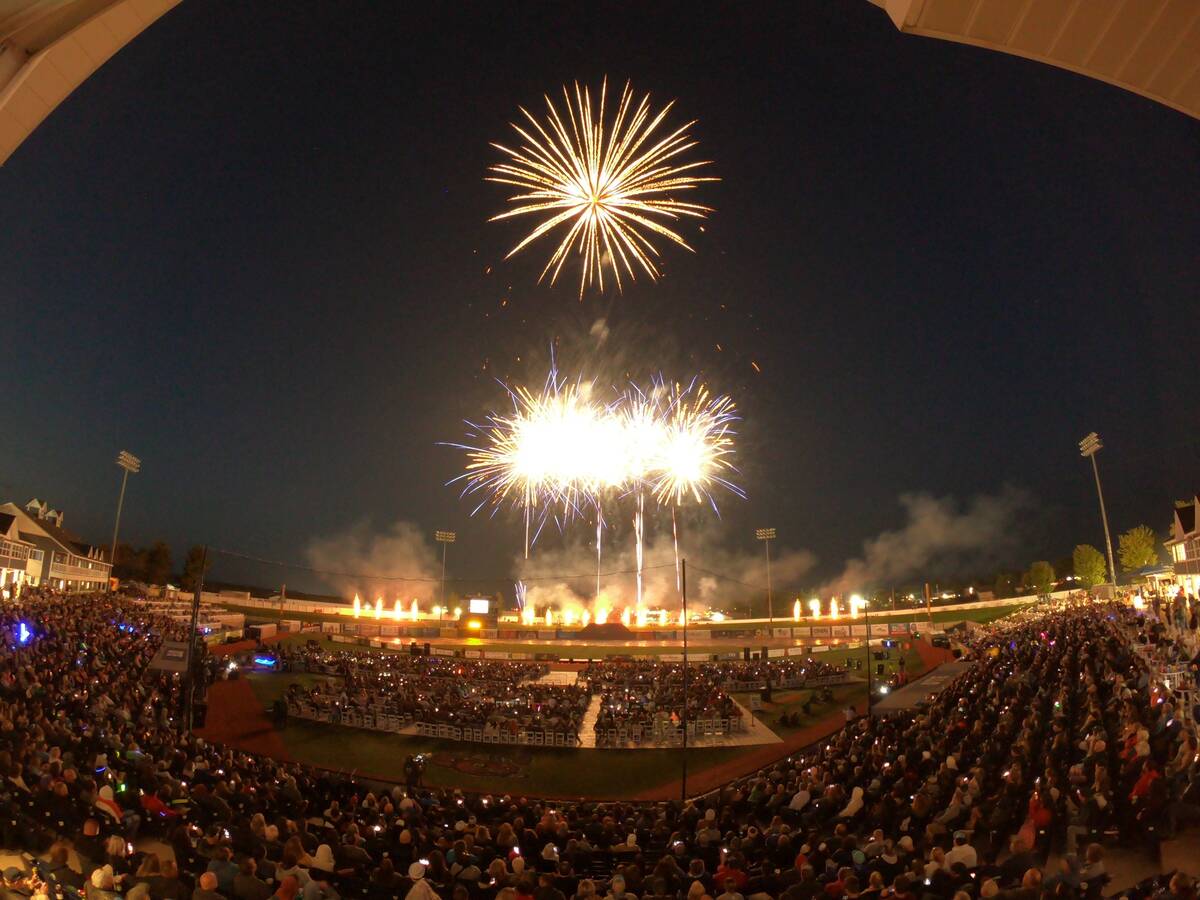
They did so with the launch of the first International Fireworks Championship in Traverse City, Michigan, in 2023.
It was an instant hit.
“Man, the tickets sold so fast. We couldn’t even believe it,” Tyree says. “We’re in a minor league baseball stadium, and it sold out in half-an-hour. … So they brought in 2,500 seats and put them on the infield of the stadium, increased the price, and those seats sold out in eight minutes. They’re like, ‘Okay, I think we got something going here.’”
After three successful years in Michigan, Tyree looked west.
“Coming into Las Vegas, the entertainment capital of the world, it was just trying to expand and show other audiences what this type of fireworks competition is, the artistry of fireworks,” he says. “It was just a vision of, ‘Where could we take this?’”
‘Fireworks are so impactful’
Gunpowder was pretty much his birthright.
Joe Rozzi’s a fourth-generation fireworks man. His great-grandfather Paolo Rozzi founded Rozzi’s Famous Fireworks in Southern Italy in 1895 before emigrating to America, the company relocating to its current home in Cincinnati, Ohio, three-and-a-half decades later.
Rozzi, along with designer Tyler Wiesmann, is heading up the U.S. team at the International Fireworks Championship, having competed around the globe for years.
“Competition shows are a little different than your average fireworks display,” he says. “There’s a good amount of planning.”
The way it’ll work here: all teams will use a uniform layout that Tyree created and fire everything from the same positions. Each squad was also provided with a vast catalog of fireworks to choose from, but have to do so with a set budget.
“And then over their 12- to 15-minute display, they can only use 1,000 cues,” Tyree elaborates. “However, they can put up to three devices on each one of those 1,000 moments. So it’s challenging for these designers to reel that in.
“You might think, ‘Everybody’s using the same fireworks, it’s the same,’” he continues. “But it’s not like that at all. You look at one and then the next one, and you would maybe think the criteria was different, but it’s just their style and their approach to the design. Some people maybe want to use more smaller devices — they’re cheaper, and you can use more of them — and then someone else’s approach is, ‘I want to use larger devices. They’re more expensive, so I can’t use as many of them, but, man, they’re going to be more impactful.’ It’s really amazing to see the difference in design and design processes that these people use.”
To hear Rozzi tell it, there are also clear contrasts between how different nationalities approach the craft.
”Japanese traditional fireworks displays are very different than what we what we’ve come to know here in the US,” he says. “Italian designers are more powerful and elegant. The French have their nuances. Everybody does their own different thing.”
Predictably, technological advancements have also changed the industry, with Rozzi noting how he’s gone from handwriting scripts to doing so digitally.
“With design software, it takes a lot of the guesswork out,” he says. “We can actually lay something out. ‘Do we like this? Do we want to tweak it?’ We can tune it.
“It makes it more efficient,” he adds. “In order to do very, very complicated sequences coupled with digital firing, you can pretty much do almost whatever you can imagine.”
On Saturday, competitors will be judged on artistic design, originality and creative composition, synchronization and musical interpretation, technical execution and overall audience impact.
Prior to the main event, renowned Spanish pyrotechnics designer Ricardo Caballer will attempt to set a world record for the largest mascletà, a unique pyrotechnics display originating in Spain’s Valencian Community.
“It’s daytime fireworks using mostly sound — booms and bangs of different sizes and different tones — but there’s a lot of colored smoke,” Tyree says. “There’s a lot of different things that are really super cool. It really hasn’t made its way over to the U.S., but it’s getting to be more and more popular throughout the world. This world record is going to be something that you’re going to hear and feel and smell. Your senses are definitely going to be on fire to get you ready for the competition.”
About those senses, they’re at the heart of the enduring appeal of fireworks, which have had remarkable staying power one generation after the next, even though it’s among the more antiquated forms of entertainment — staring up at the sky, watching stuff explode into a celestial rose garden of color in the atmosphere above.
Before we end our call with Tyree, we ask him why he believes this is the case and why the appeal has never waned.
“I just think fireworks are so impactful,” he says. “It uses so many of the senses where maybe some other things aren’t quite as impactful as that. I know drones are coming on the scene and the laser light shows — everyone thought that was going to take over fireworks. Everybody thinks there’s things coming on that are going to take over fireworks, but nothing ever does.
“There’s still that fireworks thing,” he concludes, “something about it that people just love.”
Contact Jason Bracelin at jbracelin@reviewjournal.com or 702-383-0476. Follow @jasonbracelin76 on Instagram.