
‘How to Make a Killing’ wavers between satire, cautionary tale

In 2022, filmmaker John Patton Ford wowed audiences with his directorial debut “Emily the Criminal,” a gritty, character-driven crime film starring Aubrey Plaza, about a down-on-her-luck woman who turns to a credit card fraud scheme as a means of tackling her student debt. It was class-conscious from the bottom up, an L.A. noir from the point of view of the streets.
In his follow-up, “How to Make a Killing” (loosely based on the 1949 British black comedy “Kind Hearts and Coronets”), Ford takes a top-down approach, with a riff on the 1 percent — a kind of “Saltburn” meets “Talented Mr. Ripley,” with shades of the real-life “Kennedy curse” rippling throughout.
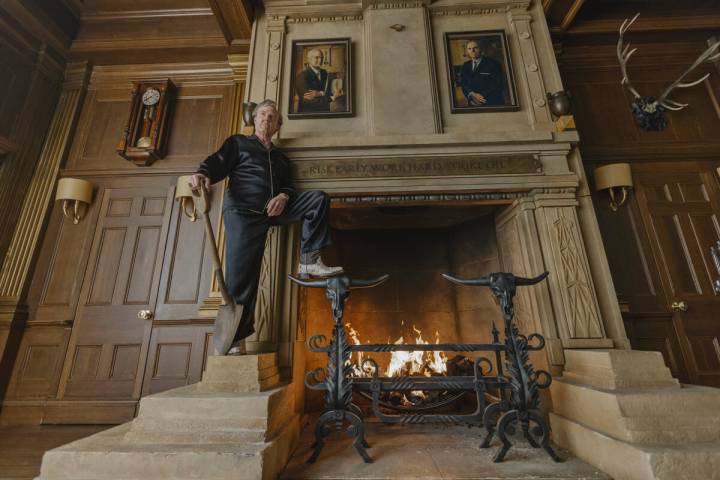
Glen Powell stars as Becket Redfellow, the bastard scion of a billion-dollar banking family. His mother, Mary (Nell Williams), finds herself cast out of her tony Long Island family at age 18 after becoming pregnant by a cellist from a string quartet, and she raises her son in a townhouse in Newark, New Jersey. On her (far too early) deathbed, Mary makes Becket promise to continue fighting for the life she thinks he deserves, and thanks to an ironclad trust and some tax laws, he remains in line for the inheritance, just seven spots down the list.
Like the protagonist of Park Chan-wook’s “No Other Choice,” Becket decides to take matters into his own hands and eliminate the competition. With his chiseled good looks, upper crust training and a variety of hats, he’s able to slip into character, infiltrate his cousins’ inner circles and orchestrate a few “accidents.”
“How to Make a Killing” is much more of a high-concept fable about billionaire aspirations than authentic character exploration, starting with a narrative framing device that is Becket’s death row confession to a prison priest. One might think this jailhouse recounting would drain the film of its suspense, but there’s a twist or four in store.
This is also an ensemble piece, and the film is at its best in its broader comedic moments in the first half. The three youngest cousins on whom Becket sets his sights are caricatures of rich monsters, and Ford and the actors nail these parodies.
Raff Law plays a version of Dickie Greenleaf in “The Talented Mr. Ripley” — the character that made his father Jude famous — in a wild “Wolf of Wall Street”-inspired setting. Zach Woods steals the show as a terrible trust fund kid. Then Topher Grace almost steals it all out from under him as an overly coiffed and corrupt megachurch preacher.
This all works thanks to the colorful character work, but our protagonist at the center of it all is a void. Becket is a chameleon, unknowable to those around him, but also unknown to the audience. His desires seem surface-level, and his reasons for continuing his dangerous quest are shoehorned in by an awkward plot device in the form of Margaret Qualley as a childhood crush, Julia, who waltzes back into his life. Qualley feels like she’s in an entirely different movie than everyone else, an oddball femme fatale with mysterious motivations and a deadpan attitude.
Ford wavers between full-blown satire and cautionary tale, and the unwieldy tone and emphasis on plot over character means that “How to Make a Killing” never quite coheres.
It’s not exactly a skewering of the billionaire class, but Ford never depicts being rich as all it’s cracked up to be, either. Unfortunately, this “Killing” just isn’t the windfall that was expected.
How to Make a Killing
Two stars out of four

 Add as a preferred source on Google