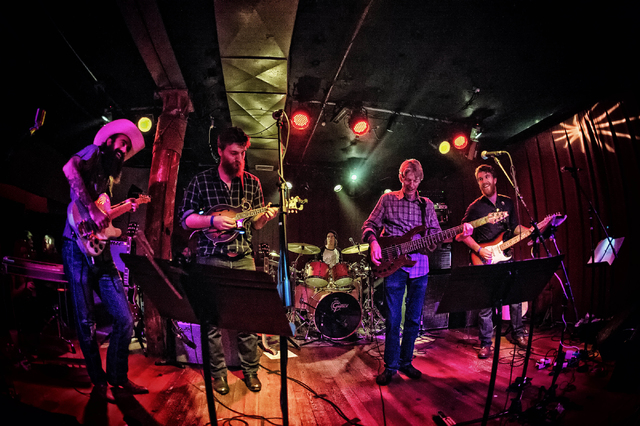
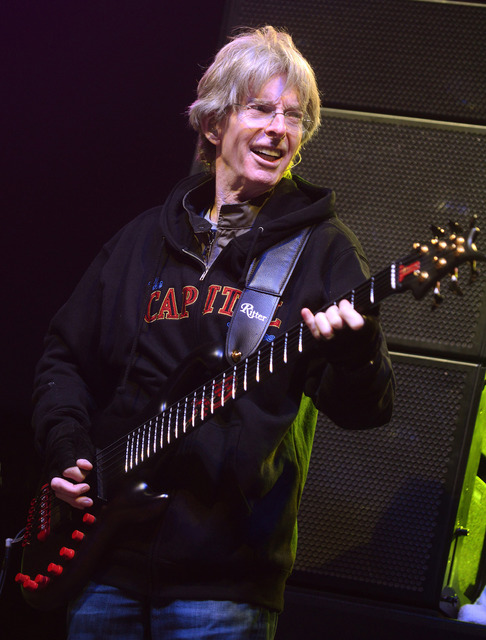
Phil Lesh and Friends keep the Grateful Dead’s music alive

They were a band and a skeleton key alike, their music significant not just for what it was, but for what it unlocked.
The Grateful Dead was a genre-less band for genre-less times, coming of age in the heyday of ’60s AM radio, back when it wouldn’t have been odd to hear a country tune after an R&B number after a surf rock ripper without having to touch the radio dial.
Their catalog is akin to the musical version of the human genome project, mapping the DNA of so many disparate sounds — jazz, country, folk, rock ’n’ roll, Delta blues, New Orleans funk — the band members’ vast, diffuse record collections in place of nucleotides.
For plenty of those who’ve immersed themselves in the Dead songbook — a hefty tome with more footnotes than the collected works of David Foster Wallace — the band has opened doors to different sounds by refusing to acknowledge the existence of said doors.
Drummer Tony Leone counts himself among these disciples of The Dead. Leone has a deep background in acoustic jazz, in which he’s formally trained, but from there, he’s played with everyone from country instigator Shooter Jennings to blues rockers Chris Robinson Brotherhood.
He traces the diversity of his tastes back to The Dead, whom he saw live numerous times between 1984 and 1991.
“The Grateful Dead were a huge part of my musical growth,” Leone says. “I learned about a lot of other styles of music through the Grateful Dead. I learned about people like Bill Monroe, Merle Haggard, Sun Ra, Ornette Coleman, because the Grateful Dead draw from so many musical wells. If you’re really listening to the music, and you want to find out more about, well, ‘Why are they playing that song “Aiko Aiko”? Where did that come from? The words are kind of weird, what does it mean?’ ‘Oh, it’s an old New Orleans tune, Dr. John played it, The Meters played it.’ ”
And so when Leone was recruited by a friend and fellow musician to jam with Dead bassist Phil Lesh’s band a few years back, it was like his musical life had come full circle.
“For me, it was a mind-blowing experience,” Leone recalls. “Here I was about to play with somebody whose playing I had enjoyed for so many years. He’s an inspiring guy. He plays with as much heart and restless energy to invent as anyone half or even a quarter of his age. When you get on stage to play with Phil, you’re there to really play, to make some stuff happen.”
Stuff will happen en masse this weekend, when Phil Lesh and Friends and Lesh’s Terrapin Family Band take over Brooklyn Bowl for three days (Lesh and Friends, which encompasses the Chris Robinson Brotherhood, play on Friday and Saturday; The Terrapin Family Band closes things on Sunday).
Leone equates performing with Lesh to taking a road trip with the destination in mind, but not necessarily the route.
“Playing with Phil Lesh really opens that door up into that big room of improvisation,” he says. “You’re not just playing the song itself, which you want to do with as much integrity as possible, but then they serve as a point of departure for exploration, which is really exciting to me, and inspiring.”
Guitarist Ross James, who plays in the Terrapin Family Band, underscores the importance of intuition and chemistry when jamming with Lesh.
“We could play the same set list two nights in a row — not that we would — and the shows would be so completely different, that you wouldn’t necessarily even know that we’re playing the same songs,” he says. “He’s got this line that he’ll use every now and then, ‘Don’t play the same thing once.’ If you’re playing and something happens and everybody’s listening, we can take a quick turn and go off wherever that is, without it being discussed before.”
As Leone and James tell it, Lesh will give the musicians he’s going to be playing with at a given gig a set list a few days before the show, and while he heavily mines the Dead catalog, the song selection is just the starting point for how things might develop.
“We’ll stay pretty close to what songs we’re going to play, but there might be an area where we segue from one tune to another, we might start in one key and then Phil might call out another key, and the next thing you know, we’ve changed the sound and we might change the rhythmic feel,” Leone says. “It’s those kind of in-the-heat-of-battle situations where you draw on your ears, your head and your heart to make some music in the moment.”
Being in the moment means being liberated of any expectations. It’s not as if this bunch engages in free-form, structure-less jamming. It’s just that they mastered the rules to the extent that they’ve become just as skilled at breaking them.
“There’s one credo that you’ll often hear Phil say: ‘There are no mistakes, only opportunities,’ ” Leone says. “That’s like someone handing you the key to the door, you know? ‘Go ’head in, man, everything’s cool.’ ”
Read more from Jason Bracelin at reviewjournal.com. Contact him at jbracelin@reviewjournal.com and follow @JasonBracelin on Twitter.
Preview
Who: Phil Lesh and Friends
When: 8 p.m. Friday and Saturday
Where: Brooklyn Bowl at The Linq, 3545 Las Vegas Blvd South
Tickets: $69.50 per show; $135 for two-day pass (702-862-2695)
Who: Phil Lesh and The Terrapin Family Band
When: 1 p.m. Sunday
Where: Brooklyn Bowl
Tickets: $35