‘Steve Jobs’ nearly as innovative, cold as its subject

It's more than a biopic, and it isn't just a movie.
"Steve Jobs" has all the makings of a Greek tragedy.
Or maybe it's a geek tragedy.
Either way, the remarkable, innovative tale is unlike any other movie you'll see this year.
Taking place behind the scenes just before the unveilings of three key products — 1984's Macintosh, 1988's NeXTcube and 1998's iMac — the movie arrives with no pretensions of accuracy. Despite being based on Walter Isaacson's best-selling biography of the Apple co-founder, screenwriter Aaron Sorkin has called the film an "impressionistic portrait." And, speaking of the NeXTcube and iMac scenes, which represent two-thirds of the movie, Sorkin says in the press notes, "I'm sure they played out very differently than how I imagined."
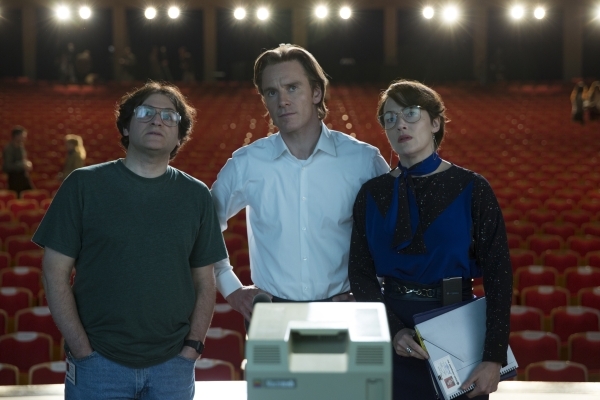
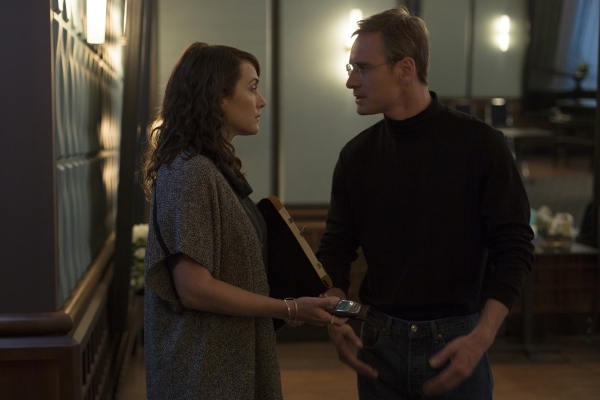
Instead, Sorkin and director Danny Boyle paint that portrait of Jobs (Michael Fassbender) through his relationships with six people: his long-suffering marketing executive and "work wife" Joanna Hoffman (Kate Winslet), Apple co-founder Steve Wozniak (Seth Rogen), Apple CEO John Sculley (Jeff Daniels), Macintosh team member Andy Hertzfeld (Michael Stuhlbarg), ex-girlfriend Chrisann Brennan (Katherine Waterston) and daughter Lisa (played at various ages by Makenzie Moss, Ripley Sobo and Perla Haney-Jardine).
It's a good thing Sorkin is upfront about the creative license he took with his subject, because it's nearly impossible to believe this much angst and drama could possibly keep happening on three of the biggest days of Jobs' life. Sorkin even has him marvel at the phenomenon: "It's like, five minutes before launch, everybody goes to a bar, gets drunk and tells me exactly what they think."
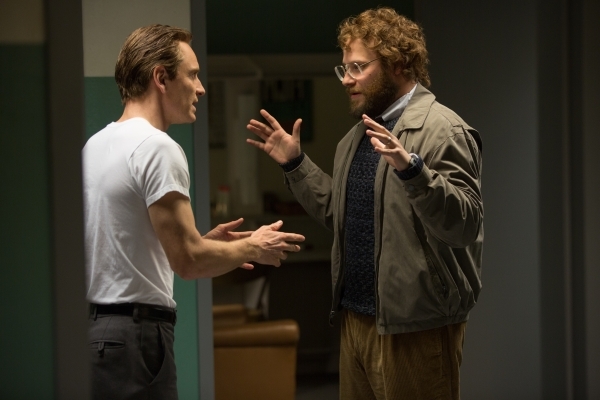
Each of the three 40-minute acts are presented in real time with only a few flashbacks: Jobs and Wozniak in a garage arguing over slots and closed systems, for example, and the tumultuous Apple board meeting during which Jobs was removed from his company. And each segment feels like a separate movie.
The rough-around-the-edges Macintosh event was shot on 16mm film, long a format for home movies. The sleeker, operatic NeXTcube launch was filmed on 35mm, the industry standard for decades. And the iMac's debut, brimming with technological advances, was shot digitally. From a technical aspect, "Steve Jobs" is a tribute nearly worthy of the Apple visionary.
Its depiction of Jobs, though, is just brutal.
When we first meet Chrisann and 5-year-old Lisa, Jobs' Apple stock is worth $441 million. The support he pays — $385 a month, just as the court mandated — isn't nearly enough, so his former sweetheart has had to apply for welfare. But not only does Jobs deny fathering Lisa, in a world before "Maury," he developed a complex algorithm to prove that 28 percent of American men could have been her father.
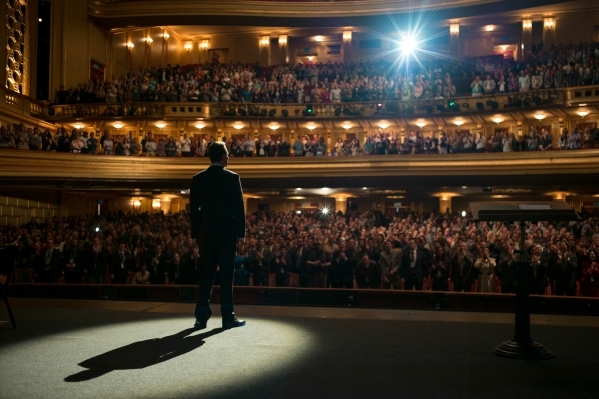
During the Macintosh launch, which plays out with all the foot-stomping of a rock concert, Jobs wants to turn off the EXIT lights because they'll distract from the unveiling, even though the fire marshal would shut them down. "If a fire causes a stampede to the exits," he declares, "it will be well worth it for those who survive."
In addition to being a suave, muscular genius, the Steve Jobs of "Steve Jobs" is an insufferable bully whose leadership style wavers between demanding and condescending. "It's not binary," Wozniak finally laments. "You can be decent and gifted at the same time." But this Jobs is so prickly, he makes the Mark Zuckerberg of Sorkin's "The Social Network" feel like a Disney prince.
Still, it makes for a riveting, powerful, nearly Shakespearean performance from Fassbender. As Wozniak, Seth Rogen basically plays Seth Rogen, minus the weed and weird laugh, but it works. And seeing Jeff Daniels once again rattle off Sorkin's verbal gymnastics should be comfortably familiar for fans of HBO's "The Newsroom."
"Steve Jobs" is an intriguing experiment, bristling with bursts of artistic genius. It's as elegantly made as any Apple product yet — with the possible exception of the Newton, which takes its fair share of abuse in the movie.
Still, it's a tough film to love, one I don't have much interest in seeing again, and I see hundreds of movies multiple times.
That's largely because "Steve Jobs" ultimately feels every bit as cold and distant as its subject.
— Contact Christopher Lawrence at clawrence@reviewjournal.com. On Twitter: @life_onthecouch.