

Reducing waste seen as key to ending hunger

"Hunger is curable. When you talk about getting food to food-insecure people, the first question you ask is if there is enough food. The answer is a resounding, 'Yes.'"
Those may sound like the words of a hopeless idealist, but they're actually from Dan Williams, chief operating officer at Three Square food bank, who knows a thing or two about the hungry and how much food is available to them.
Or, rather, should be.
"We grow, manufacture or produce 40 percent more food than we consume as a nation," Williams said, with estimates ranging from a conservative 68 billion up to 130 billion pounds — "every single year."
Yet in Southern Nevada, as across the country, people are going hungry every day. Williams said the national "meal gap" is 8.6 billion meals a year. The 200 food banks and 60,000 agency partners of Feeding America (of which Three Square is one) distribute about 3.2 billion meals a year, which leaves a shortfall of 5.4 billion meals, or 6.48 billion pounds of food.
It's this disconnect that prompted the U.S. Department of Agriculture and the Environmental Protection Agency on Sept. 16 to announce the nation's first waste-reduction goal, of 50 percent by 2030. The American initiative was followed Sept. 25 by the countries of the United Nations, who announced the same target worldwide.
According to the EPA, food is the single largest component of U.S. municipal solid waste.
The question would be how to reconcile the surplus food with the shortage of food. The first part of the solution, Williams said, would appear to be source reduction, where only the amount of food we need would be produced.
"That's never going to happen," he said. "You wouldn't want to see half-empty shelves of produce, and you don't want to see a ding on your apple."
The key, he said, is that we need to be smarter with what we do produce. Some 48 billion pounds of food, he said, never makes it out of farm fields because of tightening labor regulations and other factors that cause costs to skyrocket.
"Literally, it's cheaper to leave the food in the fields than it is to harvest it," Williams said. And some of the food that's technically left in the fields actually is recovered through use as animal feed.
Another 29 billion pounds, he said, is lost in processing and manufacturing, although some of that also is recaptured.
But another huge chunk is incinerated or sent to landfills.
"That's what we do with 22 billion pounds at the retail level," Williams said. "We only need to perform at about a 34 percent rate" to close the hunger gap.
In Southern Nevada, an obvious major source of waste would seem to be the hotel-casinos, but Williams said supermarkets actually waste more.
"They don't throw that much away," he said of the casinos. "They are pretty smart about food."
While two casino companies declined to talk to the Las Vegas Review-Journal for this story, Chris Brophy, MGM Resorts International's vice president of corporate sustainability, said the company's food-waste reduction process starts with smarter purchasing, working closely with chefs to ensure that the food bought is in line with the menus planned.
Some food is lost in the preparation process, but Brophy said that has been greatly reduced; in banquets, for example, the loss to food prep is only about 10 percent. But banquets pose other challenges, such as over-preparation, because the number of people who end up attending them can be as much as 10 percent to 15 percent higher than expected. And sometimes, the opposite is true.
"Our biggest issue," Brophy said, "is to fight that, and figure out what the proper preprepared overage should be. We want to make sure we're servicing our customers appropriately, but not overproducing."
And much overage is recaptured, he said, through employee dining rooms, which don't normally serve such things as lobster that can be banquet leftovers.
"It gives our employees some nice options sometimes," he said.
Brophy said in every one of the company's restaurants, food waste is separated from recyclables, which keeps the recyclables cleaner and allows the food waste to be diverted from the landfill.
Much of the food waste, he said, goes to a local pig farm. But disposal itself — at least in terms of what's diverted from landfills — has its own limitations, especially in Southern Nevada.
"Right now, RC Farms is pretty much at capacity, in terms of what he can take," Brophy said, although he said owner Robert Combs' offspring have founded a food-waste recycling enterprise and some expansion of services may be in the offing.
Another major source of the company's food-waste disposal, a composting firm, burned in 2014 and shut down, which meant that much of MGM's waste had to go back to what Brophy calls "regular disposal." In 2013, he said, the company diverted 25,000 tons of food waste, 20 percent of the total 120,000 tons.
"In total, our waste diversion is right around 50 percent," he said. "Obviously, with a lack of food-waste alternatives in the valley, we've had to scramble and try to find ways to expand the capacity."
Brophy said food that's traditionally recaptured from sources such as supermarkets and given to the hungry — think slightly damaged fruits and vegetables, or pantry goods that are nearing their expiration dates — actually is used within the company.
"We use plenty of non-pretty food," he said. "As it relates to bruised bananas or bruised fruits, we'll find other uses for them, almost always. Our chefs are really good about finding ways to use that. They'll turn it into jams, turn it into sauces. Nothing but twice-used bones are going out the door in our waste stream," after being used for such things as sauces and stocks.
The chefs, he said, have financial incentives to reduce food waste, as every chef is accountable for his or her restaurant's budget.
And Brophy acknowledges that the company gets more from the reduction of food waste than the satisfaction that they're doing the right thing.
"We find that the concept of sustainability is all about finding the balance within social, economic and environmental objectives," he said. "Pretty much everything we do certainly has a financial benefit as well. We're really happy we can find that doing good for the planet also means good business."
The Clark County School District also has launched programs to reduce food waste, sometimes in tandem with Three Square.
"We have eliminated over 500 cubic yards of solid waste that is picked up every day in the Clark County School District," said Mark Jones, the district's sustainability officer. "That's a fair chunk of change."
Jones said unopened prepackaged, shelf-stable foods, such as breakfast bars and cookies, are used for after-school food programs and that the "share boxes" in most of the schools enable kids to deposit such items for redistribution by Three Square.
He said composting plans are on the horizon, but a major challenge is getting kids to separate food waste from other recyclables. There are some success stories, he said, like Henderson's Basic High School, which has quadrupled the amount it recycles. Such schools are rewarded, he said, with recycling rebates, and 20 schools recently shared a rebate of $267,000.
Such financial incentives make it difficult for Williams to understand why most supermarkets don't recapture more of their food.
"A typical day for a produce manager," he said, "is he goes in at 6, grabs a couple of boxes of bananas and fills the banana table. Then he goes and gleans the table; they've got to make it look good for Mr. and Mrs. Consumer. The majority of grocery stores in the United States take that food and throw it down a chute, and that's how it comes to a landfill."
But the food doesn't go directly to a landfill; first, it must be held in dumpsters.
"If you think about trash removal, $85 to $90 a ton is trash removal," Williams said. "Also, the bottom line is you're going to get tax incentives from it."
Williams said Southern Nevada is one of the leaders in food recovery in the Feeding America network.
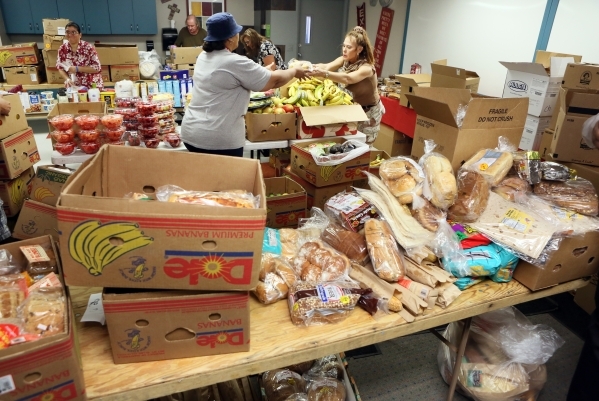
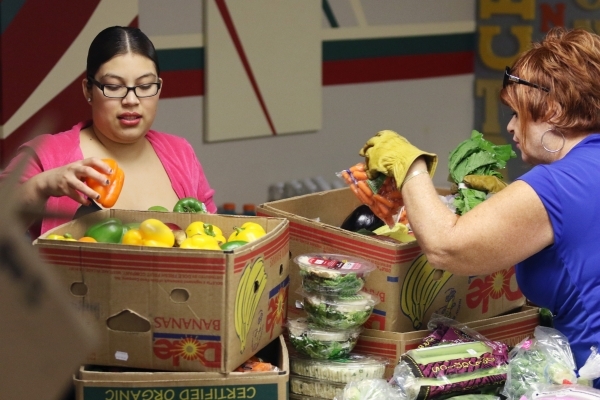
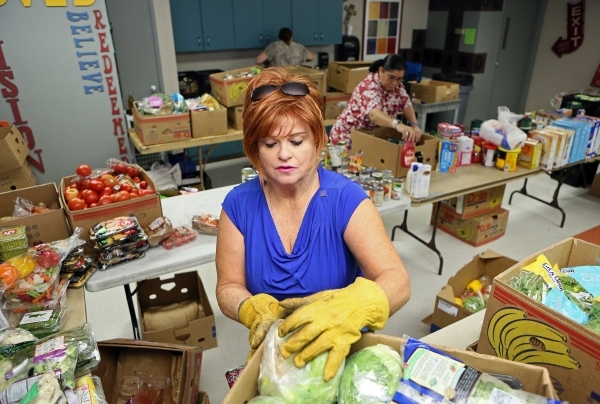
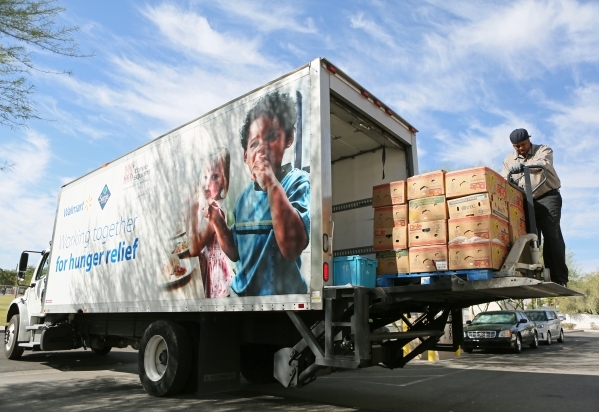
"When we look at our food recovery from the last 30 months, we're up 207 percent," he said. Three Square has seven dedicated truck routes, he said, that go to 135 locations, some as many as four days a week. Still, there's plenty more available.
"We think we're capturing about 65 percent of the available food that can be repurposed," he said. "We still have 9 million pounds in the valley that we could recover every year, just from grocery stores. We're really good, but we're not great. So we have some work to do."
Williams said that after speaking engagements, he's often asked which chains are the worst offenders. He won't say, but he'll tell the questioner to go to his or her store director and ask them about their food-recovery process.
"That's how you can be an advocate for hunger," he said. "Start putting pressure on the grocery stores. It's all about awareness. The bottom line is, hunger can be solved in the retail industry tomorrow, if that's the direction that we put some pressure on. I think reducing food waste should be a national priority."
So, you're feeling pretty smug right now, are you? You know you're really good about reducing food waste in your own home? You may well be wrong. Dana Gunders, a scientist at the National Resources Defense Council, a nonprofit environmental advocacy group, and author of the new book "Waste-Free Kitchen Handbook," said not much research has been done into food waste in American homes. But in the United Kingdom, research shows that consumers represent a large proportion of the waste, possibly as much as 40 percent.
It's been estimated, she said, that food waste costs an average family of four about $120 per month.
"One of the biggest challenges is we don't see it," Gunders said. "It happens in such little bits that we don't really notice. We're very conscious of prices when we're in the store, but once we get home, we kind of forget that we spent all that money on that food, and we end up throwing a third of a chunk of cheese out."
But Gunders said there are a lot of things we can do to reduce waste in the home. First, she said, be more realistic when you're at the grocery store; "Take a second look at your cart before you check out and think about when during the week you're going to actually eat that food."
We should be using our freezers better, she said, freezing foods like bread, milk and cheese, if only for a few days, to extend the length of their use.
And, she said, we need to better understand package expiration dates — "a manufacturer's best guess of when food is freshest," she said, and often a measure of food quality, not food safety.
"Oftentimes, the quality measures are so precise that we don't even notice," she said.
Plus, she said, we need to control portion sizes, both at home and at restaurants, to reduce waste.
Major reductions in both food waste and hunger, Williams said, can be achieved.
"When we talk about solving hunger, what we're really saying is that we want to make available the needed food in a certain geographical area," he said. "We want to make that accessible for food-insecure people. That's when we say that hunger is solvable.
"I think we have to make it a public issue; the public has to decide. We shouldn't have to be affluent to afford food."
Contact Heidi Knapp Rinella at Hrinella@reviewjournal.com. Find more of her stories at reviewjournal.com, and follow @HKRinella on Twitter.