

Pack a punch with pickled veggies

Chef John Kujundzich figures it's time pickling regained some popularity.
"Pickling is one of those things that's kind of been lost over the years," said Kujundzich, assistant executive chef of Red Rock Resort. "Originally it was based on preservation, and it kind of went away. There were store-bought dill pickles and that was about it."
Times definitely have changed. More and more restaurants are pickling in-house, and they're not sticking to cucumbers.
"With the culinary resurgence, people are pickling just about anything," Kujundzich said.
And how.
"Right now I have a lot of butternut squash going on," Kujundzich said. "That's a really fun one. You can cut it any number of ways — slice, dice, julienne. I like shaving it into ribbons. It'll pickle a lot quicker, and it'll make a nice presentation. My favorite right now is a farro salad with the pickled squash ribbons and lots of fresh herbs. You can use the pickling liquid as a base for your vinaigrette. You don't want to waste all that goodness."
Joseph Kudrak, a chef-partner at Glutton in downtown Las Vegas, said he also likes to use an array of vegetables pickled in-house.
"It gives us a chance to put some really great flavors into some seasonal items," Kudrak said.
Examples would be a cumin-pickled shallot they serve with a wood-fired curried cauliflower side dish. Or pickled cherry heirloom tomatoes, which they serve with whipped ricotta. Pickled mushrooms in a blue cheese, mushroom and pepper relish. Even pickled celery, which they served with a Buffalo sweetbreads dish that's no longer on the menu.
Matthias Merges, chef/creator of Yusho at the Monte Carlo, has memories of his grandfather bringing up jars of pickles from the cellar, and he, too, is glad to see the practice returning.
"I think there's a resurgence of people who are interested in these things," he said. "The average consumer these days is much more knowledgeable about food and food technique, and they look for these things just as chefs do."
The chefs said that beyond sparks of flavor and color, what pickled vegetables bring to the table is balance.
"I love that acid and fat balance," Merges said. "With a fatty risotto, or a really thick-broth ramen with a braised meat, it really cleans the palate up before your next bite. It balances out the acids in your stomach as well."
"We do it a lot because it helps to balance the foods," Kudrak agreed. "With rich foods, fatty steak or something savory, when you get that acid in there — the vinegar — it helps to balance it nicely. A lot of chefs finish a lot of dishes with oils. We like to use fresh herbs, vinegars and pickles to balance our foods."
The pickled mushroom relish mentioned above is served with flank steak, Kudrak said; "with a nice fatty piece of meat, the acid on the mushrooms cuts through that and complements it very nicely."
And they offered plenty of tips for home cooks who'd like to try pickling.
"I like to stick with bright vegetables, bright colors, that are going to maintain their own flavor without being overwhelmed by the pickling," Kujundzich said. "I want to still taste what the vegetable is."
He said he wouldn't recommend using dark liquids; lighter colors help retain brightness.
Merges noted that vinegar denatures chlorophyll, so some green vegetables, including asparagus, are apt to turn brown.
He said he also likes to take textures into account.
"You can have a pickled carrot that has a nice crunch, but then you have a pickled chanterelle right next to it, which is soft," Merges said. "Some might be spicy, some might be more acidic than others, some might have dry spices like coriander and fennel seed. You're exploring through the bowl and you're getting new things instead of just one singular flavor. Each forkful or spoonful is a new kind of adventure."
To keep vegetables from getting soggy, Kujundzich said not to add the brine when it's boiling hot. It needs to be heated enough to dissolve the salt and sugar, but letting it come close to room temperature will help the vegetables retain color and crispness.
Merges said it's important to use a good vinegar.
"Don't get a gallon of really cheap white wine vinegar or white vinegar," he said. "Get one made out of grape juice that has the must in it. Depending on acidity, you can always spin it out with water and it's not as aggressive on the palate."
But don't dilute the liquid too much, Kudrak cautioned.
"For me, it's just the balance, developing your own pickling liquid," he said. "It's going to taste stronger when you first make it, but whatever water content the vegetable has will dilute it a little bit. When you taste the first time, you're kind of taken aback a bit. It'll mellow out."
And you don't want to leave the vegetable in the pickling liquid too long, the chefs said; Kujundzich said he pickles his butternut squash ribbons no longer than 24 to 48 hours.
"Something that's sliced real thin like that, it's best to keep it to a day or two," he said.
Kudrak said the cherry tomatoes are pickled even more quickly.
"Tomatoes are very soft, so they just need a quick introduction to the vinegar, a couple of hours," he said, which is why they pickle tomatoes daily.
Kujundzich said he, too, is a frequent pickler: "We've got some sort of pickles going all the time."
"It's a great condiment for families to put on the table," Merges said. "It spices things up a bit."
PICKLED CARROTS WITH TARRAGON
1 pound young carrots, any color, trimmed and peeled
1 shallot, peeled and quartered
4 garlic cloves, peeled
2 red or green Thai chilies
2 sprigs tarragon
1 tablespoon black peppercorns
1 tablespoon coriander seeds
1 cup unseasoned rice vinegar
1 cup sugar
1 tablespoon kosher salt
2 cups water
Pack carrots, shallot, garlic, chilies, tarragon, peppercorns and coriander seeds in a large heatproof jar.
Bring vinegar, sugar, salt and 2 cups water to a boil in a medium saucepan, whisking to dissolve sugar and salt.
Pour pickling liquid over carrots to cover. Let cool; cover and chill at least 24 hours. (Carrots can be pickled 5 days ahead. Keep chilled.)
Makes about 2 cups.
— Recipe from Bon Appetit
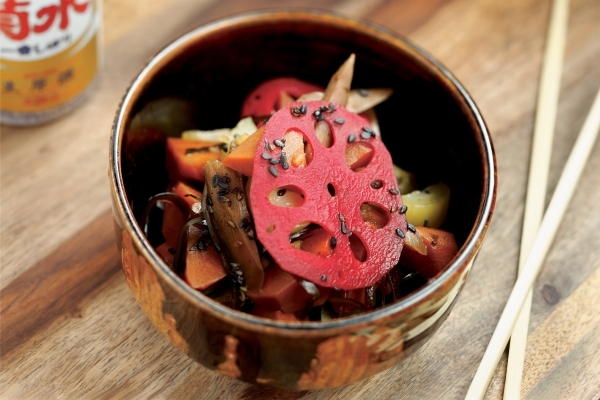
PICKLED VEGETABLES
2 medium beets (1/2 pound total), trimmed
4 bunches baby carrots (1 pound), peeled and stems trimmed to 1/2 inch
1/2 teaspoon caraway seeds, toasted
3 celery ribs, cut diagonally into 1-inch pieces
1 1/2 teaspoons coriander seeds, toasted
1/2 small head cauliflower, cut into 1- to 1 1/2-inch florets
1 1/2 teaspoons shichimi togarashi (Japanese seven-spice blend)
6 cups water
1 1/2 cups rice vinegar (not seasoned; 12 ounces)
3 cups sugar
1/2 cup plus 1 tablespoon kosher salt
Peel beets, then cut into very thin slices (less than 1/8 inch) with an adjustable-blade slicer and transfer to a nonreactive heatproof bowl. In separate nonreactive heatproof bowls, combine carrots with caraway seeds, celery with coriander seeds and cauliflower with shichimi togarashi.
Meanwhile, bring water, vinegar, sugar and salt to a boil in a large nonreactive saucepan, stirring until sugar has dissolved. Remove from heat and pour 1 1/2 cups hot brine over beets, 2 cups over carrots, 2 cups over celery and remaining liquid over cauliflower. Cool to room temperature, stirring and pressing vegetables down occasionally (or keep them submerged with a small plate). Transfer each vegetable with pickling liquid to a separate airtight container and chill, covered, shaking occasionally, at least 1 week. Serve using a slotted spoon. (Pickled vegetables can be chilled as long as 2 weeks.)
Makes 8 hors d'oeuvre or side-dish servings.
— Recipe from Gourmet
BREAD-AND-BUTTER PICKLED ONIONS
1 pound sweet onions, halved and cut into 1/4-inch-thick slices
1 pound Kirby (small pickling) cucumbers, cut into 1/4-inch-thick slices
2 garlic cloves, thinly sliced
1 fresh red chili pepper, halved, seeded and thinly sliced
2 tablespoons kosher salt
2 cups apple cider vinegar
1 1/2 cups sugar
1 teaspoon mustard seeds
1/2 teaspoon ground turmeric
Toss together first five ingredients in a large bowl. Cover and let stand one hour. Transfer to a colander; drain 20 minutes. Pack into three 1-pint jars, filling to 1/2 inch from top.
Bring vinegar and next three ingredients to a boil in a small saucepan over medium-high heat; boil, stirring constantly, one minute, or until sugar dissolves. Let stand 5 minutes.
Pour vinegar mixture over onion mixture in jars, filling to 1/2 inch from top. Cool completely (about 20 minutes). Cover with lids and chill 8 hours before serving. Store in refrigerator for as long as two weeks.
Variations: Bread-and-butter pickled onions with green tomatoes: Prepare recipe as directed, substituting green tomatoes, cut into 1/2-inch pieces, for cucumbers.
Bread-and-butter pickled onions with radishes: Prepare recipe as directed, substituting radishes, cut into 1/4-inch slices, for cucumbers; white vinegar for cider vinegar; and celery seeds for turmeric. Add 2 fresh tarragon sprigs to each jar just before covering.
Bread-and-butter pickled onions with carrots: Prepare recipe as directed, substituting carrots, cut into 1/4-inch-thick slices, for cucumbers; a serrano pepper for red chili pepper; and cumin seeds for mustard seeds.
Makes 2 pints.
— Recipe from Southern Living
ASPARAGUS PICKLES
2 pounds fresh asparagus
1/4 cup kosher salt
1 teaspoon black peppercorns
1 teaspoon mustard seeds
4 garlic cloves, minced
2 fresh tarragon sprigs
1 1/2 cups white vinegar
1 tablespoon sugar
1 cup water
Trim off bottom of asparagus so that asparagus fits into 2 1-quart sterilized canning jars, leaving 1/2-inch headspace. Discard asparagus ends. Divide salt and next four ingredients between jars. Pack trimmed asparagus, pointed ends up, into jars.
Bring vinegar, sugar and 1 cup water to a boil in a small saucepan over medium-high heat. Pour vinegar mixture over asparagus, filling to 1/2 inch from top. (Fill jars with additional hot water, if needed.) Remove air bubbles; wipe jar rims. Cover with metal lids and screw on bands. Shake to combine and chill 24 hours (flavor will improve as time goes on). Store in refrigerator for as long as 1 month.
Makes 2 quarts.
— Recipe from Southern Living
PICKLED BABY PATTYPAN SQUASH
1 1/2 cups white vinegar
1 1/2 cups water
1/3 cup sliced shallots
1 tablespoon kosher salt
1 tablespoon sugar
1 tablespoon black peppercorns
1 teaspoon white peppercorns
1 teaspoon coriander seeds
1 teaspoon mustard seeds
1/2 teaspoon crushed red pepper
3 garlic cloves, crushed
1 bay leaf
2 1/2 cups baby pattypan squash (divided use)
4 tarragon sprigs
4 green onions (green parts only), halved lengthwise
1 lemon wedge
Combine first 12 ingredients in a medium saucepan; bring to a boil, stirring until sugar dissolves. Place 1 1/4 cups of the squash in a 1-quart canning jar; add tarragon, onions and lemon. Add remaining squash to jar; top with hot vinegar mixture. Cover and seal. Refrigerate 2 days.
Serves 8.
— Recipe from Cooking Light
— Contact Heidi Knapp Rinella at Hrinella@reviewjournal.com. Find more of her stories at reviewjournal.com, and follow @HKRinella on Twitter.