Wham, Bam, Thank You Dam

Oblivious to the obvious, are we?
Like New Yorkers who never visited Lady Liberty lifting her torch. Or Philadelphians who never eyeballed the crack in the Liberty Bell. Or Bostonians who never quaffed a cold one at the Bull & Finch. (The pub inspired the exterior of "Cheers" -- who says that's not historic?)
To that roll call of natives who never bother with local landmarks others cross oceans to see, add Nevadans who never give a dam.
(Yes, we're succumbing to the easy joke. Up here, it's nearly required.)
"I've had people who live here and have driven over the dam many times and never stopped," says Hoover Dam tour guide Charles Herrington. "They tell me this is their first time."
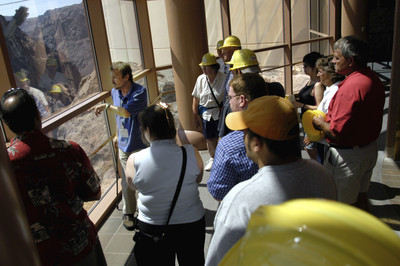
Don't worry, they're gentle. Visitors prone to vertigo and claustrophobia while traversing the tunnels and bowels within this massive man-made monument to engineering ingenuity could be forgiven for a tinge of fear. Yet the scale of it as appreciated from inside its chugging, churning, water-gushing belly is as humbling as it is captivating.
"You feel like a piece of sand on the beach," says dam customer service manager Ruth Ahl. "People are overwhelmed. A lot of times the guides are giving presentations and our customers are so mesmerized by the enormity and beauty of the things they're looking at that they're not really tuned into the speaking parts. But that's OK, we're used to that."
Murals, maps and photos chronicle its historic 1931-35 construction over the Colorado River, straddling the Nevada/Arizona border, plus its role in taming the rivers, creating Lake Mead, contributing to the modernization of the West and its invaluable functions for power, drinking water and irrigation. Beyond factual explanations, the dam experience is comprised of two tours, from the power plant to a more extensive exploration of its complex inner workings.
"We just love to show this off to our foreign visitors," Ahl says, "because they go back home and talk about it."
Opened by the obligatory narrated film on its history, with grainy archival footage, soaring phrases such as "human spirit" and "great aspirations" and swelling orchestral music to underline its grandeur, the tour takes off in earnest when a group is led to an elevator to descend 530 feet into the wall of the Black Canyon. Through a 250-foot-long tunnel drilled out of rock, tour-goers are deposited into the Nevada wing of the power plant.
Tossing in the expected quips -- "I'm your dam tour guide," "Take your dam photos," "Have a dam good time" -- guides enumerate the mechanics of the diversion tunnels, cylindrical black behemoths where water washes through at 88,000 gallons per second in monster pipes wide enough to accommodate three side-by-side school buses.
"The engineering makes a big impact on people," Herrington says. "People say, 'I can't believe that people did this without computers.' "
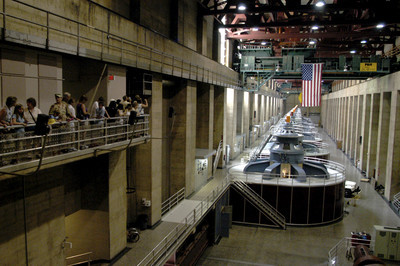
Beneath an American flag hanging from the dizzying rafters, huge, gun metal-gray generators jut up like silos, humming in unison, their tips widening into windowed sections resembling Apollo space capsules. The scene is impressive looking down from behind a railing, if a bit dizzying (that's the vertigo alert).
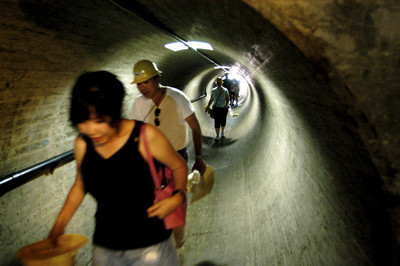
Moving on, visitors pass through large doors with fans blasting through to cool the tunnels and arrive at a ... what's the word? ... cozy tunnel 5 feet 10 inches high (that's the claustrophobia alert), duck-walking single file to the mouth to catch a stunning tableau of the dam on the Nevada side, witnessing water pressure of 45,000 pounds per square foot.
En route, they pass over a grate covering a long drop to ... a dead end (another vertigo alert). For some, the reliable old trope of "don't look down" is prudent advice here. "People walk over the grate, look down and go, 'Holy cow!' " Herrington says. Some substitute words come to mind as well.
(The feeling inside this cavelike tube? Flash back to a tunneling John McClane in "Die Hard," sarcastically griping, "Come out to the coast, we'll get together, have a few laughs.")
Back out and into the more spacious winding hallways, scrawls on the walls mark where small cracks were inspected, some dating back to 1942. Finally, advancing to the top of the dam outside, a lush, downward-looking view confirms this remarkable marriage of man's ambition and nature's gifts.
"The thing that really blows me away is that it was built in the 1930s to withstand an earthquake of eight-point-something," marveled tour-taker Jake Richardson. "But in the '30s, how much knowledge did we have about earthquakes in that range? It's a wonder they pulled this off."
Herrington hears a lot of that. "People can't believe the enormous scale of it," he says, "the fact that it'll be here in 2,000 years."
That should be long enough to outlast the Bull & Finch.
Contact reporter Steve Bornfeld at sbornfeld@reviewjournal.com or 702-383-0256.
ON THE WEB Slideshow PREVIEW what: Hoover Dam Tours when: 9 a.m.-6 p.m. daily where: Hoover Dam, US Highway 93, Boulder City tickets: $8 for visitor center admission without tours, free for children 3 and under; tours are $9-$30 (494-2517)