‘W.’

By his own admission, George W. Bush has his faults, so it seems almost fitting that "W." should have them, too.
Whether they're fatal flaws depends, in part, on how you feel about America's 43rd president, who'll be an ex-president in 94 days. (Not that anyone's counting or anything.)
It also depends on how you feel about director Oliver Stone, the once-controversial firebrand who seems to have mellowed after all these years. (A movie as bad as "Alexander" will do that to you.)
Stone once delighted in generating heat, if not light, with such incendiary polemics as "JFK" and "Nixon." But this time around, he's not interested in getting mad. Or even getting even.
Maybe he figures that his subject already has been so pilloried that no additional outrage is required.
Or maybe Stone's more interested in understanding how, and why, we find ourselves where we are -- or, more precisely, how, and why, Bush got us here.
It's a potentially intriguing issue. And while I've never been a big fan of Stone's particular brand of overkill, a bit more fire and fervor might have given "W." a sharper focus.
As it stands, it's an intermittently interesting ramble through the life of a guy nobody ever thought would amount to much. Especially his own father.
Yes, as if you couldn't have guessed, George W. has daddy issues. Easy enough when your daddy is George H.W. Bush, 41st president of the United States.
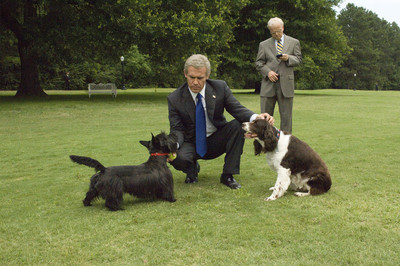
But "Junior" (Josh Brolin), as his father derisively calls him, feels inadequate long before Poppy (James Cromwell) moves into the White House.
In exploring the strained relationship between patrician father and down-to-earth son, "W." bounces around in time, from the title character's days as Yale fraternity pledge (where he winningly demonstrates his grasp of drunken hazing rituals) to the aftermath of the Sept. 11 attacks.
There, he presides over tense cabinet sessions in which Vice President Dick Cheney (Richard Dreyfuss) and Secretary of State Colin Powell (Jeffrey Wright) seem on the brink of war -- and Secretary of Defense Donald Rumsfeld (Scott Glenn) seems marooned on Planet Rummy, ruminating on something nobody seems able to determine.
In between, we see Bush the Second try (and fail at) a variety of careers, from oil worker to congressional candidate. Finally, he finds a home on the baseball field, running the Texas Rangers, and dreams that, someday, he might become the commissioner of Major League Baseball.
His dreams get bigger, however, when Poppy casts brother Jeb (Jason Ritter) as heir apparent, prompting Dubya to run for governor of Texas, even as his brother pursues the same office in Florida. Besides, God told him to.
"W." screenwriter Stanley Weiser (who also scripted Stone's 1987 "Wall Street") creates episodes illustrating various aspects of the title character's personality, from his impatience to his stubborn certainty.
Throughout the movie, however, there's the inescapable sense that Stone doesn't quite know what he wants "W." to be: scathing satire, gripping docudrama (especially in scenes exploring the run-up to the Iraq war) or insightful psychological study.
Stone even ventures into the realm of surrealism, occasionally using Dubya's beloved baseball as metaphor -- a device that gives those scenes a haunting, dreamy quality. (In one telling sequence, the former baseball executive's in center field, trying mightily to keep his eye on the ball -- only to realize that he's not only missed the ball, he has no idea where it went.)
More such symbolism might have given "W." a stronger story line. Instead, watching the movie is like flipping randomly through a photo album -- the pictures register, but without an overall context, they never fully tell the story.
The same could be said for several members of the movie's cast of thousands. (OK, it's only a cast of dozens, but sometimes it feels like thousands.)
The script's sketchy nature means that such dramatic powerhouses as Wright, Ellen Burstyn (as Bush matriarch Barbara), Stacy Keach (as the minister who helps Dubya get religion) and Bruce McGill (as CIA director George Tenet) have limited opportunities to score, yet score they do. Elizabeth Banks (as Bush's supportive wife, Laura) and elfin Toby Jones (as political mastermind Karl Rove) also have their standout moments.
Alas, Thandie Newton's Condoleezza Rice rarely rises above the level of caricature. But Dreyfuss proves eerily uncanny as Cheney, right down to that trademark grin/grimace that's forever threatening to turn into a snarl. And while Cromwell neither looks nor sounds like the elder President Bush, he ably captures his dignified, yet demanding, bearing.
Not surprisingly, however, it's Brolin's title-role portrayal -- a home run if ever there were one -- that dominates the movie, moving beyond familiar mannerisms to suggest the frailties and little-boy doubts lurking beneath Dubya's genial Lone Star swagger.
If only "W." were as good as the guy playing him.
Bush's father once acknowledged that, as president, he had trouble with what he called "the vision thing." It seems astounding to note that Oliver Stone, of all people, seems to be having trouble with the vision thing, too.
Contact movie critic Carol Cling at ccling@reviewjournal.com or 702-383-0272.
REVIEW movie: "W." running time: 131 minutes rating: PG-13; profanity, sexual references, alcohol abuse, smoking, brief disturbing war images verdict: B- now playing: multiple locations DEJA VIEW George W. Bush may be the only sitting president to turn up in a big-screen incarnation, but plenty of chief executives have inspired rousing cinematic portraits: "Young Mr. Lincoln" (1939) -- The Great Emancipator is decades away as director John Ford's classic explores the life-altering triumphs, and heartbreaks, of struggling young lawyer Abe Lincoln (Henry Fonda). "The Indomitable Teddy Roosevelt" (1983) -- Bully! This inventive documentary blends newsreel footage and impeccable re-creations (featuring Bob Boyd as T.R.) to recapture the Rough Rider's life and times. "Secret Honor" (1984) -- Philip Baker Hall's stunning solo performance and director Robert Altman's probing camera bring Richard Nixon to life as the disgraced president records recollections that no one will ever hear. "Truman" (2000) -- Gary Sinise stars as straight-talking Missourian Harry S Truman, who replaces the irreplaceable Franklin Delano Roosevelt in the White House, overseeing World War II's end -- and the Cold War's start. "Warm Springs" (2005) -- Future president Franklin Delano Roosevelt (Kenneth Branagh) struggles to overcome polio at a Georgia clinic with the help of his estranged wife Eleanor (Cynthia Nixon). -- By CAROL CLING