Unbounded Sound

By Jason Bracelin
LAS VEGAS REVIEW-JOURNAL
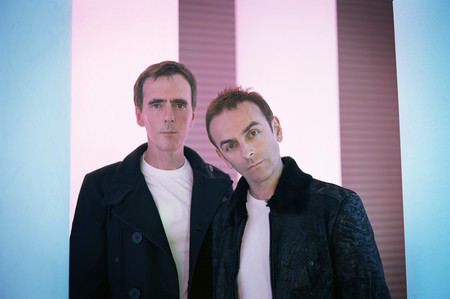
Back in the day, Karl Hyde had two goals: make music for TV commercials and work with Brian Eno.
He'd eventually achieve both.
But not before he tried to be a pop star for 10 years and failed.
And so Hyde and his counterpart, DJ Rick Smith, stopped making music from the head and started making it from the heart.
"We'd given up on the idea of a career in music," recalls Hyde, one half of the sublimely concussive British electronica duo Underworld. "We were making music for TV adverts. We felt very proud of what we were doing. We were putting food on the table doing that, and so it was just like, 'Let's have some fun and make some dance tunes.'
"You didn't need radio in those days," he continues. "You just made a 12 (inch record), you put it out, you sold it around the specialty shops and if a DJ played it and 200 people bought it, you could afford to make another one. That's when it all changed."
And it didn't just change for these two.
Beginning with their seminal 1993 disc "dubnobasswithmyheadman," which also featured DJ Keith Emerson at the time, Underworld gradually began to establish itself as a gateway act for a new form of electronic music, a hybridization of sorts, one that fused techno trademarks with a rock 'n' roll style, big production live show, a jam band's flair for improvisation and a hint of conventional songwriting that harnessed the dance music of the day to a fine, bayonet-sharp point.
It was a deliberately broad sound, impulsive and amorphous, with songs that drifted apart and came together like cloud formations.
By the time Underworld issued 1996's watershed "Second Toughest of the Infants," Hyde began to incorporate more of his entranced, anesthetized vocals into the mix, which, combined with the band's enveloping, whiplash beats and cochlea-crunching production values, firmly ensconced the group at the forefront of the mid-'90s electronica boom.
But Underworld wasn't much like its big-selling peers at the time, acts such as the Chemical Brothers and The Prodigy.
They took a free range approach to the dance floor, incorporating not just electronic music subgenres like acid house and drum 'n' bass into their wide-eyed repertoire, but also pop hooks and hard funk rhythms, which they buried in an avalanche of unbounded, unabridged sound. There might be three different choruses in a single song, none of which are repeated. It was a different, diffuse approach.
"One of the frustrations of the '80s was that we used to put out records that followed the 31/2 minute time length of what a radio single was thought to be," Hyde says, reflecting on his time in the group Freur with Smith, which was a more straight-ahead dance pop project. "We loved Miles Davis. How are you supposed to make a 31/2 minute Miles Davis song? Kraftwerk weren't exactly short with their tunes, you know? We were interested in making music that was a journey, and when you play a dance tune, you don't want it to finish in 31/2 minutes. You want it to go on for as long as it feels right."
As such, Underworld became a group that really brought a new way of conceptualizing electronic music to these shores, especially after scoring a hit with the signature tune "Born Slippy," which was featured on the "Trainspotting" soundtrack.
That cut still serves as a punchy, spine-tingling summation of what Underworld is all about, namely, that too much is never enough when it comes to these dudes. They tend to favor an amalgamation of most anything that strikes their fancy, musically speaking, at any given moment, and do so in unabashed terms.
They wear their motives on their sleeves, their writing is on the wall -- just long enough for them to knock any walls down.
"Sometimes in America, certain musical genres really segregate people," Hyde says. "If you're into techno, you can't like country and western. If you like rap, you can't like speed metal. Rick and I grew up listening to DJs on the radio who were playing very eclectic music. You could hear a Blind Boy Fuller track next to a German electronic track next to some hard-core punk track. That was normal to us.
"And so how Underworld came about, we were putting together music that we liked and bringing it into a groove that made people dance," he continues. "That's the premise, to pass on this groove, to get your body moving, but there's so much cool music out there, why can't you bring bits of it into that sound? I'm a guitarist. I love the delta blues. We like funk, we like AC/DC, we like Aerosmith. What's wrong with that?"
Contact reporter Jason Bracelin at jbracelin@ reviewjournal.com or 702-383-0476.
Preview
Underworld
9 p.m. Thursday
The Joint at the Hard Rock Hotel
$39.50-$250 (693-5583)