Turnabout Is This Play

This rape is timed.
"The suffocating, we had it up to two and a half, we have to get it up to three. I'll have my stopwatch."
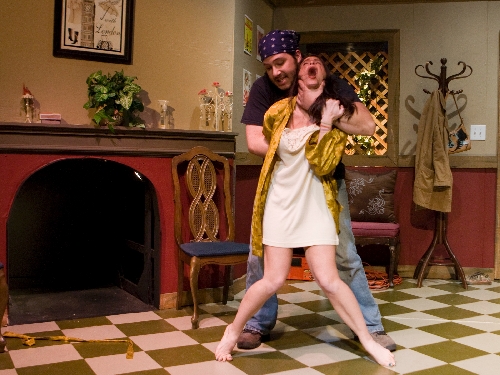
He straddles her chest. A purple pillow is mashed in her face. Her legs flail wildly. Uneasy silence hangs over wordless minutes. Occasionally, she gasps.
"Thirty seconds," says the rape supervisor. "One minute ... 1:30 ... two ..."
She comes to. He roars.
"KISS ME! Tell me you love me. TELL ME! Touch me all over. Tell me you want to make love. SAY IT!"
"I love you. I want to make love. ... Please ..."
"And ... blackout," says the rape supervisor. "Breathe for a couple seconds. You OK?"
They are. Will the audience be? This is rehearsal for "Extremities" at Las Vegas Little Theatre's close-quartered Black Box, where the faux-assault will play out mere feet from theatergoers.
The attacker and his victim are actors Geo Nikols and Jamie Carvelli. The supervisor with the stopwatch -- in case you're tempted to make gender assumptions -- is female director Daneal Doerr.
"We had a fight choreographer come and choreograph the rape scene," Doerr says. "We've been careful so it looks really violent and real. We've got one slap, where there's actual contact. We're taking every safety precaution we can."
But "Extremities," William Mastrosimone's 1982 play and later movie that validated the late Farrah Fawcett as a "serious" actress, can bruise audience sensibilities -- and at the original New York production, bits and pieces of the actors. Fawcett and original lead Susan Sarandon were sometimes seen with bandaged and splintered fingers.
"We want it to be intense and gruesome, but safety is installed in all of us," says Nikols. "But my knees get a couple of bumps and bruises. It's not from physically hurting each other, but our relation to the space, if we get up on the wrong angle or lean over too much."
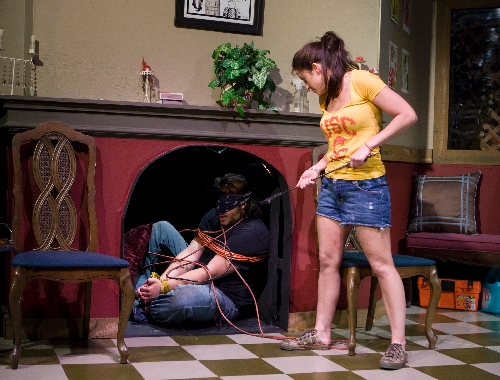
Challenging audiences with its brutality upon its debut, "Extremities" centers on Marjorie (Carvelli), who is assaulted in her home by Raul (Nikols), but manages to escape the rape -- bug spray to the eyes -- and capture her rapist, leaving him bound in belts, wire and cords, blindfolded with his own bandana and imprisoned in her fireplace (a premise New York Times reviewer Leah Frank labeled "preposterous").
Her initial instinct? Bury him alive in her garden.
When Marjorie's two startled roommates return, a game of psychological pinball ensues. Raul -- who had stalked all three and knows personal details -- alternately taunts, pleads and emotionally manipulates the women, pitting them against each other, at one point puncturing Marjorie's veil of virtue by revealing she had dated her friend's boyfriend.
He even suggests that if he's turned in to the police, she cannot prove rape but he can prove assault. Once the incident is over, he says, he will find her again.
"I don't think she really wants to murder someone," Carvelli says. "The fury comes not from what he physically did to her, but the things he keeps saying to her, pushing her further and further over the edge. If he was just to sit there and say, 'I'm sorry, I'll admit what I did,' she would have just called the police."
Mastrosimone triggers fierce debate over the effectiveness of the judicial system versus the rage that fuels vigilantism, and where morality falls between the two. Critics point out that the playwright created Marjorie nearly as sadistic in her retribution as the rapist.
Though some of the issues have been mainstreamed into other entertainment ("Law & Order: Special Victims Unit" often explores such thematic terrain), Mastrosimone's setup -- angry, violent, claustrophobic -- is still unsettling, a lit match looking for a gas tank.
"(Mastrosimone) met a woman who had been raped and was afraid to leave her house afterward," Doerr says. "She had identified him in a lineup but he got let go. The justice system wasn't there to protect her. When he heard the story, that's when he wrote the play."
Frank of the Times insisted the playwright "entertains and embellishes the terrible myths that women invite attack by their sexual mannerisms and mode of dress," citing one of the roommates, a rape victim years before, who blames herself for her assault. And both roommates -- as well as Raul -- call Marjorie a tease. "I don't think the play supports those myths at all," Doerr says. "I see how that impression could be there, but I think he wrote it to de-myth it."
Back to harrowing business.
"Lights up," Daneal says.
He's screaming. He's writhing in pain. She hogties him. Shoves him into a tight, dark, smoke-choked jail cell.
The attacker is the prisoner. The victim is the captor. Mental torment. Moral anguish. Psychological chess match.
The real fuse of "Extremities" has just been lit.
Contact reporter Steve Bornfeld at sbornfeld@ reviewjournal.com or 702-383-0256.
Preview
"Extremities"
8 p.m. today, Saturday, Thursday, April 16-17; 2 p.m. Sunday, April 18
Las Vegas Little Theatre Black Box, 3920 Schiff Drive
$14-$15 (362-7996; www.lvlt.org)