Traits of the State

What's no longer there is everywhere here.
"He was all about documenting the entire state, north and south, in pieces of landscapes and towns and things that have disappeared," says Mike Spiewak, curator at Springs Preserve, where "Nevada: The Photography of Cliff Segerblom" continues through mid-June.
"His images capture the beauty that existed within Nevada."
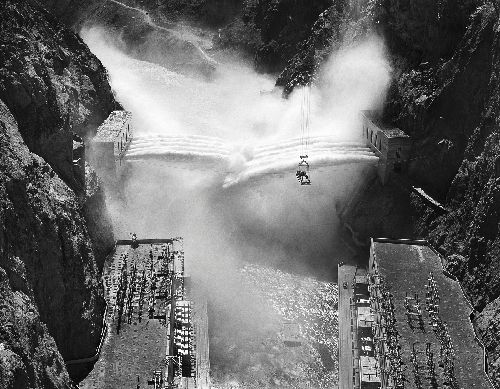
Plus some that, in spectacular fashion, still do. "His most famous image is of the Hoover Dam Needle Test," says Spiewak about the striking photo, prominently displayed, as muscular blasts of water erupt from the canyon wall needle valves, the massive sprays dwarfing a troupe of engineers dangling on a platform, reduced to fly specks against the monster monolith.
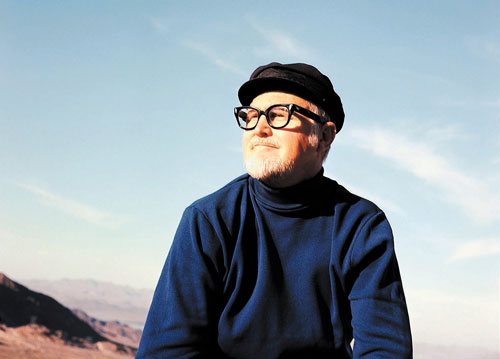
Primarily celebrated as a painter -- among his works is a commissioned acrylic depiction of the splashdown of Apollo 12, part of the U.S. Navy's official art collection -- the late Segerblom was a longtime Boulder City resident. He wasn't as acknowledged for his photography when he passed away in 1990.
Hired as a staff photographer by the Bureau of Reclamation to document the Hoover Dam project in 1938, his photos were subsequently published in Life, Time and National Geographic magazines and displayed in New York's Museum of Modern Art. Simultaneously looking ahead and behind, Segerblom portrayed Nevada's promise of progress, as well as vanishing landmarks of its frontier past.
"We toured every inch of the state," says his widow, 92-year-old Gene Segerblom, a fourth-generation Nevadan from Ruby Valley, who penned stories accompanying her husband's depictions that appeared in Nevada Magazine. "These little villages were wonderful and such fun. Some didn't have any place to stay, so we'd sleep in our car."
Based on negatives supplied by the Nevada State Museum, the exhibit includes photos taken in Berlin, Luning, Mina, Boulder City, Pioche and Belmont, as well as the Ruth Copper Mine. Documenting ghost towns that flourished during the gold-and-silver rushes, only to collapse into empty shells once ore deposits had been drained, Segerblom revealed not only abandonment and decay in his images, but also the stark beauty of a rugged state in its infancy.
Withered from neglect when it was snapped, Belmont's Cosmopolitan Music Hall is littered with tumbleweed and debris, torn curtains blowing out the windows, decrepit and lonely. A ghostly shack in Luning -- fronted by a "U.S. Senator Cannon, Nevada's Man" campaign sign for late Sen. Howard Cannon -- sits empty, Southern Pacific train cars in the background.
Segerblom's lens captures a deserted street in Mina with its boarded-up buildings, a sign peddling "meats, groceries, beer, liquor and cold drinks" an echo of a once-active area. An abandoned white railroad car, photographed in 1975, sheds peeling paint -- and yet was repurposed as makeshift community church.
Closer to home, a 1953 photo of a Las Vegas Club billboard promises "Real Lifelike Western Badmen," featuring four masked desperadoes, one with a slot-machine chest. And in a startling reminder of the city's accelerated growth over the past three decades, a snapshot of the intersection of Tropicana Avenue and Jones Boulevard taken in 1978 reveals nothing but a stretch of dirt trails, rocks, brush and small cliffs.
"We went to every little town," Gene Segerblom says. "It really bothered him that people had all moved away."
Turning his eye toward more sweeping, picturesque aspects of the state, Segerblom also photographed vistas before development circled them. Ruby Valley's rock-dotted landscape rises up into snowcap-tipped mountains, Winnemucca Lake is caught in its sprawling beauty and Boulder City stretches into a seemingly endless desert in 1953.
Given his copious documentation of Hoover Dam and its environs, additional photos include a stunning aerial view from 1963, the Lake Mead intake structures snapped in 1953, the rubble-strewn construction site of the railroad tunnel, and a tranquil overview of Lake Mead in 1950, the Dam construction railroad threaded through it.
"He really does an amazing job in terms of maintaining our culture," Spiewak says. "For people that care about the state, north and south, it shows that it really is one big, amazing place."
Contact reporter Steve Bornfeld at sbornfeld@ reviewjournal.com or 702-383-0256.
Preview
"Nevada: The Photography of Cliff Segerblom"
10 a.m.-6 p.m. daily
Big Springs Gallery at the Springs Preserve, 333 S. Valley View Blvd.
$4.95-$9.95 for Nevada residents; $10.95-$18.95 for nonresidents; free for children under 5 (822-7700; www.springspreserve. org)