The Maiden’s Voyage

Cause of death: dancing.
Beats a heart attack, huh?
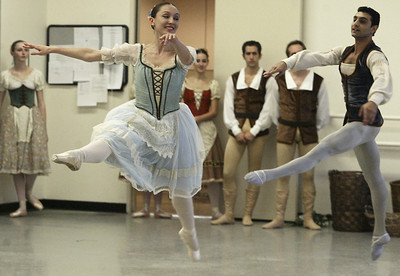
"They're empowered as women to get revenge on men as they dance them to death," says James Canfield, Nevada Ballet Theatre's interim artistic director, about the dance-till-you-die plot pivot in the classic "Giselle," staged for a five-show run this weekend at the University of Nevada, Las Vegas.
"These are young maidens who die before their wedding day of deception -- or of broken hearts."
Cross a gang of dead virgins at your own peril.
But let's back it up: "Giselle" tells the tale of the title lass, an innocent sweetie who falls for fellow peasant Albrecht, except he's a disguised nobleman, complete with a noble-fiancee. When the ruse is revealed, Giselle's sanity jumps the tracks, she suffers a massive broken-heart attack and dies. (This was the 1800s -- today she'd just go Lorena Bobbitt on him.)
By Act II, her never-say-die love (post-death) might be the only way to rescue the rascal from the "Wilis" -- vampire ghosts of maidens who, betrayed by their betrothed, drop dead before they can swap vows. (Today they'd just file a palimony suit.) Understandably irked, they convene nightly for a little graveside boogie, luring men and forcing them to, yes, hoof themselves into the hereafter. (Today, you'd think of it as a sort of John Edward-Meets-"Dancing with the Stars" thing.)
From beyond the Great Divide, Giselle still has an itch only Albrecht can scratch, so she attempts to thwart the ghosts' voodoo vengeance by keeping him limber and twinkle-toed so he can survive until dawn, when the spectral sisters retreat to their daytime dirt naps, proving that love transcends death.
It's all very romantic in an I-see-dead-people kind of way. ... Or an I-must-be-smoking-too-much-weed kind of way.
"I view it as Albrecht needing to resolve this incident within himself," Canfield says, "so Act II is something that he stirred up in his mind to clear his conscience. Does she really forgive him or is he forgiving himself so he can go on with his life?"
In the canon of classic ballets, "Giselle" is notable not only for its choreography, but its theatricality. Performers must act as well as dance, and in one instance, act instead of dance. "The famous scene known as the 'mad scene' at the end of Act I, after she realizes his deception, there are actually no steps involved," Canfield says. "It is purely an acting role."
That required extra emphasis at rehearsal. "Giselle is a complex character, not very experienced, and she goes from being very happy and in love to very confused and upset about Albrecht," says Rebecca Brimhall, one of three dancers in rotating casts performing the title role. "She loses her mind. It's an emotional struggle and difficult to make that switch-over, but James has had us really focus on that, what we can feel along with the music and the emotions we're trying to portray."
Adds Grigori Arakelyan, one of a trio of Albrechts: "It was really difficult, but it was a dream of mine to do this," he says. "You have to understand the character you're doing. And in the second act, you do so much dancing, and that's the whole point -- you dance until you die."
Beyond being an appropriate, if extreme, dance-company motto, that concept is a contradiction in this piece. "I have really enjoyed the choreography," Brimhall says. "It's not technically challenging, but in the simplicity, it's very technical."
Come again?
"With the simplicity, you can't hide," she says. "You have to be on for your turns and for your balances, everything has to be so precise, there's no tricky stuff. It's ballet in its purest form."
As a fascinating footnote, "Giselle" also scandalized the ballet cognoscenti, not due to content but the monumental moxie of one of its more famous Albrechts, Vasily Nijinsky. At one performance, Nijinsky emerged onstage minus the bloomers (or "modesty trunks") male dancers traditionally donned, appearing only in his tighty-tights. Condemned as obscene, the dance demigod was dismissed from the production.
"Everyone went running out the theater," Canfield says. "That changed the course of events in regard to the way a male was viewed in costume. And the dress of the women was shortened, showing a little bit more leg."
Hubba-hubba historical trivia notwithstanding, "Giselle" has, at its core, a virtuous, G-rated vibe.
"It's that kind of love about what a kiss on the hand meant," Canfield says, "the innocence of first love."
Today, they'd just, well ... NC-17, anyone?
Contact reporter Steve Bornfeld at sbornfeld@reviewjournal.com or 702-383-0256.
PREVIEW
what: "Giselle"
when: 8 p.m. today, 2 and 8 p.m. Saturday, 1 and 4:30 p.m. Sunday
where: Judy Bayley Theatre at the University of Nevada, Las Vegas, 4505 S. Maryland Parkway
tickets: $35-$75 (895-2787)