‘The Cove’

It's one of the year's most gripping thrillers, with a crackerjack team of undercover operatives tackling a clandestine high-risk mission.
But "The Cove" isn't just a thriller.
It also happens to be one of the year's most gripping documentaries -- and yet another demonstration that documentaries aren't just for the classroom anymore.
After decades of drab, schooly snorefests, recent nonfiction films have emerged to showcase some of the nerviest, more compelling filmmaking around.
"The Cove" -- an audience award-winner at film festivals from Sundance to Sydney -- continues that trend, melding high-octane storytelling with an equally powerful topic.
It also boasts a pair of lead characters worthy of an "Ocean's Eleven" caper. Except they're a lot more interesting -- and the stakes are a lot higher.
Leader of the pack: director Louie Psihoyos, a National Geographic photographer (and Oceanic Preservation Society co-founder), who's organizing a not-impossible mission to expose the bloody secret lurking beneath the deceptively placid waters of Taiji, Japan.
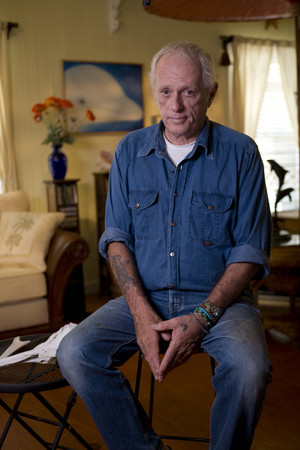
And right by his side: guilt-ridden Ric O'Barry, who somehow feels it's all his fault.
Back in the '60s, O'Barry found fame and fortune training the bottlenose dolphins who portrayed the irresistible title character in the hit TV show "Flipper."
The show's success kicked off an international bottlenose floodtide that has yet to ebb at marine parks where audiences cheer trained dolphins -- and at resorts where guests can "swim with the dolphins" for a price.
It's a billion-dollar business -- one O'Barry's been battling ever since Kathy, "Flipper's" star dolphin, died in his arms, prompting a change of heart.
"I was as ignorant as I could be for as long as I could be," he explains. "I spent 10 years building, and the next 35 trying to tear down."
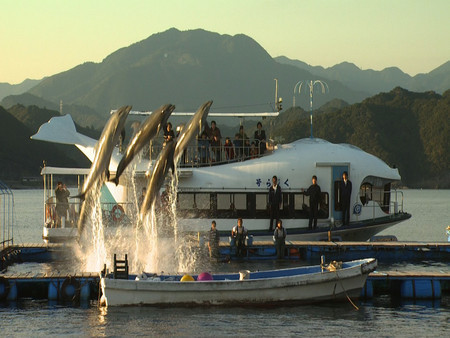
In "The Cove," the target is Taiji, a picturesque village where local fishermen round up dolphins and sell them (for about $150,000 a pop) to trainers from around the world.
But what happens to the captured dolphins that aren't chosen to become marine-park stars?
No one in Taiji will say, but O'Barry knows: They're slaughtered, and their meat is packaged and sold to unsuspecting Japanese consumers who have no idea that the whale meat they think they're buying is really mercury-tainted dolphin.
So Psihoyos, with O'Barry as co-pilot, recruits an A-team to infiltrate Taiji's isolated, well-fortified cove -- while they're supposedly documenting ocean-reef deterioration.
The assembled eco-warriors include champion free divers, an ex-Canadian air force avionics engineer and other assorted adventurous types.
To document Taiji's dark secret, they outfit themselves with an array of ingenious equipment, from digital microphones to heat-sensitive cameras (embedded in make-believe rocks created by a moldmaker who works at Industrial Light and Magic, George Lucas' special-effects house).
Not surprisingly, their presence attracts considerable attention -- from local fishermen armed with video cameras, from local officials anxious to maintain the town's image as a dolphin haven, from mysterious figures with possibly sinister intent.
Because "The Cove" is at least as much a documentary as thriller, however, the movie ranges beyond Taiji to explore such issues as the human-dolphin bond and the politics of international whaling policy.
The one notable talking-head omission: someone from the world's marine parks to try and justify the entire enterprise.
Then again, O'Barry's rueful recollections of his former professional life at the Miami Seaquarium serve much the same purpose.
"The Cove" unfolds with such urgency (thanks in part to award-winning "Sicko" editor Geoffrey Richman) that it's easy to overlook its aesthetic strengths.
But Psihoyos and his cinematographer, Brook Aitken, show an uncanny knack for capturing haunting, indelible images, whether those images depict the beauty of the dolphins swimming free -- or the horror of what they endure in "The Cove's" title killing zone.
Contact movie critic Carol Cling at ccling@reviewjournal.com or 702-383-0272.
Review
Carol Cling's Movie Minute
"The Cove"
91 minutes
PG-13; disturbing content
Grade: A-
At Village Square t Village Square
DEJA VIEW
What’s up, doc? In these award-winning documentaries, a world of world-class filmmaking:
“Hoop Dreams” (1994) -- Two impoverished inner-city Chicago students chase high school basketball stardom -- and hope for college scholarships.
“Roger & Me” (1989) -- Oscar-winning documentarian Michael Moore’s feature breakthrough takes a sardonic, ruefully hilarious look at a most unfunny subject: how General Motors’ corporate greed ruined the lives of numerous employees in Moore’s hometown of Flint, Mich.
“The Fog of War” (2004) -- Errol Morris’ Oscar-winning portrait of former Defense Secretary Robert S. McNamara, who ponders the difficult lessons learned from U.S. involvement in Vietnam.
“Grizzly Man” (2005) -- Director Werner Herzog’s stunning study of obsessed, self-styled “grizzly guardian” Timothy Treadwell, who lived -- and died -- among the bears with whom he shared 13 summers in the Alaska wilderness.
“Man on Wire” (2008) -- An Oscar-winning account of tightrope artist Philippe Petit’s 1974 high-wire walk between the twin towers of New York City’s World Trade Center.
-- By CAROL CLING