The Beastie Joys

Spielberg blew it.
“Jaws” was 345 million years too late.
Setting the Scariest Fish Story Ever Told back then, and dumping comparatively affable Bruce the Great White Shark, the acclaimed auteur could’ve truly terrified us by instead using, say, a mechanical Helicoprion.
That’s it right there, Brucie’s ancestor, exposing the most blood-chilling jaws a soon-to-be-entree could ever stare into — front teeth that form a whirling, grinding buzz saw.
“It makes a very clean cut,” Gary Staab says. No kidding. Why sloppily chomp it when you can precisely slice it?
“Unlike modern sharks whose teeth roll out and drop out of their mouths, this one saves its teeth. The older teeth are on a spiral on the inside.”
True, Roy Scheider wouldn’t have been around to famously suggest a larger vessel. But imagine the special effects, turning prey into neatly carved, prehistoric deli meat.
“It’s a fun romp through time looking at all these strange animal forms,” says Staab, a sculptor/illustrator who focuses on reconstructing ancient life forms and designed “Bizarre Beasts Past and Present,” the newest installation at the Las Vegas Natural History Museum, which also centers around frightening giant birds, dinosaurs, mammals and other ocean-dwelling oddities.
“Over the years, I would research and find these fossils that were just mind-blowing and screamed to be restored,” says Staab, whose work also has made it to the Smithsonian Institution’s National Museum of Natural History and the Carnegie Museum of Natural History. “I developed a wish list of animals I wanted to restore under the theme of bizarre beasts, something that really tells the story of evolution.”
And gradual adaptation to their environment, as creatures develop anatomical aids to help catch prey and avoid becoming it, as well as in reproduction. “I find these animals particularly interesting because of some strange, circus-freaky-like adaptations,” says museum executive director Marilyn Gillespie. “A lot of things that actually happen in nature, it’s like a science fiction writer was making up something.”
“Do-what-ya-gotta-do” could cover the point of “Beasts.”
Say, with that ostrich, the flightless, graceless bird that can gallop away from pursuers at 43 miles per hour, with only two toes on its legs providing greater running speed. Nature spurred that skill. Or the oddly named dwarf mammoth. “I love it because the dwarf mammoth seems oxymoronic, the small elephant, but it happens with mammals in island situations, they tend to reduce in size,” Staab says, pointing out that there is limited food in isolated areas, so animals using fewer resources are more likely to survive and morph into new species, a process called “speciation.”
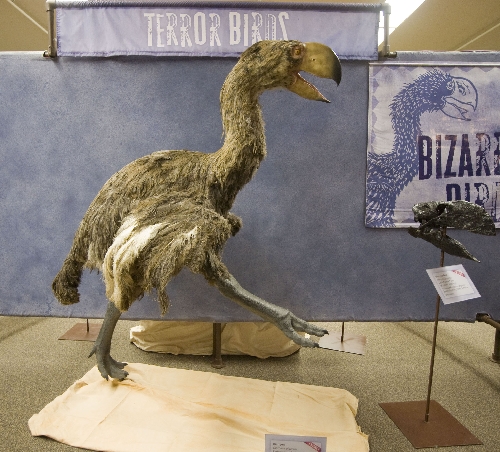
Elsewhere are examples of, well, fill-in creatures, such as the strangely shaped “stomach bird,” called a Diatyrma. “We’ve got animals with very impressive beaks, and this one preyed on the ancestor of the modern horse,” Staab says. “This bird filled a niche left vacant after the extinction of the dinosaurs. It’s like the T-Rex of its time, it looks silly, like a big ostrich, until you start looking at the power of the head.”
Though environment triggers changes, a section of “Beasts” also examines how man has stirred the mix, as with dogs originally descended from wolves. “If we think about how we as humans have changed the shape of domestic animals around us, we see how we changed dogs, pigeons, horses and cattle,” Staab says. “All of them are in their diversity because we selected them for certain traits we find desirable, and bred for that.”
Back beneath the waves, the green, wriggling amphibian named Diplocaulus sports a boomerang head that helps it plow on against powerful currents rushing toward it and feed on insects on the surface. “Without much effort, it could raise its head up like the wing of a plane and propel it up to grab it and come back down,” Staab says. “The other thought about its head is it would make it very difficult to be swallowed.” Nearby is an explanation of the abilities of the hammerhead shark, its snout teeming with small, jelly-filled pores that enable it to detect electrical signals given off by hiding fish, particularly stingrays, its favorite snack, buried in the sandy bottom.
As for the variety of protrusions on many of these prehistoric oddballs, Staab explains simply: “Bumps, knobs and tusks are all about sexual selection. They’re all trying to attract a mate and, as we know, males do crazy things to attract a mate.”
We try not to picture romantic canoodling between buzz saw-mouthed Helicoprions, but ...
Imagine the makeout sessions.
Contact reporter Steve Bornfeld at sbornfeld@ reviewjournal.com or 702-383-0256.
Preview
“Bizarre Beasts Past and Present”
9 a.m.-4 p.m. daily (through Sept. 12)
Las Vegas Natural History Museum, 900 Las Vegas Blvd. North
$5-$10, free for children 2 and under (384-3466)