‘Sound of Music’ comes to Summerlin for monthlong stay

Raindrops, roses, whiskers, kittens, doe, a deer, hills, alive, the whole Austrian nine yards.
Need we elaborate? Fine, we will.
Salzburg comes to Summerlin in "The Sound of Music." They're hoping you climb every mountain to get there.
"When times are difficult, people want to see something that's going to bring them joy, which is what they did during the Depression, put them in a place where they could have some happiness," says Leslie Fotheringham, director of the classic musical that brings us nuns, a sunny governess, an uptight papa, warbling rugrats and Nazis.
"This is a perennial favorite for us and the timing might really be good." (Perhaps also because this month, the 1965 film marks its 45th anniversary with celebratory events.)
One of your favorite things, along with cream-colored ponies and crisp apple strudels? Right up there with doorbells and sleigh bells and schnitzel with noodles? Beginning Monday, you have a month -- the usual extra-long run, by our community theater standards, that Signature Productions schedules -- to do-re-mi-it out to the Summerlin Library Performing Arts Center. (We regret to report there are no discount tickets for theatergoers who are 16 going on 17.)
Yet those who think of "The Sound of Music" only in terms of that zoom-into-the-hillside shot of Julie Andrews twirling amid the Bavarian Alps in the movie may require reminding of the musical's serious dimensions, coupled with the cheery, Rodgers and Hammerstein score.
Yes, the fact-based tale of free-spirited nun-in-training Maria becoming governess to the seven children of Capt. von Trapp, the rigid, widowed Austrian naval officer -- and the love story between Maria and von Trapp that ensues -- is as sweet as a Splenda packet.
Nazis do enter into the plot, however. (Spoiler alert -- wait, can there actually be a spoiler alert for "The Sound of Music"? -- the family is transformed into a singing ensemble that, when Nazis oppose the captain's Austrian patriotism, escapes from a guarded theater during a performance into Switzerland.)
"That era is important to me, the Holocaust thing, and there are still a lot of people left here from that," Fotheringham says. "I try when I do traditional musicals not to get caught up in the fluff of the show, but bring out the story. We'll have the Nazi flags at the end. It will be very apparent that presence is there."
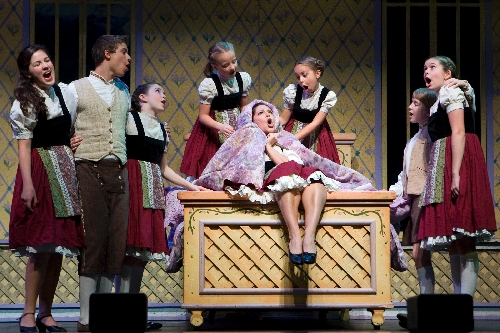
Assuming the iconic, Julie Andrews-Forever role of Maria (with a nod to 1959's original Broadway Maria, Mary Martin), Rebecca Kaufman is applying her own take. "It's a different interpretation, it expands on Maria's character," Kaufman says. "It's more of a youthful Maria, a lot more rolling on the floor, climbing on the couch, jumping on the bed with the kids. In the movie, she has playfulness, but not as much as we're bringing to the character."
One of those children, initially wary of Maria before becoming bewitched by her, is Louisa, portrayed by 14-year-old Ellie Smith, trying to balance being one of seven with creating a distinct character. "You want to try and blend in with them as much as possible but try to have different personalities without standing out too much," she says. "I've made myself the kid who catches on slowly."
Von Trapp's kiddie troupe was chosen, Fotheringham says, out of more than 150 who auditioned. "What you'll see is the cream of the crop," she says. "They're all pros, even the very youngest have been onstage before. I treated them like the adult performers. I expected them to rise to the occasion and they have."
Opposite Kaufman as von Trapp, the military martinet who left the parenting to his late wife and winds up treating his brood like a ship's crew before he's thawed out by Maria's charms, Alex Cheney's expectations were shaken when he began rehearsals. "I thought this would be an easy thing to jump into, being so familiar with the movie, but I discovered what a complex character the captain is and how he's very stern but also very loving," Cheney says.
"I'm playing him a little harsher than Christopher Plummer did (in the film), but in my tender moments, maybe a little more tender. I need those extremes so people understand it's not a one-level character."
Productionwise, this "Sound of Music" may also be striking for what it lacks -- live musicians. Recorded tracks will replace them. "Orchestras cost us between $12,000 and $14,000," Fotheringham says. "We need to cut that for now. We didn't think it was fair to pay live musicians when everybody else is volunteering their time."
Audiences, she notes, will still find a "Sound of Music" as robust as Julie Andrews crooning atop those alive-and-well hills. So scan the crowd for girls in white dresses with blue satin sashes.
Just don't expect snowflakes that stay on your nose and eyelashes.
Note: The 45th anniversary of the film will be celebrated with "singalong" versions released to local theaters Tuesday and Oct. 26 (check local movie listings), plus a cast reunion on Oprah Winfrey's show Oct. 29.
Contact reporter Steve Bornfeld at sbornfeld@review journal.com or 702-383-0256.
PREVIEW
What: "The Sound of Music"
When: Preview performances 7:30 p.m., Monday, Oct. 21 and 22; regular performances Oct. 23-Nov. 20
Where: Summerlin Library Performing Arts Center, 1771 Inner Circle Drive
Tickets: $15-$23 (878-7529; www.signatureproductions.net)