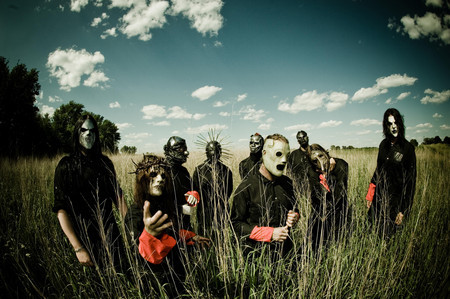
Slipknot

He was a kicker on his college football team, so the dude is used to wearing a number.
These days, he goes by #3.
That's Chris Fehn's nom de plume in Slipknot, the nine-piece heavy metal storm front with a high tolerance for pain and even higher insurance premiums.
Their shows are full-contact stamina tests that have resulted in plenty of emergency room visits -- for both the band and its fans.
"I jumped off Joey's (Jordison, drummer) riser one time and tore my ACL," the percussionist says from a tour stop in Vancouver, sounding like a veteran recounting old war wounds. "The first show on this tour I tore my MCL. The last few shows it's really swelled up and really been hurting," he sighs, "but today it feels pretty good."
You've heard of plenty of artists suffering for their art, but for this bunch, the suffering is their art.
Slipknot trades in a kind of unrelenting, hard-eyed, rock 'n' roll nihilism that manifests itself in terse blast beats, muscular thrash riffs of quartzlike density and lots of lyrical scab picking that tends to view humanity in the same light as a surgeon would a tumor.
It's an intense, overwhelming sound, pointedly polarizing in its all-encompassing anger. There is a sort of hardened optimism buried beneath all the misanthropy, a refusal to accept defeat in the face of inevitable collapse.
But you have to dig for it.
Case in point: The title of the band's latest record is "All Hope Is Gone."
Slipknot serves as a pressure valve, basically, an outlet for the blowing off of geysers of steam.
In many ways, the group is a blank canvas upon which their fans can project all their rage, and this may be why the band members choose to wear masks: It's better if they're faceless, because this way they could be anybody -- even you.
For his part, Fehn favors a bondage mask with a long 7-inch, Pinocchio-style proboscis jutting out from the face.
"I'm so used to it, that it's just me now," Fehn says of his headgear. "It's like putting on the pads or something. Once you put the mask on, you know it's go time. But other than that, I don't even realize that I have it on anymore. It's just a part of me now."
Onstage, Fehn is a blur of barely controlled energy, climbing atop the two empty beer kegs that serve as his primary instruments, which he often whacks with a baseball bat.
The band pulses with a chaos that its members tend to embrace in bear hug fashion. Their concerts are sweaty scrums, awash in adrenaline and catharsis, with the group practically hurling themselves at the crowd.
On its records, Slipknot is just as frenzied. It began on the outer fringes of the rap-rock boom of the late '90s, with some hip-hop influences on its self-titled 1998 debut. But since then, the band has honed in on both the melody and the malevolence, crafting an obsidian-dark sound with bright hooks.
It's a deliberately schizophrenic aesthetic.
"We don't have a plan," Fehn says. "That's one good thing about us. I think if we did have a plan, it wouldn't work. The floodgates just open. For nine guys, anybody's welcome to throw ideas in there. There's a lot of songs that come out of a lot of people, so we have a ton of material that we can put together, throw in the trash, save for the future, use on this record. A plan would definitely suck."
What doesn't suck for these guys is the success they've attained for themselves by turning their rage into something relatable to so many kids in black concert T-shirts.
They've been at it for more than a decade now, recently rereleasing their debut, revisiting their past, which is an odd proposition for a band that has never even acknowledged a future.
For anything.
"It's weird, because there's a DVD that comes with the (reissue) CD, and I watched it and was like, 'Man, dude,' like, I couldn't believe the small clubs that we played and how intimate it was," Fehn says. "It brought back a lot of feelings. That was a special time for the band. We really had to bust our butts. A lot of times, we only got 20, 25 minutes to play. So, you pretty much had to lay it all out within that 25 minutes and try and get our art across. Those were good times, man," he continues, taking a pause to seemingly reflect on his words for a second, "but I'm glad we are where we are today."
Contact reporter Jason Bracelin at jbracelin@ reviewjournal.com or 702-383-0476.
Preview
Slipknot
8 p.m. Saturday
The Pearl at the Palms, 4321 W. Flamingo Road
$44-$64 (942-7777)