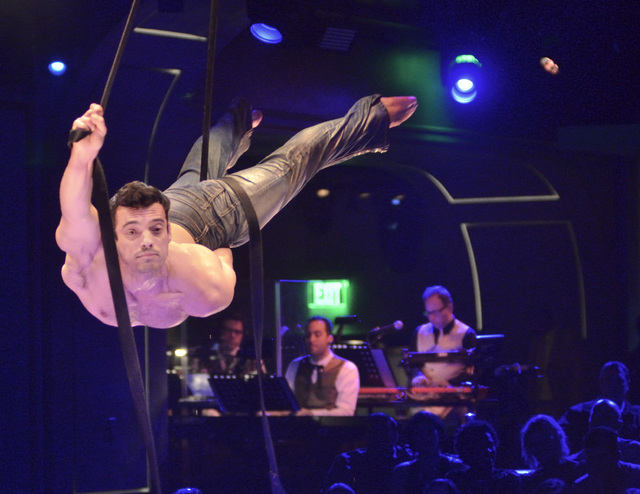
Rose.Rabbit.Lie. is grand experiment that joins restaurant, nightclub, show

It’s a “social club” that seems right out of a movie, so Cosmopolitan CEO John Unwin commissioned a short film, or “tone video,” to explain it.
Familiar movie stars from the ages are cross-cut into a montage of elegant celebrations in those soundstage supper clubs you only see on the big screen — or a fuzzy black-and-white TV, in the case of Ricky Ricardo’s Club Babalu, which was the working name for the project that became Rose.Rabbit.Lie.
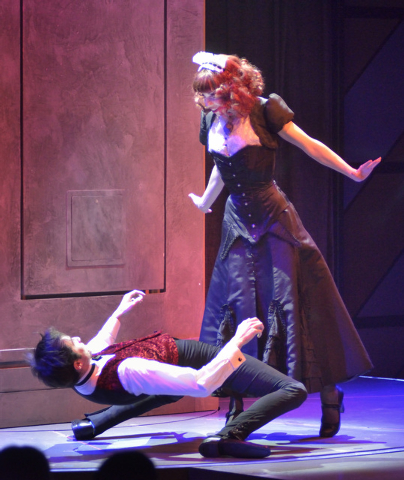
Whether you know it from 1940s MGM musicals or “Indiana Jones and the Temple of Doom,” it’s the gorgeous nightclub where your tux-and-gowned persons of interest are escorted to a ringside table to witness a retro floor show, until a fight (or Mighty Joe Young) breaks out and someone ends up wearing a tray of drinks.
In Las Vegas it was the Sands’ Copa Room, or the brief reign of the Moulin Rouge, better known today as legends than specific realities.
“Las Vegas owns a piece of real estate in the minds of practically everyone in the world,” Unwin says. “We like to take a look back and try to find the romantic parts of that real estate and bring them back in a modern, relevant way.”
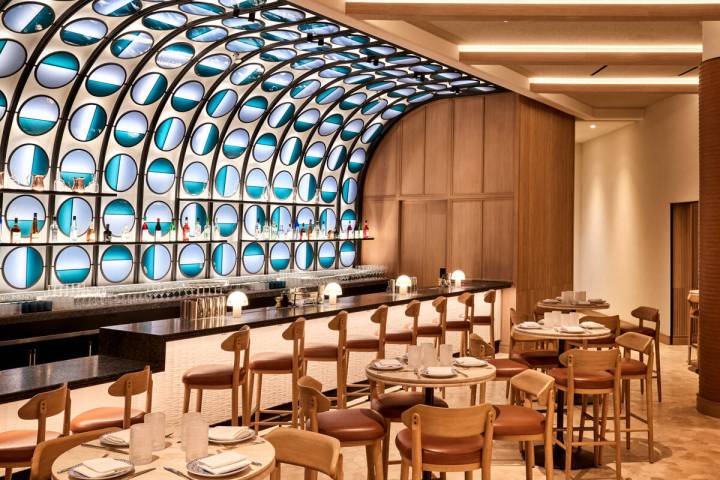
And so comes Rose.Rabbit.Lie., an attempt to combine a bar, restaurant, nightclub and ticketed show under one roof — and into one experience if you choose to go all in.
Visitors enter an octagonal, Haunted Mansion-like antechamber with eight doors, each leading to different places.
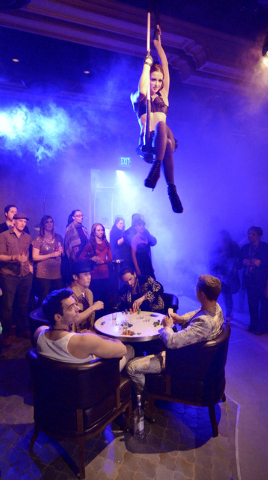
You can visit for craft cocktails or small-plate dining and have what the creators call the “immersive” experience. “I’ll be intervening in that meal in a hopefully not too intrusive way,” promises show director Wayne Harrison. “A beautiful song played on an instrument from the 18th century, or tap dancers dancing very close to your caviar.”
“It creates that thing, ‘Did you see that happen? We all saw it together.’ That explains the social club concept,” says David Bernahl, who oversees the dining and mixology components.
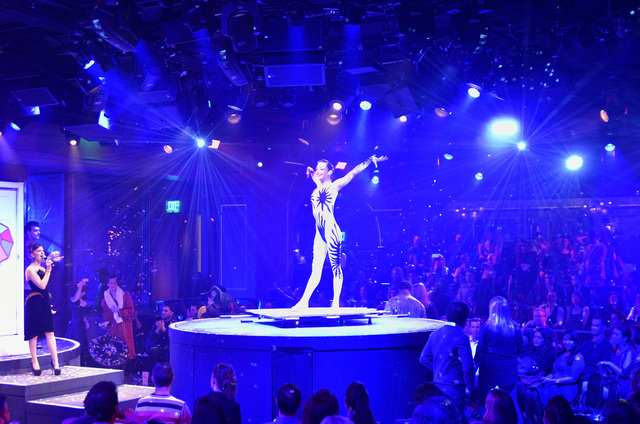
One dining area offers a “backstage” view of the big room’s show, where sofas, chairs and VIP boxes circle the stage and bars line each side wall for the main event, “Vegas Nocturne.”
But even here it’s not so clear-cut.
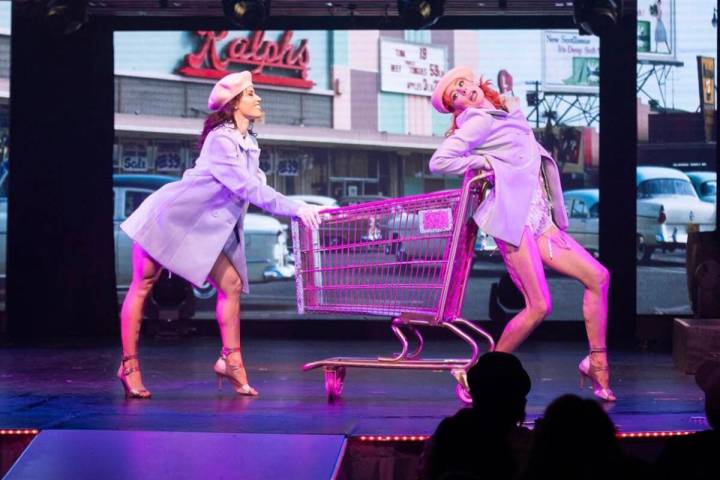
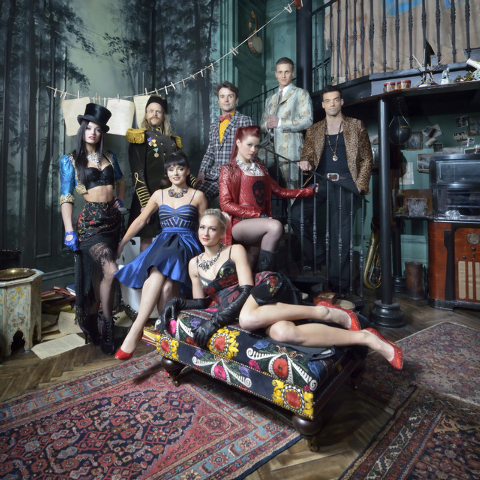
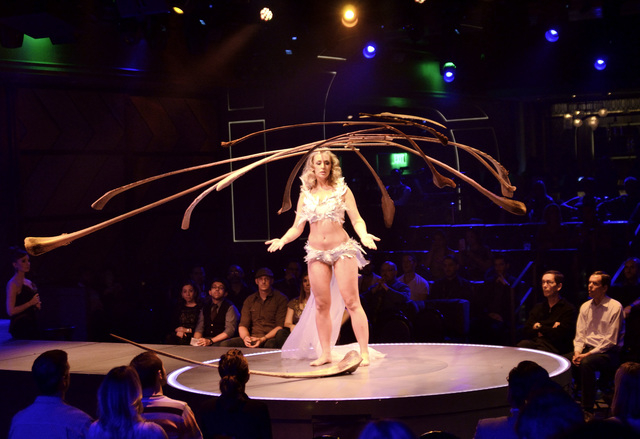
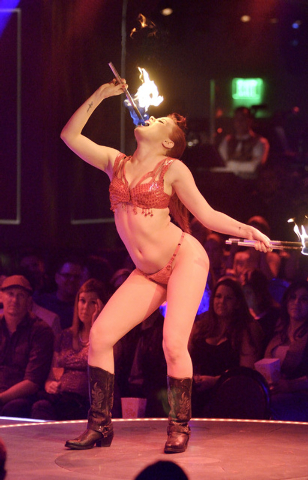
The 8 p.m. performance (here the shows are called “cantos”) is a 90-minute revue of neo-vaudeville and acrobatics that will ring familiar to those who have seen “Absinthe” from the same creators.
At 10 p.m., the seating is reduced from 500 to 250, and the show is shorter, with different content.
At midnight it’s shorter still, segueing into a dance club environment with a DJ as the wall panels open up, unifying the different rooms into more of a single space.
“I suppose they get more Vegas as the night goes on,” Harrison says. “We might start the evening with a nice Chardonnay and by the end of it we’re kind of throwing down the shots. It’s a drive towards turning it into a more communal experience. It starts quite formal and then it kind of unwinds a little, loosens up.”
And if you are working the box office, attempting to explain these various options to customers?
Good thing they call the desired demo “the curious class.”
“When we talk about the curious class, it’s more of a psychographic than a demographic,” Unwin adds. “It’s more your spirit and sensibility” than your age. That said, the new venture is “not meant to be for everyone. It definitely has a point of view.”
The right blend
Befitting a patchwork creation combining different partners, Rose.Rabbit.Lie. corrals various attempts to reunite the ticketed shows and nightlife that have divided into separate industries.
The idealized movie supper club was even tried before, with “Copacabana” at the Rio in the 1990s. It quickly proved more lucrative to make that retro showroom into Club Rio, a pioneering casino-based nightclub.
“Caesars Magical Empire” in the late 1990s also echoed the mystery mansion concept of Rose.Rabbit.Lie. Visitors were led from dining chambers to small theaters. But it was way more structured than what The Cosmopolitan is attempting, and wrongly perceived as a family-theme park attraction. Symbolically enough, it was replaced by Pure nightclub.
A 2001 investment at the Aladdin got as far as Carmen Electra posing in a hard hat to “break ground” for a venue where, after a show called “Lumiere,” the walls would retract to create a nightclub.
By the time that project was swallowed up in the Aladdin’s bankruptcy, the prevailing mood on the Strip had shifted: People like to separate their restaurants, shows and clubbing into different locations (and age groups).
But now, Rose.Rabbit.Lie. and the simultaneous opening of Beacher’s Madhouse at the MGM Grand — where visitors pass through a discreet “library” into decadent post-vaudeville revelry — suggests the zeitgeist may be changing, and perhaps in need of new descriptives.
“We wanted to stay away from ‘dinner theater’ or ‘dinner show,’ because that normally implies bad food and mediocre theater,” Unwin says.
Instead, he used his pro-active position of “executive producer” to combine partners who were good at each.
The Monterey, Calif.-based Coastal Luxury Management oversees the sustainable caviar, cocktails-on-tap and 300-item sparkling wine list. Ross Mollison’s Spiegelworld extends the neo-vaudeville shows created for “Absinthe,” recycling some of the peripheral, midway elements that were reined in by the show’s landlords at Caesars Palace.
Even as the plans were “resketched 42 times, redrawn and redrawn” says Coastal Luxury’s Bernahl, the team that had been recruited by Unwin came together, unified by a sharp attention to detail.
“All the little things that are easy to gloss over, when you pay attention a little bit more microscopically, all of a sudden it comes to life in a romantic way,” Bernahl says of the antique dinner plates, or espresso cups in the shape of human heads.
Champagne and subtext
Unwin talks about how the average age of the Las Vegas visitor is trending downward — to a median of about 45 — and “how people consume things has changed.”
“I think they want more choice, I think they want more control, I think they want it to be a little less prescriptive,” he says. “Come when you want, leave when you want. Kind of customize the evening to what you want to do.”
“Discovery is a word we use a lot,” Bernahl says of chambers such as “the library” and “the music room.”
So, while Harrison is in charge of about seven hours of material for 38 performers (including musicians), the goal is for no one to actually realize that, and for no two visitors to witness exactly the same thing.
Some patrons will be content to buy a ticket for the 8 p.m. showing of “the top nouveau-cirque cabaret acts in the world,” Wayne says while chatting in a small side room that could be part of a vintage bordello, down to the antique bathtub.
“Or,” he adds with wry smile, “you could accept an invitation to come into this room and get a little bit of added entertainment. … Or you might encounter part of the story that kind of explains why we’re all here.”
That, as it turns out, is the subtext: the unifying notion that this mansion was here before The Cosmopolitan (or even The Jockey Club). Audiences can piece it together if they choose to.
“You don’t really need to know that maybe what (an acrobat) is doing is an act that’s been in the family for maybe 100 years,” Harrison says. “You can come and just see it as a variety show or go, ‘Hang on, somebody’s actually making informed choices here according to something I don’t quite know,’ ” Harrison adds.
On this count, Harrison doesn’t mind comparison to environmental theater such as “Sleep No More,” or even “Tony n’ Tina’s Wedding,” where the actors improvise based on a “bible” explaining the backstory of their characters.
Rose.Rabbit.Lie. is subtitled “the grand social experiment,” Harrison says. “I guess it’s a little bit of a theatrical experiment at the same time.”
Contact reporter Mike Weatherford at mweatherford@reviewjournal.com or 702-383-0288.
Preview
"Vegas Nocturne"
8 p.m., 10 p.m. and midnight Thursday-Sunday
Rose.Rabbit.Lie. at The Cosmopolitan of Las Vegas, 3708 Las Vegas Blvd. South
$134-$156 for 8 and 10 p.m. shows; $30 for midnight show (877-667-0585)