Real Israel

Headlines scream of a land that affects the world politically.
Gallery walls whisper of a land that explores itself artistically.
"Having lived in Israel for a year, I had ideas through the media that Israeli art needed to be political somehow, but they were addressing urban contemporary concerns that could apply to any city," says Naomi Arin, owner of Naomi Arin Contemporary Art, site of the "Israeli Art NOW" exhibit.
"As I look at this show, I realize how dark it is, so much pathos going on in this work. Whether that's because all the artists are from Israel, I don't know."
While Israel commands global attention for its retaliatory assaults on Hamas targets in Gaza, Arin's gallery focuses on its more aesthetic sensibilities in a display of work by noted Israeli artists Adi Nes, Nir Hod, Ori Gersht, Michal Rovner, Maya Gold, Gideon Rubin and Khen Shish.
"The purpose of the exhibition was to show Israeli artists working today that are gaining international recognition," wrote curator Omer Shani in an e-mail from her home in Tel Aviv. "I found it especially important to exhibit a variety of artists in various stages of their careers. ... There is no unifying theme among the pieces, but rather a revealing glimpse at contemporary Israeli art that is becoming increasingly more universal and multicultural."
Substance abuse, homelessness and a commentary on the concept of luxury in a country where hardship hangs over daily life are among subjects that suffuse the exhibit. Nes, whose photographic work is respected in Israel and beyond, poses street people in bold compositions that channel the power of historical paintings with a biblical bent, such as "Hagar," in which a woman in frayed clothes, hand over mouth, wears a look of disbelief while gazing off into the distance. The piece quotes the iconic Dorothea Lange photograph.
"It garners feelings of loss and sadness and urban dismay," Arin says. "But there's also a historical feel to it. It looks old, but it feels new and addresses the issues of homelessness and desperation."
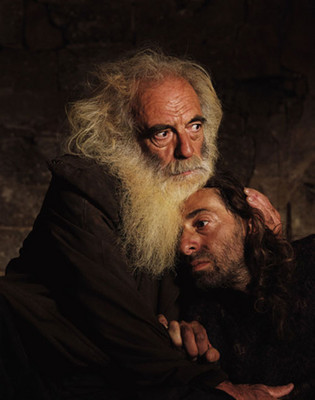
In Nes' striking "Saul and Samuel," suggesting the biblical story, an elderly man in a long, scraggly white beard worthy of the Old Testament cradles the head of a distressed younger man. "Look at the look in his eyes and his son's eyes," Arin says, and indeed, their intensity is striking.
Hod's stark piece spells out "L-U-X-U-R-Y" in silver letters set against a crumpled foil background, as if the very notion invites contempt and derision. "From what I knew from living in Israel, I understood 'luxury' to be kind of a dirty word, that it's frivolous," Arin says. "Having this statement on this shimmering but tattered foil, I found it really interesting."
Conversely, an ethereal feel pervades Rubin's pastoral series of nine small paintings on jagged pieces of cardboard, with featureless characters in everyday acts such as a boy holding a red flower, a father reading to his daughter and a girl atop a pony. "He's addressing memory and family, things we consider really valuable," Arin says, noting that Rubin's use of cardboard "takes a step away from the canvas, the pinnacle of the art world, and even working on paper, using randomly cut cardboard to bring it to a day-to-day level."
In Hod's "The Night U Left," thin chalk lines representing cocaine drizzle down a black mirrored backdrop, and Rovner's "Site F" uses twin metal-framed LCD screens to display bleak, slow-moving computer images depicting oil fires burning in Kuwait.
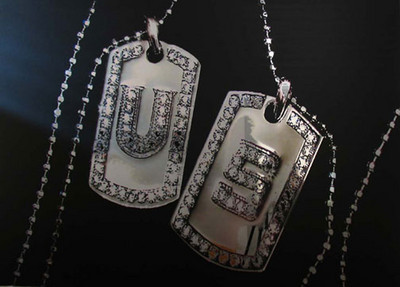
And in the gallery's window display is perhaps the exhibit's most compelling work, Hod's "US," a large mirrored piece, two big dog tags bearing the bejeweled letters "U" and "S." While that image suggests a military reference to the United States, and perhaps to the bond between America and Israel, Arin recalls a meeting with the artist in which that perception was disabused, but underlined the interpretive, and most fascinating aspect of art.
"When I went to visit (Hod) in New York, I said, 'I just love the U.S. piece.' And he says 'I'm not really sure we're talking about the same piece.' I said, 'The U.S. dog tags,' and he says, 'Oh, US! Why would you think U.S.?' In his mind, he loves the idea that because it's on a mirror, we can see ourselves and we're included in the experience and it's about us."
Inside this gallery, headlines concede the spotlight to the aesthetics of a nation.
"I was thinking people would bring an attitude, whether it's positive or negative," Arin says. "No matter how you feel about its existence, you can't deny there's some really amazing art coming out of Israel."
Contact reporter Steve Bornfeld at sbornfeld@ reviewjournal.com or 702-383-0256.
Preview “Israeli Art NOW” 11 a.m.-6 p.m. Tuesdays-Saturdays (through Feb. 15) Naomi Arin Contemporary Art, 900 Las Vegas Blvd. South Free (880-3878)