Nuclear Legacy

Ominously scary yet sweetly silly, weren't they?
Flash back to "The Flash," the term that made an atomic mushroom cloud sound like a popped camera bulb. And to those grade-school air-raid drills in the early '60s, when we were assured that diving under wobbly wooden desks made for 7-year-olds would shield us from nuclear Armageddon. And to that cute Bert the Turtle, the little cartoon fella whose inexplicably peppy theme went: "There was a turtle by the name of Bert, and Bert the Turtle was very alert. When danger threatened him he never got hurt, he knew just what to do -- he'd duck and cover!"
Past our Cold War jitters of yesteryear but steeped in today's militant era of fear, you can get a fascinating dose of radioactive reality at the Atomic Testing Museum.
"It's an immense amount of power, a terrible weapon, but a necessary one, and people have a one-sided view of what atomic testing is," says Rick Rodino, events coordinator at the museum that houses a multimedia-to-the-max history of the Nevada Test Site in artifact-rich galleries. Topics include atmospheric tests and the fallout issues that led to their abandonment, the rise of underground testing and environmental impact.
"Going to this museum, people realize a lot more came out of it -- alternate forms of energy, medicine, different aspects than just bombs that blew things up," Rodino says.
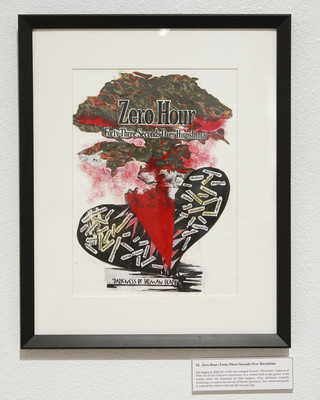
Pegged to the Hiroshima bombing anniversary earlier this week, the museum just debuted "Bridge to Forgiveness," a monthlong exhibit of artwork by Takashi Tanemori, a survivor who was almost completely blinded in the attack when he was 8 years old. (Tanemori will give a lecture at 2 p.m. Saturday.)
That buttresses a standing display startling in its depth, dimension and elements that are -- dare we apply this word -- fun. (Bad joke alert: You'll be blown away.)
"For some reason, people think we're a museum of boring pictures, and they have no idea we have huge artifacts and state-of-the-art technology," says education director Ellen Leigh. "People think it's going to be a small little museum. That's not what we are."
More sensory experience than historical recitation, the museum surprises at nearly every turn, its educational content couched in a creatively conceived package. "It's 8,000 square feet, like a maze with all the movies and interactive videos," Rodino says.
Facts and photos abound, but a three-screen montage -- a fly-by look at the World War II era with images of Hitler, Stalin, Einstein, Hiroshima, Nagasaki and the Enola Gay -- heralds what's ahead. A breakdown of an atom's structure into protons, neutrons and electrons is supplemented by a cartoon, a throwback to those grainy classroom flicks in the relatively tech-less '60s. (Watch the atom hop into bed wearing a floppy nightcap.)
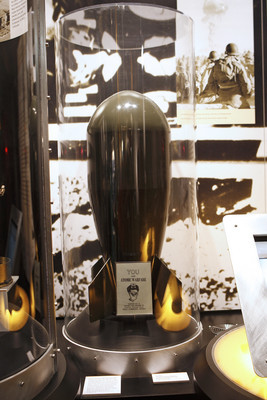
Missile models and mock-ups -- including rockets built as prototypes -- are sprinkled throughout the galleries, from air-to-air missiles to the Davy Crockett XM-388 projectile warhead, nicknamed Little Feller II, a squat, pitch-black rocket with a bulbous nose. Under glass is a handwritten letter to the chief of the Atomic Energy Commission in 1954, from a Japanese doctor unsure how to treat the radiation-exposed crew aboard a fishing trawler that strayed near the fallout from a mushroom cloud.
"In the Ground Zero Theater, there is no sparing of history of the fact that there were a lot of people who didn't want the testing," says museum executive director Ray Shubinski. The theater is indeed a centerpiece, a digital readout counting down to the next showing. Framed by red warning lights and with special effects that rumble the bleachers when a filmed explosion hits the screen, the theater unspools a balanced historical recap, including comments from former test site employees and references to protestors, workers' radiation-induced cancer and later incidents such as Three-Mile Island.
"You get a real feel for the incredible dynamics of these weapons that startles people into reality," Leigh says. "So many Americans have no idea that the test site ever existed or that almost a thousand devices were detonated just 65 miles from here."
Defending the bomb as a tool to protect democracy in the film, one test-site vet declares that "they're protesting the very thing that allows them to protest."
Elsewhere, an underground testing exhibit delivers you into a boulder-lined bunker, and a towering diagnostic equipment rack exposes compartments that contained the nuclear device, instrumentation and timing and firing hardware. Among the exhaustive tour, there's also the stocky Phoebus Nuclear Reactor (named after the sun chariot god of Greek mythology), the (silo-shaped, 'natch) Silo Theater, a description of the development of the nuclear rocket to catapult man into space, spin-browser videos that rewind and fast-forward through the devastating heat blasts that blew away houses and cars, even a display of worker badges from the site.
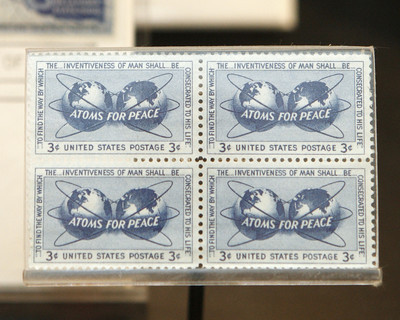
Lending dimension to the exhibit are pop-culture peeks at the era: toy ray guns, "atomic cocktails," the book "Tom Swift and his Atomic Earth Blaster," even a Peanuts strip with ol' Charlie Brown contemplating nuclear doom. Or zoom through the times via a video that pinballs from Hitchcock's "Notorious" to TV cigarette ads to "Abbott and Costello Meet Frankenstein."
"The museum wanted to place what happened at the site in a broader cultural context," Shubinski says. "When you look at it that way, it makes a lot more sense. Otherwise, it's just scientists sitting around blowing things up."
Rarely do museums make you want to both stand and look and duck and cover.
Contact reporter Steve Bornfeld at sbornfeld@reviewjournal.com or 702-383-0256.
ON THE WEB Slideshow what: Atomic Testing Museum when: 9 a.m.-5 p.m. Mondays-Saturdays, 1-5 p.m. Sundays where: 755 E. Flamingo Road tickets: $9-$12 (794-5161)