
NO KIDDING AROUND: State laws provide limited guidelines for children

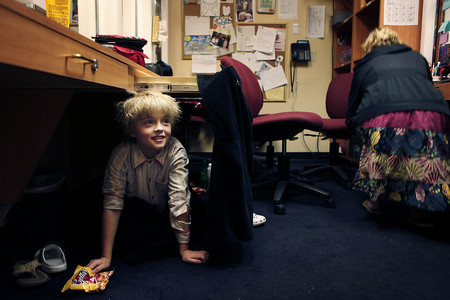
Mason Roberts, 9, and Dakotah Rhoades, 10, check the coast outside their cave. There are important matters to discuss, matters adults shouldn't overhear.
"You can't come in," Mason announces to this reporter.
Mason and Dakotah are among the six minors employed in "Love," the Beatles-inspired show by Cirque du Soleil at The Mirage (11 child performers work on the Strip in total). Their "cave" consists of a jacket draped over an open drawer beneath a backstage makeup table.
The "Love" kids appear to be living normal childhoods in competent hands. But that's little thanks to Nevada law, which is vague and could leave children vulnerable.
"There's just not a lot of guidelines for employment of minors in Nevada," says Mary Spees, human resources director for Cirque, which fills in many of the law's blanks to provide its kids with normalcy.
At 1 p.m. each weekday during the school year, Mason, Dakotah and the other "Kids From Liverpool" (Santino Cardinale, 10; Seth Wright, 11; Michael Artiga, 10; and Wally Zernich, 10) are taught the Clark County School District curriculum for three hours by a county-certified teacher in a classroom at Cirque's southwest headquarters.
This is not required by the school district, which is charged with ensuring that kids are educated but not required by law to monitor the quality of that education.
"We asked them to collaborate with us on the setup, because we wanted to make sure we did it all properly," says "Love" company manager Kathy Merachnik. "But they didn't seem interested."
According to Orval Nutting, private school consultant for the Nevada Department of Education, legal home schooling requires only that a parent or guardian file a notice of intent with the school district. For 15 years, this notice is good, and no tests are administered, no progress tracked, to challenge it.
"And they can't reject the notice," Nutting added. "If anyone said, 'What are you doing running around here skateboarding? -- they're good to go."
"The Lion King," which did not allow the Review-Journal to observe or question anyone involved in the performance for this article, provides no schooling to thespians Ruby E. Crawford, 12; Jade Milan, 11; D. Asante Ervin, 13; and Elijah Johnson, 11, explaining that education of the children is left to the discretion of their parents.
"Disney has the highest standards for education and encourages all of its juvenile actors to continue their schooling in a supportive environment," said "The Lion King" spokesman Dave Kirvin. "Disney takes every precaution to ensure that their learning is never disrupted, providing an incredible opportunity for both their future careers and personal growth."
A child actor also appears in "Steve Wyrick: Real Magic," but in a trick that its representatives thought would be compromised if they cooperated with the newspaper.
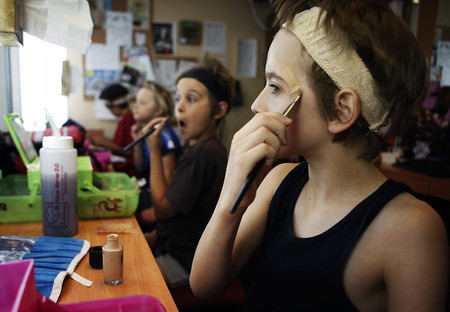
It's 6:30 p.m., airbrushing time at "Love." Santino and Dakotah must give up their grudge match of Sorry! and head into an adjacent hallway to have fake wounds sprayed onto their elbows and knees.
"Good," Santino says. "I won the last game, and now he's kicking my butt."
Before they enter the hallway, Susannah Denney checks the face makeup they applied themselves. Then she looks both ways for creepily attired acrobats on potential collision courses. Denney is the "responsible person" required by Nevada -- known in theater circles as a child wrangler -- to supervise pint-sized actors from 30 minutes before call time until their legal guardians pick them up (which, at "Love," is from 5:30 to 11:15 p.m.)
"All clear," Denney says.
A juvenile workday at "Love" is less than six hours, a week typically less than 24. (Each of the six kids rotates into four spots, working three or four nights per week.) Yet, according to Nevada law, actors younger than 16 can work as long as eight hours per day, 48 per week. While this is similar to the stricter California law, minors younger than 12 in the Golden State can work only between 7 a.m. and 7 p.m. on school days during the academic year, or 7 a.m. and 9 p.m. on summer break. (If "Love" were based in Los Angeles, its 9:30 p.m. show would be kidless.)
The Actors' Equity Collective Bargaining agreement -- followed by "The Lion King" but not "Love" -- forbids understudying or brush-up work more than once a week, and prohibits any that intrudes upon school. Kirvin said "The Lion King" also limits each of its juveniles to no more than four performances per week.
To employ someone younger than 14 in Nevada, special permission is required from a district judge. However, this is typically a formality in which a short document obtained at the self-help center of the Eighth Judicial District Court is filled out without any investigation. The child is not required to appear.
"It's very, very basic stuff," says Mark Harter, law clerk for Clark County District Judge William Voy. "It's usually no question the judge would even second guess signing something off."
Merachnik says her kids are in zero danger. They're strapped into harnesses at all times "and we have emergency procedures we go through with everybody."
What constitutes danger, however, is another area where Nevada law is limited and enforcement lax. Investigations as to dangerous work and other hardships are made primarily on a complaint basis.
"Unless it falls under one of the specific exemptions, it would be most likely based on some sort of complaint," says Nevada Deputy Labor Commissioner Keith Sakelhide. "Then we would investigate to determine whether that is a dangerous occupation or not."
"OK, ready guys?" Denney asks.
It's 6:40 p.m., time for the green room, where the Kids From Liverpool usually watch "SpongeBob SquarePants" and perform acting exercises before their first cues eight minutes into the show.
Dakotah gets an early lead on his colleagues by skipping down the hall.
"He knows he's not allowed to run," Denney explains.
Contact reporter Corey Levitan at clevitan@reviewjournal.com or 702-383-0456.