“Nine”

In the real world, nine is always greater than 81/2.
In the reel world, however, "Nine" turns out to be less -- waaaay less -- than "81/2."
Not that it qualifies as a surprise.
"Nine" may be a Tony-winning Broadway musical, but it's only a riff on its landmark source: director Federico Fellini's Oscar-winning 1963 classic, "81/2."
But not only is "Nine" not "81/2," it's not even "Chicago," director Rob Marshall's previous cinematic transfer of a standout Broadway musical.
"Chicago" won 2002's best picture Oscar. (Why, I'm still not sure -- but that's another debate for another time.) "Nine," however, is unlikely to make the Academy's expanded best picture chorus line of 10 nominees.
It's not just because "Chicago's" a vastly superior musical, with a far more interesting story and a classic score (by those wonderful folks who also brought you "Cabaret," Fred Kander and John Ebb).
No, it's also because "Nine's" musical numbers, entertaining as they may be individually, never manage to form a cohesive, compelling narrative whole.
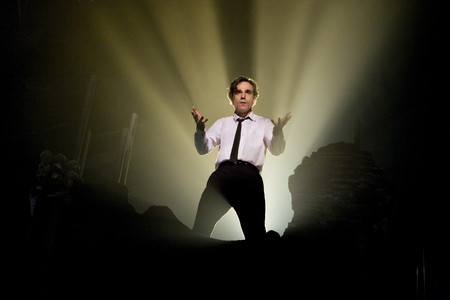
Then again, that almost makes sense -- considering that "Nine" concerns itself with the personal and professional tribulations of celebrated director Guido Contini (Daniel Day-Lewis).
Contini (rhymes with Fellini) happens to be the toast of 1960s cinema -- pursued by the press and paparazzi, besieged by eager audiences and associates, all of whom wonder what his next big-screen opus will be.
They're not the only ones.
Guido, you see, is in the grip of a major creative block, unable to conjure anything for his next production -- even though it's supposed to start shooting all too soon.
Besides, he's got other, more personal crises to face.
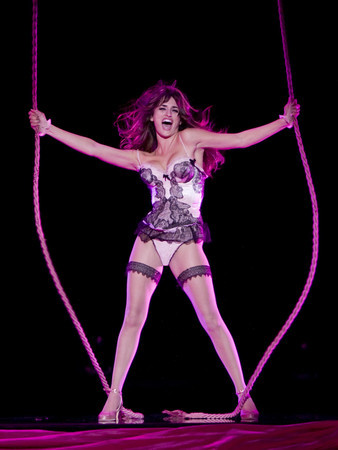
Especially his endless efforts to do right by his long-suffering actress wife Luisa (Marion Cotillard) while satisfying the demands of his needy mistress Carla (Penélope Cruz).
They're far from the only women in Guido's life, however.
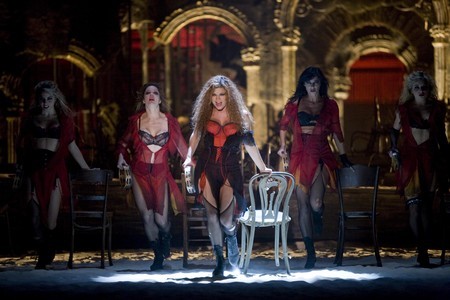
There's costume designer and confidante Lilli (a wry Judi Dench). International screen goddess Claudia (ethereal Nicole Kidman), his on-screen muse. Saucy fashion reporter Stephanie (a go-go Kate Hudson), who'd love to get up close and personal with "Cinema Italiano's" international style-setter. Not to mention childhood memories of two very different but equally influential women: his saintly mother (the legendary, forever regal Sophia Loren) and hometown tart Saraghina (a lusty, zesty Stacy "Fergie" Ferguson), who long ago showed young Guido and his pals exactly how to "Be Italian."
That adds up to six Oscar-winners in the starring cast (and seven Academy Awards -- Day-Lewis has two), plus a nominee in Hudson. (And let's not forget Fergie's Grammy Awards with the Black Eyed Peas.)
All that hardware, however, only highlights the gap between "Nine's" dynamite promise and its less-than-explosive execution.
The screenplay (credited to "The Player's" Michael Tolkin and the late Anthony Minghella, who won an Oscar for directing "The English Patient") sets the stage for a survey of Guido's circuslike life.
But "Nine" never addresses a vital issue: why we should care about the performer in the center ring, struggling to maintain his balance on the high-wire while juggling crises artistic and personal.
Director Marshall doesn't even try to deal with this structural problem.
He simply ignores it, hoping the numbers themselves will prove dazzling enough to overcome the problem.
Not quite.
Perhaps if composer Maury Yeston's songs (including three new ones written for the movie) provided as much character insight as they do chances for song-and-dance panache, "Nine" might have achieved genuine emotional impact.
Yet instead of moving the story forward, the numbers bring the movie to a dead halt every time the music cranks up. They're literal show-stoppers -- and definitely not in the standing-ovation sense.
As a result, much of "Nine" plays like a series of music videos -- more or less diverting individually, but incapable of adding up to much more.
Of "Nine's" starry sirens, all of whom look smashing, only Cotillard and Cruz convey any kind of depth along with the surface glitter.
Cruz augments her character's steamy sexual allure with crack comic timing and crazed yet undeniable vulnerability. And Cotillard displays a valiant, if increasingly world-weary, grace; when she finally calls Guido's bluff, it's as close as "Nine" ever gets to a transcendent emotional moment.
Maybe if Javier Bardem hadn't been too exhausted to play Guido, "Nine" might have had a charismatic, charming star capable of making us care as much about Guido as we do about the women whose hearts he breaks.
Sadly, Day-Lewis is not that star.
A marvelous actor, to be sure (I keep wondering what "Sherlock Holmes" would have been like if he had been cast in the title role), Day-Lewis ably captures Guido's restless lightning-in-a-bottle energy. But he never musters either the artistic vision or the gleeful passion that keeps Guido in the game -- and makes others want to keep playing, however grandiose or outlandish Guido's game might seem.
The same goes for "Nine" as a whole.
It looks great. (Alas, it never sounds quite as great as it looks.)
But if I have to choose between art direction and heart direction, I'll take the latter every time.
Contact movie critic Carol Cling at ccling@reviewjournal.com or 702-383-0272.
Carol Cling's Movie Minute
Review
"Nine"
118 minutes
PG-13; sexual situations, smoking
Grade: C
at multiple locations
Deja View
"Nine" -- inspired by Fellini's Oscar-winning "81/2" -- isn't the only Tony-winning Broadway musical based on a memorable movie. Five more memorable musical inspirations:
"Pygmalion" (1938) -- George Bernard Shaw won an Oscar for adapting his stage classic about a stuffy linguist (Leslie Howard) who teaches a cockney flower-seller (Wendy Hiller) proper speech; it later became the legendary "My Fair Lady."
"Smiles of a Summer Night" (1955) -- Ingmar Bergman explores the romantic games people play in a bittersweet comedy Stephen Sondheim later musicalized as "A Little Night Music."
"The Matchmaker" (1958) -- Shirley Booth takes on the title role in Thornton Wilder's tale of irrepressible Dolly Gallagher Levi, which became Jerry Herman's musical "Hello, Dolly!"
"The Producers" (1968) -- Mel Brooks won a screenplay Oscar for his zany tale of a has-been impresario (Zero Mostel) and a milquetoast accountant (Gene Wilder) who team up to produce a sure-fire Broadway flop; Brooks' 2001 musical version won a dozen Tonys.
"Hairspray" (1988) -- Cult auteur John Waters' hit satire, about an oversize Baltimore teen (Ricki Lake) who becomes a star on a local TV dance show in 1962, inspired a Tony-winning musical that in turn led to a 2007 movie version.
-- By CAROL CLING