

New exhibit looks at all those yucky things the human body does

Nothing against the Louvre, because the people who work there probably enjoy their jobs immensely.
But it's doubtful the Louvre ever mounted an exhibit that's quite as much fun as the one that's running through the summer at Lied Discovery Children's Museum.
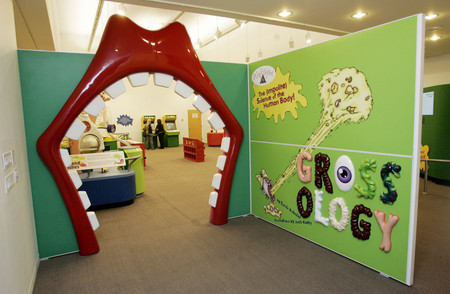
Its title: "Grossology: The (Impolite) Science of the Human Body," which explores the human body through its icky, yecchy functions that nobody is supposed to talk about in polite company.
Snot? Check. Flatulence? You betcha. Burps and urine? Yep, and double yep.
How much fun is it? So fun that Tifferney White, the museum's director of programs and education, and a reporter repeatedly break out in laughter while discussing it.
And that's the point, kind of: It's the forbidden nature of the things the exhibit explores that makes it so irresistible and so funny.
The exhibit's appeal, White says, is that "it allows you to talk about those things that are impolite, normally, to talk about, and it answers questions that people have but they're afraid to ask." "Normally, we don't talk about what happens in the human body and about body functions because it's not considered proper for us. But, for kids, this kind of makes it OK and allows them to talk openly about them." The exhibit is based on Sylvia Branzei-Velasquez's best-selling "Grossology" children's books. When the exhibit became available for Lied Discovery Children's Museum's summer slot -- it runs through Sept. 7 -- it seemed a perfect fit, White says.
First, it meshes perfectly with the museum's mission of hands-on learning. But, also, White says, the museum's attendance usually increases during the summer, when kids are out of school, families are visiting Las Vegas and parents are searching for something for the kids to do.
Because it is "such a popular exhibit," White says, "we wanted to take advantage of that and bring it in for summer."
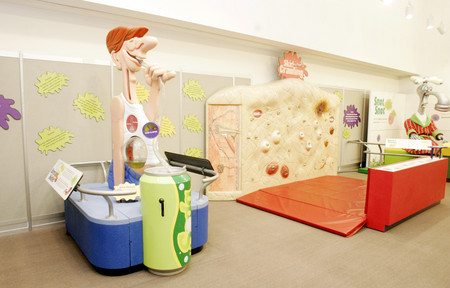
The exhibit features a display devoted to the human body and its smells, from armpit to feet to behind; a climbing wall of human skin equipped with everything from pimples to warts; and displays devoted to burps, urine, digestion and vomit.
In addition, White says, museum educators will augment the exhibit content with live demonstrations about, for example, the anatomy of the eyeball and other biology- and anatomy-related topics.
And, most of all, it's not just educational, but fun.
"It's hands-on fun. That's what it's all about," White says. "They get to have fun and play and, without even realizing it, they're learning about the human body."
In fact, that gives grown-ups a chance to enjoy it, too.
White has noticed that "little boys are all over it," while "girls are kind of slow to get in there. At some point they loosen up, but little boys are all over it."
But, White adds, "you see parents kind of standing back a little bit until they figure out what's going on."
Then, she says, "once they see that it's actually science that's being presented," they get into it, too.
"We need an excuse," White says, laughing. "We need somebody to say it's OK."
Contact reporter John Przybys at jprzybys@reviewjournal.com or 702-383-0280.
Preview
What: "Grossology: The (Impolite) Science of the Human Body"
Where: Lied Discovery Children's Museum, 833 Las Vegas Blvd. North
When: 10 a.m.-5 p.m. Monday through Saturday and noon-5 p.m. Sunday (through Sept. 7)
Admission: $7 for children ages 1 to 17, $8 for adults (382-3445)