
Multimedia show animates tale of Irish immigrant life

Emerald Isle, sparkling green.
Immigrant memories, vivid and keen.
"Ireland is a country full of remembering, whether it's politically or socially or domestically," says Timothy O'Grady. "One of the aspects of that is immigration, because it's a country that's so full of immigrants since the mid-19th century."
As author of "I Could Read the Sky" -- a "photographic novel"-turned-movie-turned multimedia production -- O'Grady will visit the University of Nevada, Las Vegas on Wednesday for a St. Patrick's Day presentation of words, music and photos derived from his novel of Irish experiences.
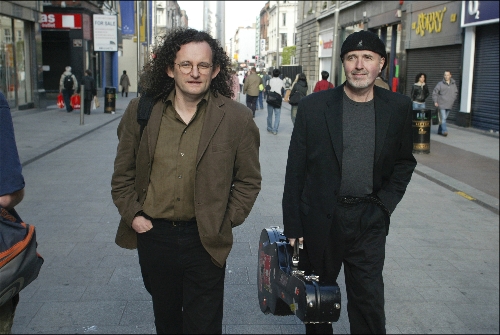
Passages read by O'Grady will be interspersed with images of Ireland from the collaborative novel taken by photographer Steven Pyke, as well as native tunes from fiddle-and-guitar duo Martin Hayes and Dennis Cahill, and vocalist Aine Meenaghan, who will sing songs in the original Irish. The program is a presentation of the Black Mountain Institute.
"Usually, I've thought that readings by writers were something to be endured," O'Grady says, "but this is something where the words are constantly broken up by something else for people to look at. I thought it was more interesting for people to see it than just listen to me."
Short bursts of O'Grady's prose accompanied by Pyke's evocative photos distinguish the original "I Could Read the Sky" book, which was adapted for the screen in 1999. Originally envisioned as nonfiction, O'Grady redirected it into a novel when he "caught this character and kept hearing his voice over and over." His protagonist, an elderly Irish laborer, winds up in England, where the postwar reconstruction of London and a promise of employment drew many Irish, who left their families and friends.
Through words and pictures, he shares memories of that exodus and its aftereffects -- broken families, vanishing relatives and immigrants who bonded over their common experiences.
"One of the things about immigration is that it's a great relief, a great joy of arrival," says fiddler Hayes. "But people forget, especially in economic conditions that forced people to leave against their will, the incredible loneliness of leaving home. There's a severing of people's lives, a lot of heartbreak as well."
Though characters are composites, O'Grady attempted to lend his novel the ring of authenticity via extensive reporting. "I started interviewing at Irish centers in London, and the images of their lives were so immediate and vivid that I thought fiction would be a much more tangible way of communicating that experience than me writing an analysis of them," says O'Grady, who also drew from his own travels and genealogy.
Raised in Chicago, O'Grady never met his grandfather, who, he says, was an earlier but similar type of immigrant as the character in his book. "He was dead before I was born, but I was the product of that," O'Grady says. "Then I moved to Ireland and I was living in London, where I was very much in an Irish world with people of all ages who were economic immigrants. I heard them play music in bars and heard their stories. I had a sense of who they were."
Pulling stories together from many Irish immigrants and fashioning them into "I Could Read the Sky," he adds, produced a book he's proud of because its impact extends beyond readers of literature. "Ordinary people would read it, because all these families have holes in their family life because someone has immigrated," O'Grady says. "Often these people are never heard from again, just swallowed up by England."
But with memories colored emerald green.
Contact reporter Steve Bornfeld at sbornfeld@ reviewjournal.com or 702-383-0256.
Preview
"I Could Read the Sky"
7 p.m. Wednesday
Doc Rando Recital Hall, University of Nevada, Las Vegas, 4505 S. Maryland Parkway
Free (895-5542)