Moral Quarrel

American Dream/Capitalist Nightmare.
How much moral compromise turns the former into the latter?
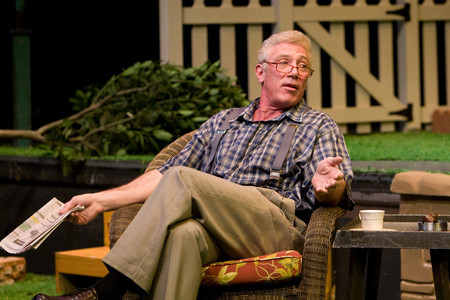
"The element of corruption and the greater good is what this morality play is about," says Steve Rapella, who stars as a businessman who betrays his countrymen in Arthur Miller's "All My Sons," opening tonight as staged by Nevada Conservatory Theatre at the University of Nevada, Las Vegas.
"Miller is making the point about man's place in society and his obligation to society above and beyond family."
Debuting in 1947 (and recently revived in New York with John Lithgow and Katie Holmes in her Broadway bow), "Sons" was Miller's first successful play -- he famously vowed to try another vocation if it didn't find an audience -- and centers around the Keller family, particularly patriarch Joe (Rapella).
During World War II, Keller, a manufacturer and otherwise decent man, allows cracked cylinder heads to be installed in military aircraft to meet a deadline for a lucrative government contract, resulting in the deaths of 21 pilots.
"I remember reading horrifying stories about Italian manufacturers sending their troops off with shoes with paper soles, which dissolved when they were sent to the Russian front," says Thomas Markus, this production's director.
Leapfrogging decades, charges were lobbed at the Bush administration that troops in Iraq and Afghanistan were underequipped. And any drama invoking war profiteering flashes "Halliburton" across theatergoers' minds.
"The number of targets large and small doing precisely what the character in this play does is significant," Markus says. "It's terrifyingly immediate."
Exonerated after dumping blame on his partner, who is subsequently convicted, Keller justifies himself by claiming he did it for his family. The moral consequences to him and his clan -- and on the wider society -- ripple powerfully through a classic piece highly regarded by critics, even if, in the words of one, it's "a melodrama mounted on a soapbox."
Reviewing an '80s revival, The New York Times' Mel Gussow called its themes "the struggle between fathers and sons," "the illusory American dream" and "the sacrifice of humanity brought about by 'doing business.' "
"All My Sons" was inspired by a true story of a child who informed on her father, who had sold defective equipment to the military. Its skeptical take on American values was a factor in Miller's summons before the infamous House Un-American Activities Committee during the "Red Scare." (The McCarthyism theme wound up central to Miller's 1953 parable, "The Crucible," about the Salem witch hunts.)
"I had the good fortune to meet him once at a bar, after we were both at a conference and he had given the keynote address," Markus says, recalling their hourlong chat. "I came away with an extraordinary appreciation for his terrific sense of humor, and also his fierce stance," Markus remembers.
Structurally, Rapella says, "All My Sons" respects ancient theatrical traditions. "It follows an Aristotelian feeling of time and place and events," Rapella says. "Three acts and a Greek type of tragic hero, as you have in Eddie Carbone in 'A View from the Bridge' and Willy Loman in 'Death of a Salesman.' "
Greek dramaturgy frequently cast these characters in situations where they commit an offense, often inadvertently, the consequences of which return to torment them, as they must learn from their misguided choice, and even die for moral justice to reign.
"Miller drew his style in this play from Ibsen, knowing Ibsen took it from Sophocles," Markus says. "Joe learns he's been morally deficient. (Miller's) making humanistic points, which have a political and moral underpinning to them."
Yet Miller refrains from painting an easily identifiable villain to illustrate those points. "It's evident from the way it's written that Miller likes Joe Keller, he finds him a sympathetic character," Markus says. "The power of the play is that the audience recognizes that we all make compromises we wish we didn't."
In "All My Sons," it's enough to turn the American dream into a capitalist nightmare.
And moral devastation.
Contact reporter Steve Bornfeld at sbornfeld@ reviewjournal.com or 702-383-0256.
Preview
"All My Sons"
8 p.m. today, Saturday and Thursday; 2 p.m. Sunday (through Feb. 7)
Judy Bayley Theatre, University of Nevada, Las Vegas, 4505 S. Maryland Parkway
$20-$30 (895-2787)