‘Medea’ tells tale of ticked-off mom

Mother of all unmotherly mothers?
We give you Medea.
"Why do you kill your kids? The answer is love, man."
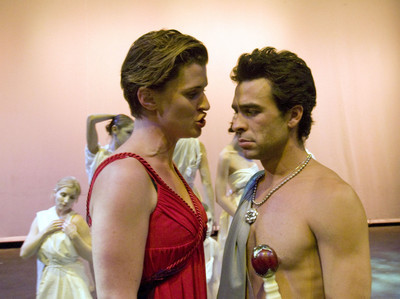
So says director John Beane of the horrific act committed -- as revenge against the man who betrays her -- by the marquee mama of "Medea," Insurgo Theater's latest production at the College of Southern Nevada.
"I think that's the delicious part of 'Medea.' It almost makes sense."
As penned by Euripides in Greece in 431 B.C., the classic about the mythical murderess seems now like an ancient antecedent to modern-day killer moms Susan Smith, Andrea Yates and Marybeth Tinning.
Based on the myth of Jason and Medea, the tragic drama revolves around her quest for vengeance when her husband leaves her to wed Glauce, the daughter of King Creon. As the play opens, Medea's elderly nurse fears what Medea -- a "barbarian woman" losing her beloved to a princess -- will do to herself or their children. When Jason suggests he'll merge both families and make Medea his mistress, she issues a chilling decree:
"Marry the maid if thou wilt; perchance full soon thou mayst rue thy nuptials."
Wielding a knife, she commits the gruesome act of a woman scorned.
"It is about the quintessence of love," says Natascha Negro, Medea's portrayer. "Looking into each other's eyes, leaving all the mundane concerns out and asking ourselves, 'What would I do for you? How far would I go for you? Could I still exist without you? Would I even kill for you?' "
Befitting Greek mythology, dragons, chariots, sorcery, poison, golden robes, the sun god Helios and the spirit of Zeus all drop in on the drama.
"It's a messed-up love story," says Beane, whose production includes brief nudity. "If you're into passionate love, that's the story we're telling. It deals with: 'How do I illustrate to my husband the atrocity that he's committed to me? How do I make him feel pain?' The story's actually about righteousness."
"Medea" is ripe for a range of interpretations. Analyzed for centuries by critics and historians, the title character -- who also offs her romantic rival and her royal papa -- has been hailed by some as a feminist heroine exacting justice in an unjust world. "She deserves that the audience is willing to go openminded on this journey with her," Negro says, "and then afterwards is free to form an opinion about her motivation."
Judged by contemporary morals, that characterization of a woman who commits infanticide may seem unconscionable -- "deranged" might better describe her in today's terms-- but some critiques point out she would be viewed differently by the standards of that time and culture.
"To fifth-century Athenian audiences, Medea's act would, under the circumstances make perfect sense," wrote critic Carole L. Hamilton in an essay on the play. "The significance of Medea's act would lie in the consequences to her society and the larger philosophical question, 'Is revenge effective?' (Greeks) thought of the individual not as a unique entity but as a component in the larger organism of society. ... Fate possesses Medea and it becomes Medea's fate to murder her own children."
In a final Grecian flip of the finger to the husband who unwisely traded up, Medea carries away the bodies of their children on a chariot drawn by dragons, denying Jason the chance to touch them one last time. Her parting shot: "I do not leave my children's bodies with thee. I take them with me that I may bury them in Hera's precinct. And for thee, who didst me all that evil, I prophesy an evil doom."
Though now considered one of Western civilizations great literary works, "Medea" was not embraced by audiences of the day. At the Dionysia play festival in 431 B.C., it was awarded a third-place prize, interpreted by some as a rejection of "Medea's" criticism of Athenian society and disrespect for the gods.
Since then, "Medea" has been reimagined by artists in forms stretching from an off-Broadway parody revue (including the segment, "Medea in Disneyland") to a dance retelling to a campy salute ("Medea the Musical") and numerous film/stage adaptations. In 1999, as part of three one-acts called "Bash," playwright Neil LaBute's version portrayed a girl seduced by her middle-school teacher. After he abandons her, she kills their child. Framed as stories about Mormon characters, "Bash" got LaBute thrown out of the Church of Latter-day Saints.
"Medea" also haunts the real-world realm, referenced in discussions of Smith, Yates and Tinning, all convicted of murdering their children with varied causes and motives, from appeasing a boyfriend (Smith) to postpartum depression (Yates) to Munchausen Syndrome (Tinning).
As the central act of vengeance that's never lost its power to unsettle audiences, Beane calls Medea's revenge, in the context of poisoned passion, "almost a poetic gesture. She kills her kids after (Jason's) done all this, it kind of makes sense," he says.
"Then we get to the actual act and it's never excusable."
Contact reporter Steve Bornfeld at sbornfeld@ reviewjournal.com or 702-383-0256.
Preview
"Medea"
7:30 p.m. today, Saturday, May 22-23, 28-30; 2 p.m. Sunday and May 24
BackStage Theatre, College of Southern Nevada, 3200 E. Cheyenne Ave. $10, $15 (651-5483)