Majesty and Memories

True West twofer, photographically speaking:
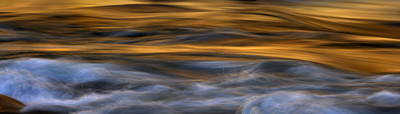
"It's such a special place," says photographer Geri Kodey, who snapped the sweeping, richly rustic images -- so akin to paintings you'll search for an artist's signature -- of the Colorado River from within the majestic Grand Canyon walls. "Many of these images were taken around dusk, so it was quiet time, and these are explorations of that time. You were in that space and in that moment. That's not a gift you get very often."
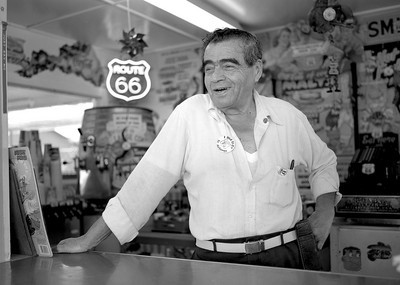
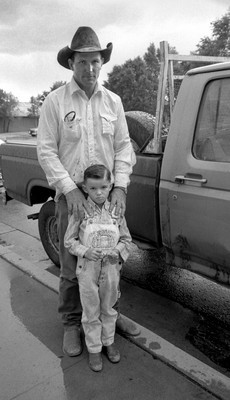
At the current gallery exhibit she shares with her husband, Wayne, at the University of Nevada, Las Vegas, her spouse's stark but warmly human black and white shots of stops along the storied Route 66 in Northern Arizona, with its depictions of dilapidated landscapes, provide an engaging counterpoint.
"I just like old buildings," Wayne Kodey says simply. "I just respond to them. I like the decaying. I just wanted to snap a moment in time before they decay even more."
Together, the duo's knack for detail comprise "Down the Colorado and Bypassed Byways," running through the summer at UNLV's Marjorie Barrick Museum.
Employing long exposures to create blurry motion images, Geri, UNLV's photo services manager, assembles a collection of photos taken during a river rafting expedition into the Grand Canyon on the Colorado River. "With the long exposure, there's this smokiness, this moodiness, with the movement of the water, and you begin to see the late evening light and the warmth that happens at dusk," she says. "Often with the colors, the sunset happening in those very closed walls makes it possible for those very orange and blue and yellow hues."
In "Ravens," Geri dramatically frames a pair of the birds comfortably perched on branches, gazing out at a vast expanse of blue-white sky. "Window," taken from inside a looming, curving black cliff in the south rim, captures the canyon in all its dizzying splendor. Sparkling-diamond currents, calm below imposing cliffs, distinguish "Lazy River." In an amusing departure, "Smiling Car" is an extreme close-up of a Chevy's front grille that resembles an auto version of Jaws smiling (just before Roy Scheider suggests a bigger boat).
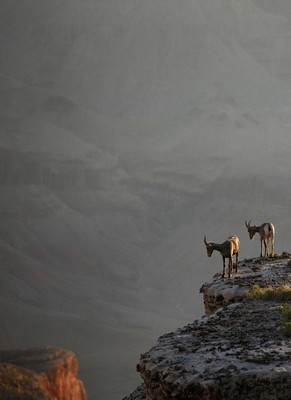
"Bighorn Sheep" depicts a pair looking down over a cliff on what seems like the edge of forever, a scene Geri and Wayne put to dual use. "That was our Christmas card," Wayne says. "You open the card and it looks like they're having a discussion and they say, 'Who pushed Rudolph?' "
Particularly striking are shots taken from towering Toroweap Overlook. "It's two hours of dirt after four hours of pavement, but it's the most majestic place to see the Grand Canyon, because it's 3,000 feet of sheer cliff straight down to the river below," Geri says. And in a touching photo, a woman and her elderly mother sit serenely on a boulder, looking up as if they could literally see the silence. "The woman had always dreamed of going to the canyon," Geri says. "She was not completely ambulatory, she walked with a cane, but it was such a special trip for them."
Turning toward a collection more bittersweet, Wayne, a retired Review-Journal photographer, has been canvassing the iconic Route 66 since the 1980s, capturing smaller moments of life along the highway celebrated in TV show and song as its fame faded. "People I talked to there can tell you exactly what they were doing when Interstate 40 opened. They said it was like somebody turned out the lights," Wayne says. "It was a much shorter, faster route, and the traffic stopped coming."
Intimate images as opposed to Geri's expansiveness, the photos burrow into the dusty backwaters of Arizona towns, from Seligman and Hackberry to Holbrook and Valentine. In "Kozy Corner," a tiki head totem fronts a quaint general store with '50s-style, trailer-park signs. "Joe and Aggie's Cafe" serves up Mexican-American food, but on this day, it's "closed, please call again." A rundown dance hall is the centerpiece of "Bert's Country Dancing" (that's Bert leaning against the entrance). A close-up of a pair of worn, chipped, metal chairs provokes an odd juxtaposition of feeling, both homey and uninviting.
An old car motors past "Supai Motel," its sign promising a vacancy and a "new color TV," while several Mayberry-like pictures depict barber Angel Delgadillo and his family, tending to customers in a shop likely anathema to the Super Cuts crowd. And the logo of a "Humdinger" malted is painted on a wall over a cracked, ceramic water fountain.
"You could make the road trip just for the milk shakes," says Geri, who contributed a few photos to the Route 66 collection.
Equal parts nostalgia and decay, the tone of the photos evokes not just a lost highway, but a lost piece of Americana. "But the characters are still there," Wayne says. "It's a slice of history preserved."
As much about state of mind as time and place, "Down the Colorado and Bypassed Byways" is a twofer tour of the true West.
Contact reporter Steve Bornfeld at sbornfeld @reviewjournal.com or 702-383-0256.
Preview
"Down the Colorado and Bypassed Byways"
8 a.m.-4:45 p.m. Mondays-Fridays; 10 a.m.-2 p.m. Saturdays (through Aug. 28)
Marjorie Barrick Museum
at the University of Nevada, Las Vegas, 4505 S. Maryland Parkway Free (895-3381)