Lied exhibit a spin through the science of rotation

Toss your kids in the spin cycle.
(Please tell us you didn't soak them in detergent. ... You didn't, did you?)
"You're learning about all kinds of forces, gravity, weight and inertia," says Tifferney White, deputy director of the Lied Discovery Children's Museum. "It's a little bit of physics, a little meteorology, a little earth science. It's some of the same concepts of astronauts, too, and how they move in space."
Scientific arcade. Educational playground. Junior astronaut training.
Pick your description of "Spin: The Science of Rotation," now amusing, entertaining and -- heaven forbid -- educating grade-school children at the museum's Cultural Gallery through mid-May.
"When we have school groups, kids are at every single exhibit, and when it's the weekends and we have families in with their children, they're doing exactly the same thing," White says. "They are having a ball."
Little Buckley Wood, at age 2 a compact bundle of unfocused energy, couldn't articulate it, but evidently agrees, darting between exhibits as his mom, Minnie, guides him through the maze of displays -- with titles such as Air Thrusters, Weighted Wheels, Fast Lane, Let It Roll, The Coriolis Effect, Spin Speed, Dynamic Dots, Racing Rollers and Human Centrifuge -- prodding him to take all of it in.
"I don't think he understands it all, but it doesn't matter," Wood says. "I think kids learn everything through playing. You get hands-on, you figure stuff out, you try it again."
Air puffing, water swirling, laser beams flashing, chairs bouncing -- all part of "Spin's" 15 exhibits that, as its subtitle declares, explores the science of rotation and the mysteries of weight, distance and motion.
Over at Air Thrusters, turn the handles above a circular platform to notice that escaping air exerts the most torque when the nozzles are farthest from the center. Two giant wheels are the attraction of Weighted Wheels, each saddled with 200 pounds of weights but differently distributed so, after giving each a spin, one is significantly easier to halt than the other.
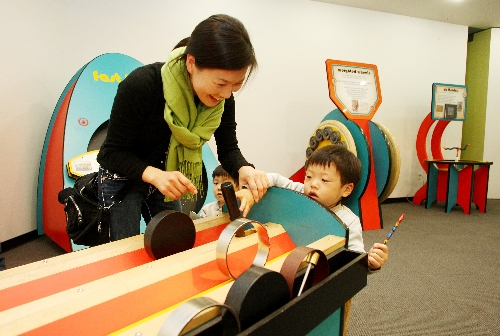
Try Let It Roll, a skee-ball-ish thingamabob (no, it doesn't spew out those arcade tickets for cheapie prizes) in which wheels made of varying materials are rolled to demonstrate rotational inertia: Which one gets to the bottom first? Which one swings back and forth the longest? Why are objects with the most weight and farthest from the center harder to get rolling and harder to stop?
"There was this little girl, a first-grader, and she was talking to her mom and telling her the science concept behind the exhibit," White recalls. "I was extremely impressed. This little girl was calling out science terms they typically don't know at this age, about forces and motion. Her teacher had taught them about it, and she was explaining how when you change the weight, you change whether it goes faster or slower. And Mom was listening to her."
Figure out the Coriolis Effect, in which one short and one long tube in a crisscrossing bar spews water into a receptacle, the curving of the object relative to the spinning, reflecting why hurricanes in the Northern Hemisphere rotate counterclockwise while those in the Southern Hemisphere go clockwise.
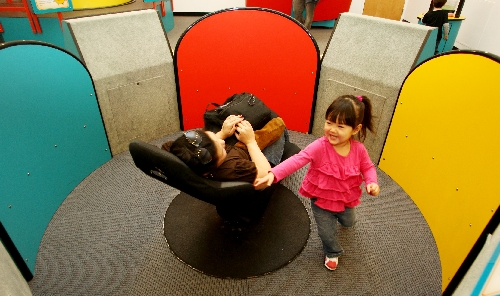
Have a seat in Spin Speed as someone gives you a spin. Pull your legs in, you spin faster. Stick them out like a figure skater showing off and you slow down, proving that changing your shape changes rotational inertia.
"Exhibits such as this need to have some visual appeal and be kinetic, particularly to the younger kids," says Tom Prendergast, exhibits director of the Catawba Science Center in Hickory, N.C., which developed "Spin" primarily for children ages 5-12.
" 'Spin' succeeds because the exhibits are very intuitive and very simple to use. You don't need to read a lot or have a strong base line of knowledge to engage with the exhibits and then walk away having learned something."
Wander over to Dynamic Dots, in which you rotate a handle and laser beam projections are made over a large, oval-shaped, two-level platform, showing that the longer the path of the dots, the faster they appear to move.
Race over to Racing Rollers, in which wheels are rolled up and down red, blue and yellow wooden tracks of differing widths. Mix and match sections of the tracks and discover that they keep changing the speed with which the wheel moves.
"We like to have them learn without them realizing that's what they're doing," White says. "If they feel like they're playing but they're learning in the meantime, then we've accomplished our goal."
Go ahead. Toss the little ones in the spin cycle.
Just keep 'em out of the dryer.
Contact reporter Steve Bornfeld at sbornfeld@ reviewjournal.com or 702-383-0256.
Preview
"Spin: The Science of Rotation"
9 a.m.-4 p.m. Tuesdays-Fridays, 10 a.m.-5 p.m. Saturdays, noon-5 p.m. Sundays (through May 15)
Lied Discovery Children's Museum, 833 Las Vegas Blvd. North
$8.50-$9.50 (382-3445; ldcm.org)