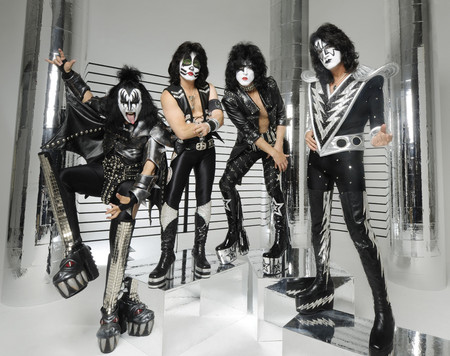
Kiss

When you're given the keys to the candy store, you tend to eat a lot of sweets.
It's a wonder, then, that Paul Stanley has any teeth left.
"What you conceive success to be and the perks of success don't come close to what it is in actuality, because you can only fantasize what's in your realm of possibility," the Kiss frontman says, occasionally pausing to chew on his words. "Anything that I thought fame was, it was that times a hundred. I'm sure that I may not have been the most easy person to deal with at certain times, but that's part of the learning curve."
Stanley's an interesting blend of hubris and humility. The dude has an ego of such girth, you could barely squeeze it into an airport hangar, and he's not shy about talking up his band in such radiant terms that his words practically glow in the dark.
"It doesn't get much better than this," he states matter of factly at one point. "I tend to tell people that all you need is money to have that Kiss show, but you can never be Kiss."
But Stanley's also a good-humored conversationalist and a die-hard populist, someone who's quick to acknowledge the role of others in his success. He's made millions catering to the masses, and he knows the value of giving people what they want.
And so he doesn't put on airs. Stanley's a stranger to artistic pretense, and while he'll laud the group that's made him famous, he doesn't shy away from pointing out their missteps, either, something with which a true egotist might struggle.
Case in point: When talk to turns to Kiss' spotty 1998 comeback effort, "Psycho Circus," to which the band recently issued its long awaited follow-up, Stanley reflects on the record with such distaste that he sounds as if he just swallowed a bug.
" 'Psycho Circus' was enough of a reason to never make another album -- and it was also enough of a reason to need to do another album," he says. "It was a really awful experience. It was trying to make a band album where there was no band. It was trying to create something that didn't exist. You can't make an album when you're spending more time communicating with attorneys than with the musicians. You can't make an album where people have unrealistic demands or ideas of what their contributions should be. Once you start to compromise and put songs on an album that don't belong, you leave off songs that do belong. So nobody wins."
In hindsight, it is hard to find much to like about the muddled "Circus," which saw Kiss try and make an album with original members Ace Frehley and Peter Criss, on guitar and drums, respectively, for the first time in years.
For the new disc "Sonic Boom," the band recorded with longtime drummer Eric Carr, who's been in the group for two decades, and guitarist Tommy Thayer, who's played with Kiss for seven years now.
According to Stanley, this led to a much more fruitful atmosphere in the studio.
"Everybody is so focused on a very different philosophy than it was at one point," he explains. "Whether it's with the album or the show, everybody here is always thinking, 'How can I make the band more famous?' In the past, it's been, 'How can the band make me more famous?' We don't need any of that. The idea of people having a birthright to songs being put on the album or demands of how many songs they should sing, there is no entitlement to those kind of things. Those are things you earn, and that was a problem in the past."
This more highly charged air is palpable on "Sonic Boom," Kiss' finest album in decades.
A loose, libidinal and off-the-cuff record, it's a disc of modern-day classic rock, recorded on tape, with a warm, unstudied feel. It's a lean sounding disc, bombastic but not overblown, alive with an abundance of hooks and hot talk.
Basically, it's the album Kiss die-hards have been waiting for.
"It was effortless and exciting," Stanley says of making the record. "We literally recorded it with all of us in the same room. There was one or two songs at the most where there was a third take. What are you going to get in your 10th take that you didn't get in your first?
"All the albums and all the music that we grew up loving was not made under a microscope or on a computer," he continues. "The things that we love about Zeppelin or The Beatles or James Brown was that there was a fire to it because it was live. It had a sense of vitality. And as the producer, that's what I wanted to capture. I wanted to capture what makes this band a living, breathing behemoth."
To this end, the record succeeds in loud, unabashed fashion. If they never make another album, "Sonic Boom" is a fittingly catchy and combustible coda. And who knows if this bunch ever will hit the studio again. They're currently on what Stanley says is their biggest, most successful tour ever, and there has been talk of the band eventually putting on a Vegas revue show.
"It really is something that's always in everybody's minds, whether or not we can do it the way that we would want to and if it ever comes to fruition, that's something that only time will tell," Stanley says of the potential for mounting such a production. "We're always interested in broadening what we do and the appeal of what we do."
In short, more is always more when it comes to this bunch. That's pretty much the same thing that defines this city. But if too much is never enough, you won't hear Stanley complain.
Excess is his operating principle.
"There's always more avenues," Stanley says. "If you don't wake up inspired every day, then you need to figure out what's wrong with your life. Every time you climb a mountain," he notes, "there should be another one next to it."
Contact reporter Jason Bracelin at jbracelin@ reviewjournal.com or 702-383-0476.
Preview
Kiss
8 p.m. Saturday
The Pearl at the Palms, 4321 W. Flamingo Road
$175-$275 (942-7777)