Horse of Pride

We've been through the desert on a horse with a name, it felt good to be out of ...
Oops. Sorry. Didn't know you were listening.
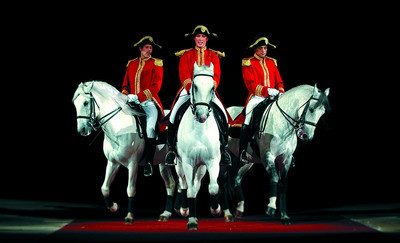
But those gorgeous, galloping stallions stride back to town this weekend, high-stepping to those highbrow tunes -- Mozart, Strauss and the boys. We thought we'd contemporize the soundtrack by a couple centuries by tweaking the 1972 radio hit, "A Horse with No Name" -- named Lipizzaners.
On reflection, perhaps it's better to leave their old-world aura intact.
"There's such a mystique about the Lipizzaner horses," says Gary Lashinsky, producer of the tour hoofing into the South Point Equestrian and Events Center. "There's only a few thousand in the world and they were preserved as living forms of equestrian art."
Horses are the noblest of beasts, and Lipizzaners perhaps the noblest breed, born of Austrian heritage and blessed with grace of movement arguably unparalleled in the animal kingdom.
"It's a simple form of entertainment but there's a connection to a peaceful place within us, it's almost transcendental," says Las Vegan Troy Tinker, host/narrator of the show whose white-coated cavalry was stationed at the Excalibur, complementing "The Tournament of Kings" in the mid-'90s. (Locally, Tinker also wrote, directed and starred in the dinner theater production "Ba-Da-Bing" and was featured at Caesars Magical Empire.)
"At the same time, it's that perfect partnership between horse and human and that's why people come back," Tinker says. "One of the biggest kicks for me is that people walk up to me after every show and say, 'I saw this as a child and I had to bring my kids to see it.' There's that connection of each generation experiencing it again."
The prancing princes -- compact, muscular and the animal embodiment of the word "distinguished" -- perform what Lashinsky describes with almost rhapsodic ardor as "an equine ballet."
In its 38th season, and with the addition of the Spanish Andalusian (the Lipizzaner's forefather), the show's been overhauled with new routines, one even choreographed to a big-band swing score -- well, that's a start toward musical modernity -- executing time-honed demonstrations from the Spanish Riding School of Vienna. Among them are highly controlled and stylized movements born of battlefield action, called "airs above the ground," including:
• The Levade: The horse raises both front legs, positioned at a 45-degree angle and stands on his powerful hind legs.
• The Courbette: The horse balances on its hind legs before jumping, his front legs off the ground and hind legs together as he hops.
• The Capriole: A jump in place as the stallion leaps into the air, tucks his front legs under himself and kicks out the hind legs while elevated.
• The Croupade: Similar to the Capriole, but with both front and hind legs tucked under during elevation.
And many more pirouettes and semiairborne maneuvers, all with froufrou French and Latin-sounding labels, because horses this exclusive can't merely trot and spin.
"It's not the circus, we're not teaching a bear to ride a bicycle, we're teaching them to do on cue what they already do naturally," says Tinker, while Lashinsky likens the process to preparing for a human art form of world renown.
"Training them is like training dancers for the Bolshoi, it takes years for our horses, as it does for dancers," Lashinsky says. "We don't even put a saddle on them until they're four years of age and we've got six to eight years invested in every horse, a lot of time and patience. We never push them, they go at their own speed. Plus, they've got a personality that's beyond most other (horses)."
Developed by the Austrian Habsburg monarchy and bred for battle starting in the 16th century -- Napoleon was rumored to have ridden one -- Lipizzaners were nearly extinct by the conclusion of World War II when Gen. Patton's troops rescued the balance of the breed.
"It intersects so many corners of history," Tinker says. "In battle, they really were the tanks of their day. And during peacetime, composers like Mozart would debut new pieces of music with the added visual of these horses doing steps and movements in time with it in grand style."
That historical highlight still influences this presentation. "We use pop-classical music that you'd expect to hear at the Spanish Riding School," Lashinsky says. "A lot of Beethoven, a lot of Strauss and Mozart, things the Boston Pops would play, very recognizable and very stirring music."
Lush and majestic? Unquestionably. But let's be musically modern about this. What else can we do to goose the score?
Actually ... nothing. We'd never debase ourselves by melodically suggesting that a horse is a horse, of course, especially one as regal and royal as the Lipizzaner.
Though this show is coming through the desert on a horse with that name.
Contact reporter Steve Bornfeld at sbornfeld@reviewjournal.com or 702-83-0256.
what: Lipizzaner Stallions when: 7:30 p.m. today, 2 and 7:30 p.m. Saturday, 2 and 6 p.m. Sunday where: South Point Equestrian and Events Center tickets: $29.50-$31.50 (797-8055)