Dropkick Murphys

They always end their shows in the most literal fashion, soaked in the sweat and sloshed brews of strangers, smelling like a bar fight incarnate.
Irish music-inflected Boston punks Dropkick Murphys fancy themselves a band of the people, and because of this, they finish all their gigs by inviting as much of the crowd onstage with them as will fit, until the band and their fans are indistinguishable from each other, one big blur of flesh and raised fists.
"If you really don't mind the fans and think that they have every right to be a part of the show and they're as important as the band, then let them all up onstage," singer/bassist Ken Casey says from his Boston home. "I think that's where a lot of the fans have said, 'Wow, these guys really don't think they're better than us. They let me come up and sing in the same mic as them and knock their stuff over and spill my beer on them.' "
The Dropkicks Murphys' everyman populism isn't an act.
Their former singer, Mike McColgan, left the band to become a firefighter full time, and none of these guys is a stranger to the nine to five, as many of them swung hammers for a living before the group eventually took off.
"For me and a lot of the early band members, we were just regular dudes working a job who stumbled into doing music," Casey says. "It was just supposed to be a joke and a hobby. It was definitely never a plan, like, 'Hey guys, let's be regular and approachable and blah, blah, blah.' It's just like, 'Why wouldn't we be?' We were working freakin' construction jobs and the next thing you know, we're getting the opportunity to go around the world and earn a living."
As such, there's a palpable blue collar vibe that's as inseparable a part of this band as the calluses on a factory worker's hands. Their songs are often posited on working class concerns, are steadfastly pro-union, and frequently sound like boisterous, raucous clarion calls for organized labor.
"Oh workers can you stand it? Oh tell me how you can? Will you be a lousy scab or will you be a man?" they sing on "Which Side Are You On" from their seminal 2001 disc "Sing Loud, Sing Proud." "Don't scab for the bosses, don't listen to their lies. Us poor folks haven't got a chance unless we organize."
Still, the Dropkicks are not a dogmatic bunch, and they're not out to turn their shows into political rallies.
"I barely got out of high school. I don't want to be that guy who's like, 'Now I have a mic, so I think I'm a political scientist,' " Casey says. "There's some people who come for the whole package, and they're into the message and what we're about. Then there's other people who are just like, 'It's got bagpipes and catchy songs and I want to get (expletive)-faced.' I don't care. If I'm talking to a kid after a show and he's saying, 'I love the lyrics from this song,' obviously, I prefer to talk to that kid. But if 50 people want to come out and get hammered and puke on themselves, they're welcome, too."
And that's the thing about the Dropkick's catalog, with their robust singalong choruses, heart-pounding bagpipes and punk rock vigor, the band's tunes are as party-friendly as they are political, grounded in Irish tradition, but also fashioning a new sound from old roots.
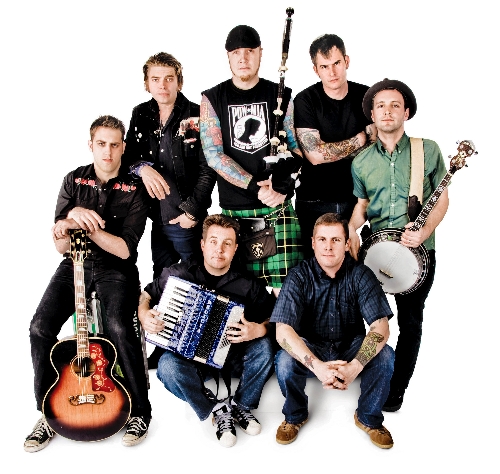
As the years have gone by, the band, now a seven-piece, has broadened their sound with an increased emphasis on mandolin, banjo, accordion and whistles, and they more frequently try their hands at the Irish songs of their youth, reworking numbers like "(F)lannigan's Ball," "Fairmount Hill" and "Johnny, I Hardly Knew Ya" on their most recent studio release, 2007's "The Meanest of Times."
"Growing up in a town like this, any family party or your friend's family parties, Irish music just seemed like the background track," Casey says. "You're growing up in neighborhoods where a lot of people's parents are from Ireland. You couldn't help but have that culture rub off on you."
As Casey alludes to, the Dropkicks have become indivisible from their hometown, as associated with Boston as the beloved Sox and late night tea parties. It's no surprise then, that they're a decidedly no-nonsense bunch, every bit as free of pretense as the city form which they hail.
"Coming from Boston, you'd better be an all-for-one, humble, team player and not seven rock stars in a band or you're going to get your lights punched out," Casey chuckles. "Most likely by one of my friends."
Contact reporter Jason Bracelin at jbracelin@ reviewjournal.com or 702-383-0476.
Preview
Dropkick Murphys
8 p.m. today
The Joint at the Hard Rock Hotel, 4455 Paradise Road
$28.50 (693-5066)