Drama in the Desert

Rivers and sewers flowing in the mountains.
Missouri and Paris tucked into Utah.
Simple deduction: "Big River" and "Les Miserables" at Broadway in the Desert.
"We do it in this natural setting, this outdoor amphitheater, and we utilize the mountains," says Scott Anderson, artistic director of the Tuacahn Center for the Arts in Ivins, Utah, where the annual Broadway in the Desert series plays on through October with the sprawling twin musicals.
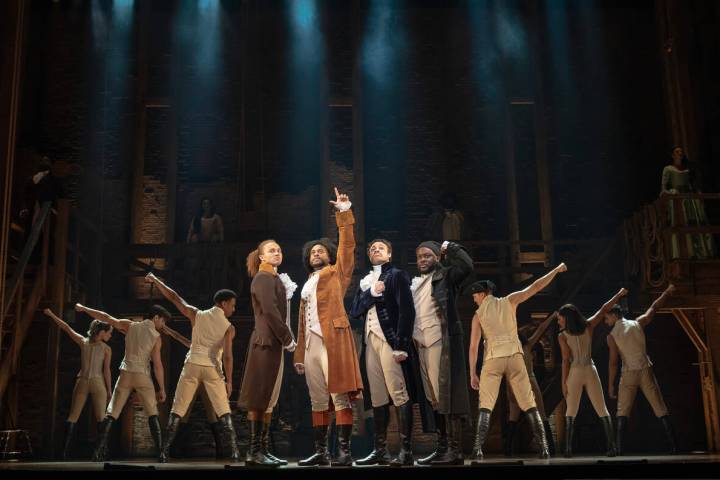
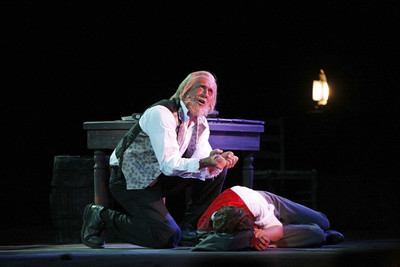
In "Big River," spunky, Missouri-bred Huck Finn finds adventure and moral awakening while rolling down the mighty Mississippi River, and beleaguered convict Jean Valjean flees from French gendarmes through Parisian sewers in "Les Miserables," with Anderson doubling as director of the latter, one of the most iconic, soul-stirring musicals ever produced.
"We actually see the battle take place in the rocks, where the French soldiers are attacking the rebels."
So ... "Les Miserables," if memory serves, is actually about Dr. Richard Kimble, wrongly convicted of murdering his wife, who escapes and is tracked by the dogged Lt. Gerard ... oops. Wrong man-on-the-run story. Try this: Unable to feed his poor family in 19th-century France, Jean Valjean swipes a loaf of bread, is imprisoned, attempts escape (four times), earns a harsher sentence, is paroled, can't find honest work, breaks parole, conceals his identity and is pursued by relentless bloodhound Inspector Javert.
With lots of other characters and subplots. And lots of commentary on good and evil, the law, French history, Paris architecture, religion, philosophy, morality, politics and love. And a student uprising that triggered the French Revolution. And lots of songs, including the rousing "Do You Hear the People Sing" and the jaunty (episode alert, "Seinfeld" fans) "Master of the House."
"The way I approached Jean Valjean is probably a lot different than many people have," says lead actor Timothy Warmen. "If someone has spent 19 years in a prison, it's a very specific wiring of your body over time. In the (Victor Hugo) book, it says he uses hatred as a weapon. Every time he meets somebody, he's not sure if he wants to snap their neck."
On that point, his director is in Parisian lock step. "Timothy plays Valjean with more heart and guts than I've ever seen anybody play it, because he doesn't become this merciful man overnight," says Anderson, who was mindful to prevent the gorgeous score from overwhelming the complex tale.
"I didn't want it to become just a concert where we have these amazing voices but there's no emotional underpinning. Some people come to a show because they just want to hear the music, they don't understand there's a real underlying theme, and this is good versus evil, but to my mind, it's really mercy versus justice."
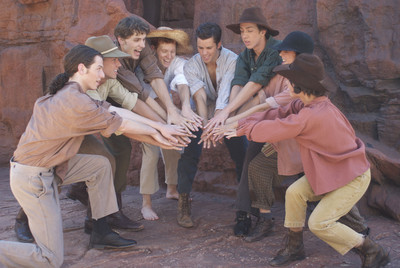
Similar themes flow through "Big River: The Adventures of Huckleberry Finn," the heartland musical based on Mark Twain's beloved characters of pure Americana, in which the irrepressible Huck helps his friend Jim, a slave, escape to the mouth of the Ohio River.
"Ernest Hemingway is quoted as having said, 'All modern American literature comes from one book by Mark Twain called "Huckleberry Finn," ' and I couldn't agree with him more," says "Big River" director Tim Threlfall. "We see Huck Finn come of age, and we see America come of age. Huck Finn is that Everyman who discovers that a black person is every bit as human as he is."
Set to an eclectic score including gospel, country and bluegrass tunes by the late "King of the Road," Roger Miller, "Big River's" big canvas also accommodates the novel's rich supporting characters -- Huck's BFF Tom Sawyer, the Widow Douglas, King and Duke and the lovely Mary Jane Wilkes, among others.
"I call it a hoedown with a heart," says Threlfall, who still had to cope with a sensitive issue confronted by all "Big River" productions: The N-word. The infamous epithet is written a whopping 215 times in Twain's classic book, and uttered 17 times in the musical. With 11 black performers, the director read the book "The Strange Career of a Troublesome Word," then sat his cast down to debate it.
"We had an extremely emotional experience with that conversation, and most of them said, 'You take the word out and I'm not going to be in the show,' " Threlfall says. "That startled me. They felt if you took that word out, you would be rewriting history ... and you'd take away the potency of it. The word is a slap in the face, and they said if you take it out, you cut the guts out of the piece."
Prior to each performance, a black cast member will address the audience on the show's use of the word.
Escaping slaves, fleeing convicts, ridin' down the river, sloshing through the sewers, true Americana and French revolutions. ... Plus the mountains of Utah.
Simple deduction: "Big River" and "Les Miserables" at Broadway in the Desert.
Contact reporter Steve Bornfeld at sbornfeld@reviewjournal.com or 702-383-0256.
PREVIEW
what: "Les Miserables"
when: 8:30 p.m. Saturday; 8 p.m. Tuesdays, Thursdays and Saturdays through Sept. 30; 7:30 p.m. Tuesdays, Thursdays and Saturdays Oct. 2-18
what: "Big River: The Adventures of Huckleberry Finn"
when: 8:30 p.m. today; 8 p.m. Mondays, Wednesdays and Fridays through Sept. 29; 7:30 p.m. Mondays, Wednesdays and Fridays Oct. 1-17
where: Tuacahn Amphitheatre and Center for the Arts, 1100 Tuacahn Drive, Ivins, Utah
tickets: $20-$56 (435-652-3300; 800-746-9882; www.tuacahn.org)