
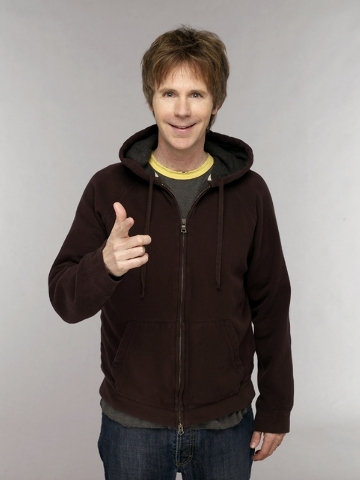
Does Dana Carvey regret turning down $50 million in Vegas?

Dana Carvey told me he turned down a $50 million offer to be a Vegas headliner about 14 years ago, and he has no regrets.
Carvey — who will do stand-up Friday and Saturday at the Orleans — wasn’t bragging. He was merely answering my questions about offers he’s had for Vegas residencies.
“I was offered the Rio when Danny Gans left, for $10 million a year, for five years,” Carvey said.
But the “Wayne’s World” and “SNL” actor worried the repetition of a nightly “paint-by-numbers” show here could have killed him.
The money held no allure.
“I live middle class. I shop at the Gap,” Carvey said. He’s happy “as long as I have health insurance, and running water that gets warm, dinner with my wife, and a maybe go for a hike.”
He joked if he had moved to Vegas, he could have ended up with a face-lift and “Arabian horses on a thousand acres.”
But Carvey enjoys playing Vegas every few months at the Orleans.
In fact, on Friday and Saturday, he will let one of his sons, Tom, do five minutes of stand-up as a celebration for turning 21.
Both of his sons do stand-up.
“They’re really good,” he said.
It’s rare for comics’ kids to go into comedy, because they know firsthand how much harder comedy is than, say, acting.
For instance, Gwenyth Paltrow, as a kid, may have been on set with her actor parents, thinking, “This looks cool, I’m going memorize lines.”
But comedians’ kids see their parents write their own material, perform jokes over and over in good and bad venues, driving across America, and they know comedians may not even be any good their first 10 years.
“I completely agree,” Carvey said about all that.
“You could take a 6-year-old actor who’s not even sure the cameras are rolling, and they might give the kid an Oscar,” Carvey said.
“But nobody could walk on and do an hour of stand-up” as an amateur.
Carvey said his sons have started the important bombing process, sharpening their comedy skills.
“Even though it’s nepotism, they’ve already bombed. They’ve been ritually humiliated, which is a part of those first few years,” Carvey said.
But Carvey said there is a way for young comics to avoid the humiliation of bombing in front of live audiences. And that method is for comics to do their comedy in online videos and bomb in front of computer audiences.
“There are these kids in their rooms, playing video games, and making jokes, and making money” with online advertising or other revenue streams, Carvey said.
In other words, billions of Earthlings can be in showbiz now. All they need to do is to start putting their own entertainment online.
“Conan (O’Brien) and I were having dinner,” Carvey said. “He said, ‘It’ll be like working for the Post Office, working in show business.’ And that’s fine. You can make $50,000 or $75,000” a year that way, Carvey said.
Carvey is blown away by the relatively cheap access to good equipment to become a do-it-yourself moviemaker.
He and one of his sons shot a short film with an affordable Canon camera, using natural light and a radio-frequency microphone.
When Carvey watched it, he couldn’t believe how the aesthetics looked.
“I was like, ‘Holy (expletive), this is like a David Lynch film.’”
“So the (technical) tools are really there. It’s almost immoral not to make a movie before you die, because you can rent the cameras.”
The downside to having all this access to technology is, Carvey feels guilty if he’s not using it to full advantage.
“I should be making a film right now,” Carvey said. “And why am I not writing a book that I release by myself? It can get you crazy, because there’s unlimited potential for anybody who wants to be an artist, good or bad.
“All of us have a responsibility to fight tomorrow-itis. Tomorrow-itis is like, ‘I’ll do that tomorrow,’ and it’s three decades later.”