COMING UP FROM THE STREETS

You can take Tony Curtis out of Hollywood.
You can take Bernie Schwartz off the streets of New York.
But you can't have one without the other -- because growing up as Bernie Schwartz has proven to be invaluable preparation for the role of Curtis' life: himself.
There have been other indelible Curtis portrayals, preserved forever thanks to the magic of the movies, from a running-for-his-life jazz musician masquerading as a member of an all-girl band in "Some Like It Hot" to a desperate press agent in "Sweet Smell of Success."
These days, the 83-year-old Curtis doesn't much resemble the Hollywood heartthrob he used to be.
A thin white fuzz is all that remains of the cascading dark curls that once set bobby-soxers swooning.
The muscular body that swashbuckled its way from medieval Persia ("Son of Ali Baba") to ninth-century Scandinavia ("The Vikings") has changed, too.
Curtis now walks with some difficulty, welcoming an arm to lean on as he precariously maintains his balance. Most of the time, it's easier for him to sit in a wheelchair -- or wheeled desk chair -- and scoot around.
It's a remnant of his late 2006 hospitalization for pneumonia and myriad complications (including a lengthy, drug-induced coma), which initially left him unable to walk -- or talk.
"My muscles forgot what they had to do," he recalls. "But I didn't want to think I'd be in a wheelchair all my life."
After all, he points out, "I'm a very physical fellow" -- and has been since his boyhood exploits leaping onto trolleys and taxicabs. After that, he says, "I learned to do all kinds of things -- fence, ride horses, kiss girls."
These days, Curtis' matinee-idol blue eyes still twinkle a made-for-Technicolor blue.
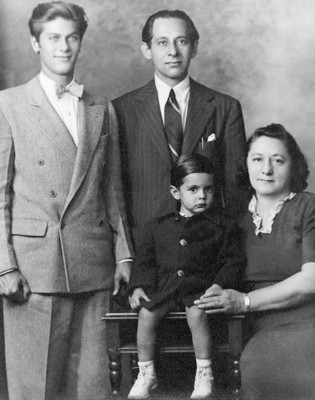
And his husky voice retains unmistakable traces of his New York hometown, where he grew up poor -- and tough -- as the son of a Jewish tailor from Hungary.
Scrappy Bernie Schwartz, whose "big hope, from the time I was bar mitzvahed" at 13, "was to be in the movies."
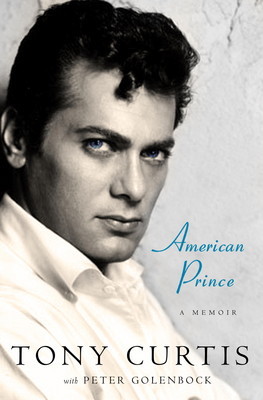
The New York-to-Hollywood journey proved a daunting one, as Curtis relates in "American Prince: A Memoir," which hit the best-seller lists when it was published last fall. (It's his second look backward; the first, "Tony Curtis: The Autobiography," appeared in 1993.)
"American Prince," written with co-writer Peter Golenbock, preserves Curtis' distinctive, up-from-the-streets voice.
"That was very important to me," Curtis says of "American Prince's" pull-no-punches style, noting that "on the first one, the guy who helped me write it (Barry Paris), he took it over in a way and kind of beautified it," he says. (Curtis pronounces "beautified" exactly the way a native New Yorker should: "beauty-fied.")
Working on the memoir, Curtis "didn't let go of it," he explains -- in part, because "I wanted to be very candid."
That he is, detailing everything from his bleak childhood to Hollywood adventures that didn't always have happy endings.
Curtis worked with movie legends from Marilyn Monroe (who was a pre-stardom lover, he writes) to his boyhood idol, Cary Grant. (In Curtis' living room, there's a photograph of Grant, with a hand-written message predicting "a long, happy and enduring" career for the young hopeful. Curtis got the picture at RKO Pictures' New York office: "Like the goniff I am," he says, using the Yiddish term for thief or scoundrel, "I took it off the walls -- and I ran.")
Despite his professional successes, multiple marriages -- and multiple affairs -- kept Curtis' private life in turmoil. He battled drug addiction, lost his son, Nicholas, to a heroin overdose, and alienated his other children (including actress Jamie Lee Curtis) with his desire for "a life of my own."
Now settled with Jill, his sixth wife (they celebrated their 10th anniversary last November), Curtis spent much of late 2008 publicizing "American Prince" in the United States and Europe.
He's still on the publicity trail, appearing everywhere from Los Angeles' Magic Castle to upcoming book-signings for a Red Hat Society chapter at Fitzgeralds and at Henderson's Sun City MacDonald Ranch. (You can find Curtis' schedule, blog and other information online at www.tonycurtis.com.)
"It's not that I forgot" what it's like to have fans, Curtis says of his personal appearances, but he enjoys the firsthand evidence that "they're glad to see me and glad that I'm feeling better."
Curtis would love to make more movies. (His most recent credits range from cameo appearances to commercials for the Clear Choice dental-implant firm.)
That's a long way from his first 1949 screen credits, when his bit roles included one as a bellboy in the Las Vegas-set "The Lady Gambles."
Despite "60 years under my belt" in show business, "I still feel like a kid," he says. "Except nobody's calling now."
Someday, "maybe one day, someone will ask me to go back to working in movies again," he muses. "Aw, that's just dreams," he admits, rolling his wheelchair closer to confide in his interviewer.
But Curtis isn't pining away waiting for the next phone call. Not his style.
Besides, he's too busy.
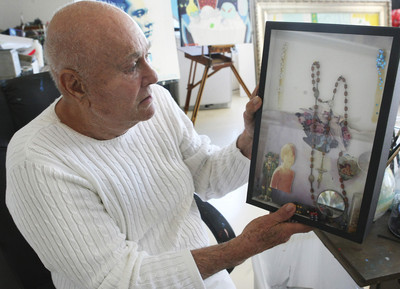
Curtis spends time every day in his studio, where he paints, draws and constructs fanciful boxes filled with found objects reminiscent of, and inspired by, the work of artist Joseph Cornell, whom Curtis met in the '60s. (Cornell used his mother's powder boxes; Curtis started with cigar boxes like the ones his father gave him when he was a kid, in which he used to store his boyhood treasures.)
The boxes Curtis has made for 40 years line shelves along his studio's walls, showcasing throwaway objects, from coins to cards to skate keys.
"I use objects to express my feeling," he says. "I make a collection of discarded things." (The boxes that contain those discarded things form another collection; he has kept all but one of the boxes, which will be the subject of a photo book he plans this year.)
Bound volumes contain Curtis' pencil drawings; canvases capture his exuberant painting technique.
And a new Web site, www.americanprince.net, features a wide array of Curtis' artworks; collectibles, from coffee mugs to signed portrait photos, will be available soon. (The proceeds will help support his and Jill's pet project, their 40-acre Sandy Valley ranch, Shiloh Horse Rescue.)
In Curtis' studio, prints featuring a photograph of the godlike young Curtis in profile (" 'The Gypsy Prince,' that's what I call that one") stand alongside posters from such big-screen hits as "Taras Bulba" and "The Great Race."
But there's also a framed black-and-white photograph, from long ago, focusing on two little boys in great big hats: Curtis' father and uncle, back when they were children in Hungary.
It's a reminder of who, and where, Curtis comes from -- and where at least part of him will always be.
As Curtis says in one of his Clear Choice commercials, "I'm still Tony Curtis." But he's still Bernie Schwartz, too -- and happy to be.
After decades of playing everybody from "Houdini" to "The Boston Strangler," Curtis revels in his current starring role.
"I'm a glorious person," he asserts. "I don't want to be anybody else."
Contact movie critic Carol Cling at ccling@reviewjournal.com or 702-383-0272.