‘Changeling’

If less is more, then it stands to reason that more is less.
For proof, check out director Clint Eastwood's latest, "Changeling."
A period melodrama that packs multiple movies into its two-hour-plus running time, "Changeling" proves unsettling indeed -- but not always in the ways it intends.
At its heart, "Changeling" focuses on every parent's most chilling nightmare: the disappearance of a child.
But, like a carnival spookhouse with twists and trap doors that lead to still more terrifying mazes, this particular nightmare keeps mutating, challenging us to hang on and wait for the end of the ride.
Eastwood eventually gets us there, of course; he's too skilled a filmmaker to do otherwise.
Before we finally see daylight, however, "Changeling" meanders down some awfully dark -- and awfully unfocused -- side tunnels.
It's "a true story," as it says in the beginning. (No wimpy "based on" or "inspired by" hedging here, no siree.) And truth, in this case, definitely proves more perplexing than fiction.
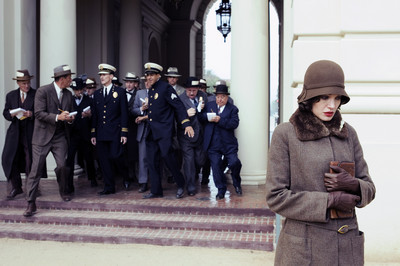
"Changeling" opens in 1928 Los Angeles, where plucky single mother Christine Collins (Angelina Jolie) and her 9-year-old son Walter (Gattlin Griffith) clamber aboard a "red car" trolley for their morning commute: Walter to school, Christine to her job as a telephone company supervisor.
Christine would love to spend every minute with her beloved boy, but one Saturday afternoon in March, a colleague calls in sick and Christine has to report to work and can't take Walter to the movies. Sure, he's disappointed, but he's not afraid of staying home alone, he reassures his mother. He's not afraid of anything.
Ah, but he will be.
So will Christine, when she returns home to find Walter missing -- and finds only indifference and arrogance when she reports his disappearance to the police.
But things can always get worse. And they do, even when, months later, the police inform her that Walter has been found, setting the stage for a grand reunion at the city's central railroad terminal.
A boy leaves the train, but -- despite official pronouncements to the contrary -- it's not Walter, Christine protests. After all, a mother ought to know her own child.
And she's determined to prove just that, no matter how many times the high-handed captain on the case (Jeffrey Donovan) insists otherwise.
Up to this point, "Changeling" seems headed down the quest-for-justice track, with Christine blowing the whistle on deplorable police department practices, egged on by a crusading Presbyterian minister (John Malkovich) who uses his regular radio broadcasts to denounce "the most violent, corrupt, incompetent police department this side of the Rocky Mountains."
The cops definitely demonstrate the violent, corrupt part -- especially when they try to stop Christine by throwing her into the city hospital's snake pit of a mental ward.
Meanwhile, back at the precinct, a dogged detective (Michael Kelly) gets a call to bring in a Canadian kid who's holed up at a rural chicken ranch -- a kid who, inevitably, will help unravel the mystery behind Walter Collins' fate.
But, alas, not before "Changeling" undergoes even more directional changes, taking us from that eerily isolated ranch to the halls of justice -- and beyond.
Every change of course takes "Changeling" further from its underlying premise -- and, in the process, further undercuts its dramatic power.
Screenwriter J. Michael Straczynski (TV's "Babylon 5") seems so chained to "Changeling's" convoluted story line that he all but ignores the characters undergoing the traumas thickening the plot.
Those narrative twists prove watchable, to be sure. But they lack the visceral impact they'd have if only "Changeling" emphasized the characters' emotions as well as the events they endure.
Add the sprawling script's stylistic shifts -- It's a mystery! Wait, it's a corrupt-cop thriller! No, it's a miscarriage-of-justice melodrama! Oh, it's a courtroom drama! -- and "Changeling" wrestles with even more questions of identity than its heroine.
Somewhere beneath all the blustery clutter lurks a classic Eastwood study of how easily evil worms its way into our lives -- and just how elusive justice can be. ("Unforgiven," anyone?)
A pity that Eastwood's far from his artistic peak here. Even when he can't be an artist, however, he's still a consummate craftsman, conjuring a persuasive period setting -- at least until his obvious, sore-thumb musical score kicks in.
Some of the movie's numerous overwrought performances prove equally distracting. Donovan might as well twirl a Snidely Whiplash moustache, so obvious is his villainy. Only the subtly compelling Kelly, as the one cop around who knows (and does) his duty, manages to transcend caricature to create a credible character.
Alas, the same cannot be said for Jolie. With her ruby-pillow lips, bobbed hair and close-fitting cloche hat, she looks as though she just stepped out of an Edward Hopper painting. She acts that way, too, delivering a flat performance that hits all the highs -- from anxiety to anguish to anger -- without much texture, dimension or shading.
It's exactly the kind of "look-at-me" performance that usually attracts Oscar attention, but Jolie's so busy playing her showy role she never disappears inside it.
If only she could have performed a disappearing act of her own, "Changeling" might have enabled us to experience her shock and sorrow. As it stands now, we can see her feelings -- but, somehow, we just can't share them.
Contact movie critic Carol Cling at ccling@reviewjournal.com or 702-383-0272.
REVIEW movie: "Changeling" running time: 140 minutes rating: R; violent and disturbing content, profanity verdict: B- now playing: Multiple locations DEJA VIEW Missing children -- and desperate searches -- inspire a wide variety of gripping tales: "Séance on a Wet Afternoon" (1964) -- A mentally unstable London psychic (Oscar nominee Kim Stanley) pressures her milquetoast husband (Richard Attenborough) to abduct a wealthy couple's child so she can prove her talents by "finding" the victim. "Bunny Lake Is Missing" (1965) -- An American (Carol Lynley) in London reports the disappearance of her young daughter, but the detective on the case (Laurence Olivier) can't find any evidence that the child ever existed. "Without a Trace" (1983) -- Kate Nelligan, Judd Hirsch and Stockard Channing headline this fact-based tale of a 6-year-old boy who vanishes on his way to school -- and his mother's determined efforts to find him. "Man on Fire" (2004) -- In Mexico City, an ex-CIA burnout (Denzel Washington) hires on as a bodyguard for a 9-year-old (Dakota Fanning), then goes on a vengeful rampage when she's kidnapped. "Gone Baby Gone" (2007) -- Ben Affleck returns to his native Boston for this directorial debut (starring brother Casey Affleck, Oscar nominee Amy Ryan, Ed Harris and Morgan Freeman) about a 4-year-old's kidnapping -- and its impact on her neighborhood.