BT

He chuckles heartily, a rolling thunder laugh, when recalling that as a kid, his parents might of thought him as a future incarnation of the Unabomber.
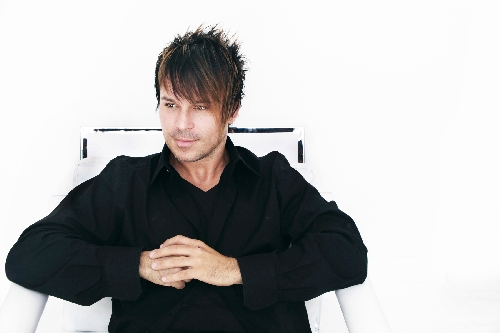
As a teenager, Brian Transeau, who would later become much better known as artist/producer/technologist BT, was a musical prodigy who had started playing piano at age 2 and who had two main interests: classical composition and electronics.
Basically, he was into math, music and building computers, which, in the early '80s, were an emerging technology with boulder-sized PCs.
"Parenting a kid like me was very difficult and challenging for my family, I'm sure," snickers Transeau. A fast talker, the dude is caffeine incarnate, with a voice that's a cannonball of enthusiasm. "I was a bright kid, I did well in school, but yet, all of my interests fell outside of the system. I was great at math, but I didn't want to sit there and do mathematics for no reason. I wanted to learn recursive mathematics because I wanted to apply it to programming. Everything that I was interested in was ahead of the curve enough for my parents to not see any career path out of it. They're like, 'Our son is going to live in a shack somewhere.' "
Well, not exactly.
Transeau would go on to become a platinum-selling artist, composer of film scores ("Monster," "Go," "The Fast and the Furious," to name a few) and music software designer with his own company, Sonik Architects.
He's built a career for himself by taking painstakingly constructed electronica -- often of a dreamy, majestic scope with cresting synth lines and massive crescendos -- assembled at an almost molecular level and then making it palatable to a broad audience.
One of his patented techniques is the stutter edit, which results in a fast flurry of sound, with Transeau actually making the Guinness Book of World Records for most vocal edits in a song: 6,178 for 2003's "Somnambulist."
On one hand, Transeau's a very studious, academic type, a classically trained musician who grew up studying the likes of Chopin and Wagner.
But his tastes are as populist as they are progressive, and he's careful not to let his background overwhelm his music.
As a music geek, he appreciates highly academic sounds -- just ask him for his thoughts on avant garde electronic composer Curtis Roads -- but he pointedly doesn't overindulge in them when constructing his own tunes.
"The things that really resonate with me, both in music and art, are often really, really simple things," Transeau says. "I can listen to a song by the Ramones and be so moved by this incredible, powerful, three-chord punk rock anthem.
"So, I'm never losing sight of that," he continues. "I think that, in a way, it's easier to go, 'Oh, let's make this super high-falutin' academic thing.' It becomes very elitist. You see that in whole subsets of electronic music. There's this badge of pride, 'We make something that you don't get, that only the three of us get.' Well, what's the point of that? That seems counterproductive to what the arts are about."
And so Transeau's material tends to work on two levels. There's an immediacy to his albums, where after one spin, plenty of bright hooks stand out. But throw on a pair of headphones, and some of the sonic detail that Transeau infuses into his repertoire becomes more readily apparent.
His latest release, the two-disc "These Hopeful Machines," is a melodically savvy collection that ranges from buoyant, anthemic pop to shoegazer-style guitar rock buffered with pulsating beats to more atmospheric soundscapes that are still tethered to a discernible song structure.
"That's the goal," Transeau says, to create "something that can be appreciated compositionally, like, 'Wow, I can feel this.' And then, upon further inspection, there's so much detail that there's a lot of different ways to appreciate it. Some of the music that I love is very heady, guys like (Hungarian composer Bela) Bartok. It's impenetrable in a way, and my hope is to write things that have a human counterpoint to that."
Before Transeau begins a new album, he writes a full-blown thesis paper, sometimes more than 100 pages long, which serves as a road map for what he wants to achieve with the project.
And yet, despite such elaborate origins, the music works on a basic, often radio-friendly level. Transeau's material may be rooted in the complex, but its appeal is always simple.
"I want something that engages people," he says, "but that makes them think, that pulls them in with their hearts, but makes them use their heads."
Contact reporter Jason Bracelin at jbracelin@ reviewjournal.com or 702-383-0476.
Preview
BT
11 p.m. Saturday
Rain at the Palms, 4321 W. Flamingo Road
$45.20 (940-7246)