Artists interpret fate of animals in ‘Unnatural History’ exhibit

Alive -- lolling about, gazing around, discovering a new environment -- they are perched contentedly on construction beams.
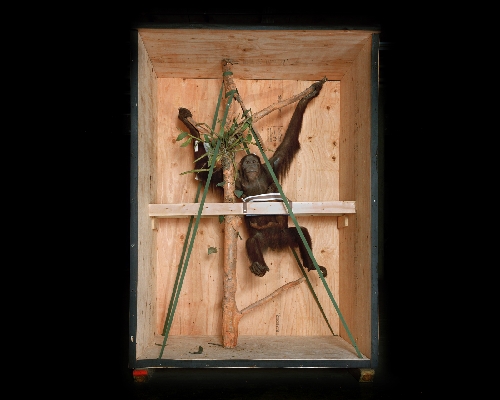
Dead -- but appearing alive, face frozen into a curious expression, hanging off a prop tree that resembles a crucifixion -- it is bolted snugly into a wooden crate.
Monkeys -- along with other species of land- and sea-based creatures -- meet contradictory fates in the dual artistry of "Unnatural History," on display through Sept. 12 in the Big Springs Gallery at Springs Preserve.
"It's the past and the future, how we treat wildlife, what we've done to them historically, what we're doing to them now and the potential future that could come of that," says Jessica Hougen, the gallery's assistant curator, about the split exhibit that features the images of photographer Richard Barnes lining one wall, the drawings of artist Don Simon gracing the other. Each approaches themes of humans and animals relating to each other and to the environment.
"We like to combine artists in ways that people in our local area haven't seen before," Hougen says. "It's more fun to incorporate various elements."
Dead monkey in the crate? That's the Barnes collection, assembled from years of the photographer's snapping images of dioramas under renovation in natural history museums, the simian straight from a storage facility at the Smithsonian.
"We go out and cull these animals from nature and bring them back to a museum then reanimate them to look as alive as they can when they're very much dead," Barnes says. "I have nothing against natural history museums, but in this critical time when we lose species daily, I want people to be aware of this strange way we have, trying to keep them alive in the context of a diorama."
Alive monkeys on the beams? That's the Simon collection, in which the artist suggests a post-mankind world -- perhaps after global warming or other catastrophes we're capable of bringing upon ourselves -- where animals have survived us, reclaiming landscapes, such as an empty construction site, its beams a new simian playground.
"I was thinking about replacing things that are native to these species' habitats with industrial things," Simon says. "It's almost as if they've been forced out of their ecosystem, so how do they replace that? Maybe it's scaffolding or a tower."
Animals dead but still strangely alive. Animals alive while we're all dead.
"They're both presenting animals in unnatural situations," Hougen says, "and asking you to take that a little further in evaluating what you're seeing."
Dissonance is central to Barnes' work. Nearly every photo of a diorama pictures the stuffed/taxidermied animals, some still sheathed in protective wrapping before the scene is arranged, sharing space with human workers building or cleaning the area. Creating a counterpart to the dead creatures they're attempting to display as alive, it's an almost theatrical tableau. "I'm interested in the theater, the idea of suspension of disbelief one has there," Barnes says. "That's what dioramas were originally conceived as."
Across the gallery, Simon's drawings of animals in a humanless world do not depict any intense, post-apocalyptic vision, but are almost soothing, life-after-us portraits. Giraffes roam through a wide, empty parking lot in one. Elsewhere, a triptych titled "After 1, 2 and 3" seems at first glance to picture a whale swimming, viewed from beneath the ocean. Closer examination reveals it is gliding over city skyscrapers submerged in water.
"That's Philadelphia, in the heart of the business district," Simon says. "I'm talking there about a possible future with the effects of climate change. I try to create images that are talking about ugly things, but are presented in a beautiful way aesthetically."
Duality defines "Unnatural History":
Life and death. Past and future. Them and us.
Contact reporter Steve Bornfeld at sbornfeld@ reviewjournal.com or 702-383-0256.
Preview
"Unnatural History" exhibit
"10 a.m.-6 p.m. daily (through Sept. 12)
"Springs Preserve's Big Springs Gallery, 333 S. Valley View Blvd.
"$4.95-$18.95 (822-7705; www.springspreserve.org)