Art-Felt Emotions

Hail the lone crusader, hell-bent to prevent -- with due respect to Bonnie Tyler's power ballad -- a total eclipse of the art.
"This is an opportunity to capture the audience that is still looking for art," says Michele Quinn, curatorial adviser of MGM Mirage, referring to the Bellagio Gallery of Fine Art, now the solo Strip sanctuary for the brushwork of the greats following the recent shutdown of The Venetian's Guggenheim Hermitage Museum after a seven-year stay.
"Las Vegas is still evolving culturally, it's just a matter of presentation and awareness and accessibility."
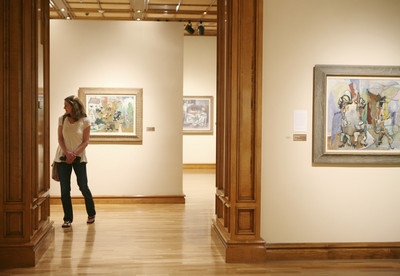
In that spirit, be aware that you have access to the presentation of the "American Modernism" exhibit at the gallery through the end of the year.
"It's raising the bar so we have to be that much more determined, because we are now the only museum on the Strip, the only educational opportunity," says gallery manager Tarissa Tiberti. "There's a lot more that we have to do, but it's pushing us to work harder. For people who want to do something different and love art, this is a great spot."
And it's where you can spot the work of such artists as Georgia O'Keeffe, Max Weber, Arshile Gorky, Marsden Hartley and Stuart Davis in the "American Modernism" showcase -- organized by Boston's Museum of Fine Arts -- celebrating 20th-century painters whose pinnacles were sandwiched between the two world wars.
"We wanted to start bridging into the next generation of artists," Quinn says. "We were recently showing Picasso and the early 20th-century work, so I thought it was a nice historical context to move toward the 1920s, '30s and '40s."
More than 30 pieces comprise "Modernism," culled from a period when artists such as O'Keeffe experimented with subjective approaches to still life and landscape paintings. O'Keeffe -- renowned for her visions of intimate flowers, stark desert landscapes and bleached white cow skulls -- has several representations in the exhibit. Framing her contributions are: Hartley's American folk art-inspired paintings; Leonard Maurer's nature-centric work; the personal interactions depicted by Weber; Helen Torr's gentle abstractions; Davis' lush take on the seaside beauty of Gloucester, Mass., where he would wander over rocks and docks in search of subjects to paint; and Gorky's dreamy, atmospheric creations.
"He's one of the more important European-American painters that came over during the war and used America as a refuge and created their career here," Quinn says of Gorky. "These are really important painters to know and understand. When you walk through the show, you see such phenomenal links to contemporary work."
Jay Hall Connaway, Arthur Garfield Dove, Hans Hofmann, Patrick Henry Bruce, Karl Knaths, Niles Spencer and Ralston Crawford also are featured in "American Modernism." It's part of an effort to enlarge the gallery's stylistic range of exhibits that might eventually include an abstract-expressionist presentation and a show that advances to 1960s and '70s paintings that, though very contemporary by art-world standards, would reflect trends now more than four decades old.
"It's a very different perception from the Guggenheim," Quinn says. "They were relying solely on their internal resources with their connection to the Hermitage, which is a phenomenal collection, obviously. But we have more flexibility to be expansive on what we want to do. We can do a photography show or even a fashion icon show. We want to see variety in a cultural context, trying to be open to a lot of different ideas."
Quinn hopes to mount an exhibit from the Museum of Contemporary Art in San Diego early next year, and challenges critics who would rate their collections as less than stellar. "There are criticisms out there -- 'Oh, you know, they're getting B-level work' -- but these museums have no interest in misrepresenting themselves at a lower level," she says.
"To those critics, I'd say, 'Well, are there better works?' Let's have a discourse rather than being confrontational and critical. How can you challenge the quality of these works? These are some of the best painters of our time, and you have to recognize the level of work and the respect these artists deserve in an art-historical context."
Critics aside, Quinn insists that for walk-in museum-goers, the experience is still a thrill, one that can't be matched by viewing the same works reproduced and reduced in an art book. "To stand in front of a great painting is so inspirational," Quinn says. "You get that gut reaction and love looking at the application of color and the composition."
Yes, the Guggenheim is gone, but the Bellagio Gallery of Fine Art goes on, and Tiberti seems confident that patrons will ensure it. "We're doing something different, so I think people will seek us out," Tiberti says. "And the artists speak for themselves."
Clearly, the Guggenheim's Las Vegas demise need not trigger a total eclipse of the art.
Contact reporter Steve Bornfeld at sbornfeld@reviewjournal.com or 702-383-0256.
what: "American Modernism"
when: 10 a.m.-9 p.m. Fridays and Saturdays; 10 a.m.-6 p.m. Sundays-Thursdays
where: Bellagio Gallery of Fine Art, 3600 Las Vegas Blvd. South
tickets: $10-$15 (693-7871)