A Blast of Beethoven

Quite a character, our Luddie B.
Maestro got a tad mad once and hurled a plate of food at a waiter's head. Apparently, Mr. Beethoven was underwhelmed by the level of service. (It might have been at a T.G.I. Friday's, though the historical record is unclear.)
Just some random revelations about the composer whose Ninth Symphony -- capped by the celebrated "Ode to Joy," based on Friedrich Schiller's poem -- provides the climax of the Las Vegas Philharmonic season Saturday at the University of Nevada, Las Vegas.
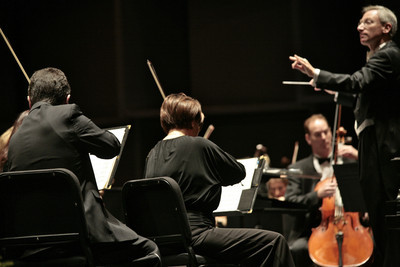
"Beethoven's Ninth is a big and glorious work and an uplifting statement," says Philharmonic music director/conductor David Itkin. "It's the way we want to end the season, particularly at a time when people are feeling scared and insecure. It speaks about the central oneness of human beings, a very important message right now."
• • •
Ludwig Lore: Born in Bonn, Germany, on Dec. 16, 1770, Beethoven lived in a room so cramped that a grown man could barely stand upright in it. ... Beethoven has an odd connection to "The Soup Nazi" on "Seinfeld." When his father caught him slacking off from practicing, he would bellow, "There will be no soup for you until you are finished." ... Mozart said of Beethoven: "Pay attention to this young man, he will make a noise in the world some day."
• • •
Considered a milestone of symphonic music, Beethoven's Ninth was created when the composer was completely deaf.
"I've been waiting much of my career to finally do a Beethoven's Ninth, even though I'm a mezzo and don't get the great part," says Juline Barol-Gilmore, one of several soloists, joining Veera Khare Asher, Mark Thomsen and Paul Rowe to perform alongside the Desert Chorale and the Las Vegas Master Singers. "I have the best seat in the house. I get to sit in front and just enjoy this wash of sound."
• • •
Ludwig Lore: Beethoven was a mac-and-cheese kind of guy. It was one of his favorite foods, along with fish, potatoes and bread pudding. ... His brusque manners tended to irritate his patrons. ... Staying at the palace of Prince and Princess Lichnowsky in Vienna, Beethoven disliked having to dress up for dinner and preferred to chow down at a nearby tavern.
• • •
"If I could fit more singers onstage, I would've recruited other choirs," Itkin says about ensuring the aural intensity of the piece, for which he already has enlisted around 200 vocalists. "I just did a performance of it with over 300 singers. It's exactly what this piece needs, this big force, because when the choir is singing, the orchestration is big and heroic and you need a big chorus to compete with them, to stand up to them."
• • •
Ludwig Lore: Beethoven was considered badly dressed and homely, but also noble and cultivated. ... If audience members gabbed during a performance, Beethoven would stop playing. ... As a conductor, Beethoven crouched during soft passages, rising during crescendos, then springing to his full height at the loudest sections before leaping into the air.
• • •
"Beethoven's vocal writing is unusual," Itkin says. "He writes for all the singers, chorale and soloists almost as though they were orchestral instruments, and his manner of shaping the vocal line is very unusual and difficult."
• • •
Ludwig Lore: Beethoven began to go deaf at age 28. ... Beethoven was said to frequently be in love, but most of his relationships with women were platonic. ... In 40 years, Beethoven moved more than 70 times.
• • •
"The soloists only appear at the end, we don't even enter the stage until the fourth movement," Barol-Gilmore says. "And as a mezzo voice, it's a challenge. It's quite low, and the soprano and the tenor cover the mezzo, so it's often joked that when you do Beethoven's Ninth, you almost look like you're lip-syncing."
• • •
Ludwig Lore: Beethoven drank extremely strong coffee -- 60 beans in every cup. ... To decompress, he'd retreat to the forest, select a tree where a forking branch would form a seat, and commune with nature for hours. ... Though he was described as having a radiant smile, he was also frequently gloomy.
• • •
"It's all sung text, but incredibly powerful, that German romantic poetry," Barol-Gilmore says about Schiller's poem, as "Ode to Joy," just like the symphony itself, is divided into four movements with rich vocal harmonies.
"I'm kind of a sucker for that. I find it incredibly moving and deep."
• • •
Ludwig Lore: Beethoven died on March 26, 1827. Approximately 20,000 people came to his grave.
• • •
"It's a lot of wonderful, spiritual material to absorb," Itkin says. "It's going to be a glorious end to our season."
(Note: Beethoven trivia drawn from classical-music-opera.com.)
Contact reporter Steve Bornfeld at sbornfeld@ reviewjournal.com or 702-383-0256.
Preview
Las Vegas Philharmonic: Beethoven's Ninth Symphony 8 p.m. Saturday
Artemus Ham Hall, University of Nevada, Las Vegas, 4505 S. Maryland Parkway
$25-$75 (895-2787)