Take a Flight Back in Time

"Hi, this is Gabe Kaplan. Did I ever tell you about my uncle Ernie? He didn't move to the right and got stampeded by a visiting Bulgarian polo team."
-- Moving walkway announcement, McCarran International Airport, 1981
Prep the rimshot:
"They've been flying for 60 years. Boy, are their arms tired."
Ba-da-bum! ... That groaner must have seemed fresh in 1948.
"By the end of the '50s, we were having a million people a year go through the airport," says Mark Hall-Patton, administrator of the Clark County Museum, hosting "How Time Flies: Sixty Years of McCarran International Airport," through November.
"You can't teach people often enough about their own history."
"This is Rip Taylor. I'm gonna smack you with confetti if you don't stand to the right. You're gonna fall, you klutz!"
A flyby of six decades of airport memorabilia and photos, the exhibit chronicles McCarran's growth that paralleled the rise of Las Vegas.
"Going through hundreds and hundreds of photographs, I wanted to just pick the ones that I really thought told the humanity of the airport," says Dawna Jolliff, curator of exhibits. "I grew up here and I remember going to the old field and standing by the fence and watching the planes come in. They were just fascinating to me."
Photos rewind time back to McCarran's predecessor, small airfield Alamo Airport, established in 1942 and operated by Davy Crockett descendant George Crockett. Prominently displayed is a bronze bust of airport namesake Sen. Patrick McCarran, whose efforts helped aviation take flight in Nevada and throughout the United States. Among those was his sponsorship of the Civil Aeronautics Act, under which an Air Safety Board was created, and the Civilian Pilot Training Act, preparing World War II flyboys.
Black and white shots recall a faraway age when people milled around on the tarmac to see off family members.
"This is Anthony Newley. Please stand to the right so people can pass on the left. If children get stuck in the middle, it takes hours to clean up the mess."
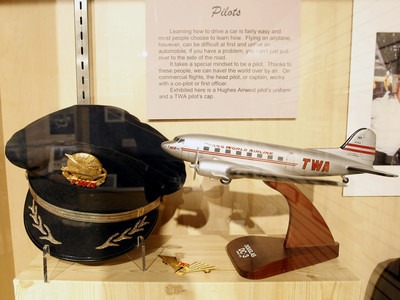
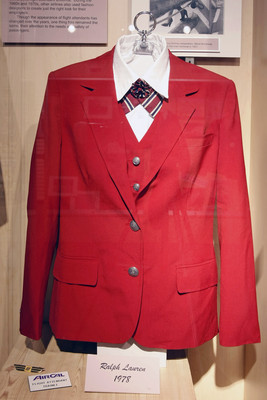
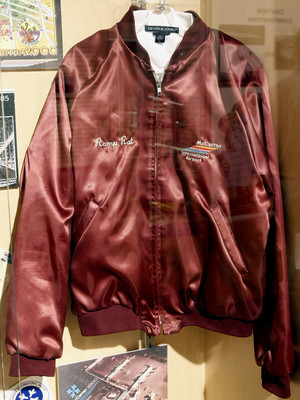
Artifacts include models of a 1955 Bonanza DC-3 and a 1965 TWA Convair 880, the colorfully named "ramp rat" jacket worn by tarmac workers, uniforms, passenger bags bearing logos of long-ago airlines, postcards depicting Vegas Vic straddling a plane, and metal palm trees that lend the airport a sleek, postmodern feel.
"It had to start growing right from the beginning," Hall-Patton says, reeling off expansions from the 1950s onward, culminating in the McCarran 2000 project. "Every time they estimate construction and how many people coming in, someone goes, 'Oh, that's just a white elephant, you're never going to meet that,' " Jolliff says. "With McCarran 2000, what they thought in terms of people coming through the airport happened by 1994."
By 1996, the annual tally hit 30 million, marking McCarran as the nation's 10th busiest airport. In 1997, traffic averaged 84,000 passengers daily.
"Hello rich and soon-to-be-rich people, this is Alice Cooper. Please stand to the right so people can pass on the left. If people are in a car, please move waaay to the right."
Consider some current travelers boarding planes with shorts and T-shirts bearing crude expressions, then gaze at photos of folks climbing aboard decked out in impeccable dress. "That's because flying was something special, not something you did every day," Hall-Patton says. "Not everybody could fly, it was expensive."
Commenting on overpacking air travelers, a mock sign suggests passengers not lug along more luggage than would have been loaded on the Titanic -- an unnerving analogy. And in an amusing nod to unamusing airport security post-9/11, Jolliff depicts items passing through a security scanner -- including shoes that must be shed before gaining entrance to the gates, and an antique trunk representing some of the ridiculously oversized belongings travelers tote around as carry-ons.
"That's why I put that funny thing at the end there," Jolliff says. "Just because it might go through there doesn't mean it will fit into the bins."
"This is Joan Rivers. When you get to the end of the walkway, get off! Don't just stand there like an idiot."
A greatest-hits compilation of celebrity advisories reminds people how to courteously conduct themselves on that moving walkway, laid out like some slow-rolling Disney World ride in the middle of the terminal.
"The moving walkway was a big deal when they put it in, and they actually had to explain to people what it was and how to use it," Jolliff says. "We went into the archives and there were all these cassette tapes they had recorded of celebrities that were so uniquely Las Vegas."
The roll call of famous voices includes Rich Little, Nipsey Russell, Mel Torme, Joey Heatherton, Debbie Reynolds, Don Rickles, Kenny Rogers, Dick Clark, Shecky Greene and Rodney Dangerfield -- even Elroy Jetson and Huckleberry Hound.
And as one celebrity reminds us, McCarran is not only a hub of air-traveling, but people-watching.
"Hi, I'm Soupy Sales. You're coming to the end of the walkway, so please watch your step. And watch that blonde on the left."
Contact reporter Steve Bornfeld at sbornfeld@reviewjournal.com or 702-383-0256.
PREVIEW what: "How Time Flies: Sixty Years of McCarran International Airport" when: 9 a.m.-4 p.m. daily where: Clark County Museum, 1830 S. Boulder Highway cost: $1.50 for adults, $1 for children (455-7955)

 Add as a preferred source on Google