
Planetarium offers otherworldly view

Space: The final fun-tier.
"We get everything from amateur astronomers and physics students -- you feel like you're preaching to the choir with them -- to people who aren't aware that the sun is a star and the planets go around the sun," says Bob Pippin, manager of the planetarium at the College of Southern Nevada's Cheyenne Avenue campus. "It's a part of science I love, helping the general public understand."
Haven't gazed upward toward the computer-generated heavens since high school? Perceptions of space -- new planets popping up on our galactic radar, star clusters swinging into our cosmic consciousness -- have likely evolved immensely since you were in class. Even if yours was the class of 2007.
"We've recently discovered over 300 planets around other stars," Pippin points out, "and we speculate that in our galaxy, there are literally millions and millions, maybe billions of planets around other stars."
CSN's digitally projected star trek is Southern Nevada's sole planetarium and one of only two statewide, the other housed at the University of Nevada, Reno.
Extensively used for lectures and classes for college students and schoolchildren, it's also open for public showings Fridays (6 and 7:30 p.m.) and Saturdays (3:30 and 7:30 p.m.). "Extreme Planets," a 40-minute presentation produced by the Clark Planetarium in Salt Lake City, Utah, is the main attraction, examining "extrasolar" planets -- those beyond our own solar system -- and exploring what might make a planet "Earth-like," touring water worlds, molten landscapes, inhabitable moons and planets with multiple suns.
"From the fifth grade on up, any of our shows work and keep the audience involved, whether children or adults," says Dale Etheridge, the planetarium's director. "Sometimes the youths get more out of it because they get more into it, they're less inhibited."
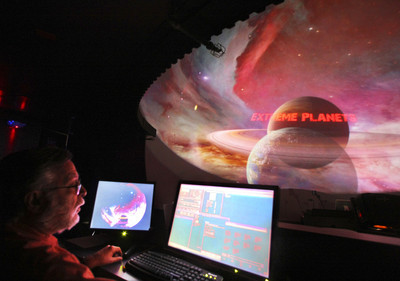
Seating 70 people staring up at a 30-foot dome, this space-o-rama launches an otherworldly experience. Swallowed up by the vast re-creation of the galaxy, "Extreme Planet" viewers -- those undaunted by brief bouts of dizziness from the swirling stars above -- can feel intimately thrust into the cosmic action as if gazing at passing planets and moons through the window of a spacecraft. Planets explode, chunks of ex-planet seemingly raining down on viewers, as a deep, authoritative voice intones: "We're still in the horse-and-buggy stage of space exploration."
"One of the things that really brought us a lot of people was when the designation of Pluto was changed from planet to dwarf planet," says Pippin, who exhibits no sense of a God complex as he plays puppeteer of the faux-universe, blithely rearranging sun, stars and moons via a computer command center. "One of the things that's most fulfilling to me is kids interested in any kind of science when they leave here," he says. "They don't necessarily want to make their living that way, but they do want to understand."
Planetary programs also include the 15-minute "Stargazing," a comprehensive constellation journey connecting the star-dots forming the Big/Little Dippers and other familiar forms in the sky. "Kids love it, big-time," says Pam Maher, NASA Nevada Educator Resource Center coordinator, who supports teachers in astronomy projects at the planetarium. "I'll show them stuff about Mars and I'll say, 'You guys have to know this stuff because you'll be going there.' They're like, 'Whoa!' They're really awed."
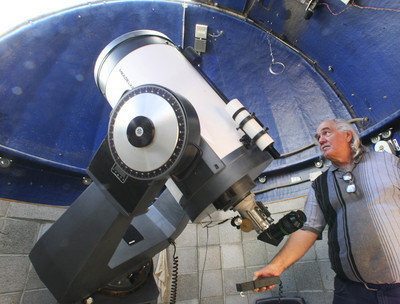
Another program geared toward kids, the animated "Mystery of the Missing Seasons," is also open to the public, and following 7:30 p.m. performances, patrons are invited, weather permitting, out to the student observatory to peer through telescopes for glimpses of a few heavenly bodies.
"We get new shows quite frequently," Pippin says. "One thing about astronomy is that it constantly changes."
They're keepin' current on the cosmos in this playground of the planets.
Contact reporter Steve Bornfeld at sbornfeld@reviewjournal.com or 702-383-0256.
PREVIEW
what: College of Southern Nevada Planetarium, featuring "Extreme Planets," "Stargazing" and "Mystery of the Missing Seasons"
when: 6 and 7:30 p.m. Fridays; 3:30 and 7:30 p.m. Saturdays
where: CSN Cheyenne campus, 3200 E. Cheyenne Ave.
tickets: $6 general admission; $4 for children, seniors and CSN students (651-4759)

 Add as a preferred source on Google