Greed: The Musical

Recessionary revenge fantasies:
Cast that Madoff clown in a remake of "Weekend at Bernie's" -- the one where the title character's a corpse. Turn a top insurance exec's acronym from AIG to R.I.P. Order an auto industry suit to work as a crash-test dummy. Deposit a banker -- with a shovel -- in a remote, desert branch.
Or rewind 72 years to realize that corporate overlords -- in this instance, the imperiously named "Mr. Mister" -- are an eternal pestilence in "The Cradle Will Rock."
"It's extremely timely," says director Robert Benedetti. "We're as close today to what was going on in 1937 as we've ever been in our history."
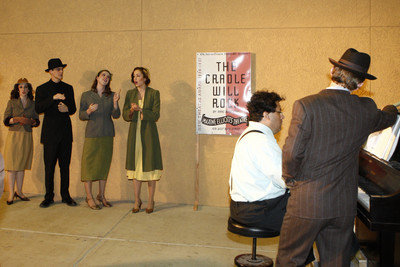
A dissonant, impressionistic "labor opera" with a past as political as it is theatrical, "Cradle" entertains audiences indoors and outdoors as Nevada Conservatory Theatre's latest production at the University of Nevada, Las Vegas.
An allegory of corporate greed versus the blue-collar masses, this working-class manifesto by Marc Blitzstein is set in Steeltown and doesn't sweat over subtlety. (In addition to wicked boss Mr. Mister, characters include union organizer Larry Foreman and the Rev. Salvation.) Foreman battles Mister to unionize workers, surrounded by societal types, including poor shopkeepers, immigrant families and a prostitute.
Benedetti's conception commences with a prologue outside the Ham Fine Arts Building, echoing the hubbub over the original's debut by director Orson Welles and producer John Houseman
A production of the Federal Theatre Project, "Cradle" dovetailed with a growing union movement that triggered violent confrontations between management and labor, including auto, metal and textile workers. The scheduled opening was shut down by "budget cuts," widely considered an excuse to silence a perceived pro-communist screed.
The theater was padlocked and guarded by armed soldiers to prevent theft of props or costumes claimed as government property (including the toupee of lead actor/ex-steelworker Howard Da Silva). Theatergoers were entertained outside until Welles and Houseman quickly found and rented another venue, leading the audience on a 20-block march to the new site.
"I want to re-create that night," Benedetti says. "We have a bunch of Woody Guthrie and labor songs from 1937. Finally (actors as) Welles and Houseman announce they've found a theater and the audience walks, symbolically, around the back and enters through the loading dock." (People preferring to pass on the prologue can proceed directly inside.)
Minus props, sets and costumes at the new ad hoc digs in 1937, pianist Blitzstein planned to perform the piece solo, but actors rose from the audience to sing their lines as a defiant act of free speech, a stirring scene often incorporated into productions -- including UNLV's -- around a spare stage, with a single piano.
Its pro-union theme seems especially relevant now.
"There's the recent bill (the Employee Free Choice Act) being debated in Congress, which would make it easier to unionize," Benedetti says. "We have, since the Reagan era, seen a tremendous decline in union power. The Obama administration is trying to make it easier to unionize."
Highly stylized and somewhat jarring, "Cradle" -- an intermissionless 75 minutes -- challenges both performers and audience, the story mostly sung but with dialogue delivered arrhythmically. Operatically conceived, it's rife with grand declarations, actors striking exaggerated poses, lines spoken as if punctuated by exclamation marks.
"It's solid music, very dense, not tap-your-foot music," Benedetti says. "It has a dissonance tonally that makes it a disturbing piece, on purpose, expressing the tension in society then. The writer closest to it now is Stephen Sondheim."
Ensemble member Griffin Stanton-Ameisen calls the experience "daunting" -- and worth the effort to tackle such a politically charged polemic. "When things were good about 10 years ago, it would have been more difficult to do this," he says, "but given the state of things now, people should see a connection immediately."
Portraying the boss's nasty but outwardly philanthropic wife -- yes, she's Mrs. Mister -- Christina Wells adopted a surprising approach. "It's intriguing to look at it from the other side," Wells says. "They represent an entire town and are the reasons we have jobs. For us workers trying to survive, we have a simple view, but when you have a corporation on your shoulders, you think, 'If I could make this one (foreman) behave, everybody else can have their jobs.' "
Mr. Mister in 1937.
Mr. Banker Bigwig, Mr. Auto Executive, Mr. Insurance Honcho -- or Ms., to be gender-equal -- in 2009.
A Depression-era allegory for recessionary times, "The Cradle Will Rock" is as old as ancient history and as fresh as tomorrow's news.
Contact reporter Steve Bornfeld at sbornfeld@ reviewjournal.com or 702-383-0256.
Preview
"The Cradle Will Rock"
8 p.m. today, Saturday, Wednesday and Thursday; 2 p.m. Saturday and Sunday (through March 29)
Black Box Theatre, University of Nevada, Las Vegas,
4505 S. Maryland Parkway
$20-$30 (895-2787)