THE HUMAN EXPERIENCE

There's no place like home.
And this year, the Las Vegas Jewish Film Festival has one. Make that three.
After wandering among venues last year, the eighth annual festival -- which opens Saturday night -- settles into the new performing arts center at the Dr. Miriam and Sheldon Adelson Educational Campus in Summerlin.
With a 375-seat, stadium-style auditorium, "there's not a bad seat in the house," says Joshua Abbey, the festival's founder and managing director.
All but three of the festival's 13 titles -- "I should have stuck with 12 tribes, but the 13th one snuck in there," Abbey jokes -- will be shown in the Adelson auditorium.
Cinemark Theatres' Century 16 multiplex at the South Point will host two festival screenings; downtown's historic Fifth Street School rounds out the festival venues.
But a Vegas connection also characterizes one of the festival's opening-weekend attractions.
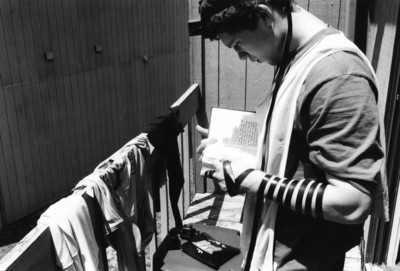
"Orthodox Stance," which shows at 7 p.m. Sunday, focuses on boxer Dmitriy Salita, a Russian immigrant -- and devout Orthodox Jew -- who began his professional fight career with Las Vegas-based promoter Bob Arum of Top Rank Boxing.
Both Salita and Arum plan to attend Sunday night's screening, to be moderated by another Southern Nevadan who appears in "Orthodox Stance," Rabbi Shea Harlig of Chabad of Southern Nevada.
The documentary's director, Jason Hutt, filmed the Las Vegas portions in late 2002, when Salita "turned pro" and made "what turned out to be his first nationally televised fight" in Las Vegas, Hutt notes.
Part of the Las Vegas segment shows Salita's manager, also an Orthodox Jew, preparing the fighter's Mandalay Bay hotel room for the Sabbath, following prohibitions against work by "taping the door jamb" so the occupants won't need to use the electronic key -- and wrapping kosher food delivered to the room in a blanket to keep it warm.
Those are specifically Jewish elements, but "so much of the humor and experience is universal," Hutt says, noting that his documentary has played in Jewish film festivals -- and on television from the BBC to New York's sports-oriented MSG cable network. "It definitely is accessible to all types," he says, "young and old, male and female, Jew and non-Jew."
And that holds true for all of the movies featured at the festival, Abbey maintains.
"Fundamentally, the Jewish Film Festival could be called the Human Film Festival," he observes, "because the ambition and conflicts portrayed onscreen are universal in nature."
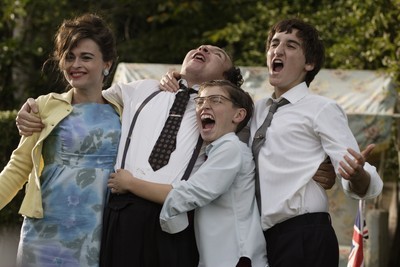
The festival's 13-title lineup covers a wide spectrum of Jewish experience, ranging from accounts of Holocaust heroism ("Blessed is the Match," "Nina's Journey") to comedies focusing on key rituals ("Sixty Six," in which a World Cup final conflicts with a London lad's bar mitzvah, and a dysfunctional family observing a seven-day mourning period in "Mexican Shivah").
Cross-cultural relationships also surface in several selections, including an Israeli-Palestinian romance ("Strangers") and the comedy-drama "Arranged," about the friendship between two Brooklyn teachers -- one an Orthodox Jew, the other a Muslim -- facing arranged marriages.
Such "sweet and positive" movies "about the potential of intercultural" rapport present "a message that's very pertinent right now," Abbey says.
In addition to "Orthodox Stance," the festival's documentary lineup features "Making Trouble" (about Jewish women of comedy, from Fanny Brice to Gilda Radner), "Praying With Lior" (which focuses on a rabbi's son with Down syndrome preparing for his bar mitzvah), "Lonely Man of Faith" (about a legendary rabbi) and "Refusenik" (which recounts the three-decade fight to free Soviet Jews).
As a guideline for choosing the festival selections, Abbey explains, "I simply gravitate to stories that search for truth and touch the heart."
And, lest we forget, home is where the heart is.
Contact movie critic Carol Cling at ccling@reviewjournal.com or 702-383-0272.

 Add as a preferred source on Google