
Resurgence of 3-D gives filmmakers powerful storytelling tool

These days, most people don't drive chrome-encrusted cars with sharp, jutting tail fins.
They don't wear saddle shoes and bobby sox. They don't dance the jitterbug to jukebox rock 'n' roll.
But there's one 1950s relic making a definite comeback these days: 3-D movies.
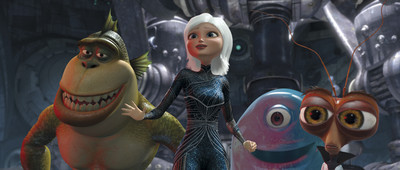
And it's not just for monster movies anymore, despite the fact that the March release of the animated "Monsters vs. Aliens" kicked off a 3-D movie boom that shows no signs of abating.
From now through the end of 2009, 10 movies, animated and live-action, are scheduled to hit theaters in 3-D form.
Two of them already are proven favorites: 3-D reconfigurations of the animated Pixar hits "Toy Story" and "Toy Story 2."
The others range from new animated features (led by Friday's sci-fi "Battle for Terra" and Disney/Pixar's "Up") to the return of "Titanic" director James Cameron with the sci-fi adventure "Avatar."
In addition to 3-D versions, "Avatar, "Harry Potter and the Half-Blood Prince" and other high-profile releases also will turn up in Imax 3-D, delivering even more cinematic immersion -- at an even bigger ticket price.
In Southern Nevada, moviegoers pay premiums of $2.50 to $3.75 more to see movies in 3-D (and Imax) rather than in the traditional two-dimensional version.
With adult admission prices often topping the $10 mark (especially at peak times), it's definitely more buck for the bang.
But movie industry officials are convinced that 3-D delivers enough extra bang to justify the expense.
After "Monsters vs. Aliens" made a smash 3-D debut in March (selling 56 percent of its opening-weekend tickets on 3-D screens, which represented only 28 percent of its total screen count) its home studio, DreamWorks Animation, asked audiences for their reaction to 3-D.
More than 80 percent of moviegoers surveyed said "the 3-D experience made moviegoing more memorable," DreamWorks Animation chief Jeffrey Katzenberg told theater owners last month at the annual ShoWest convention for industry professionals.
"Everyone is concerned about declining business," he pointed out, adding that "3-D gives audiences their money's worth -- and then some."
All of which means "3-D is a chance for us to reclaim for movie theaters" audiences who might otherwise be watching their big-screen TVs, Katzenberg adds.
There are 2,000 3-D screens in the United States and another 1,500 in other countries, notes Mark Zoradi, president of Walt Disney Studios Motion Pictures Group. "We're almost at the point where we could release (movies) only in 3-D," he adds.
But not quite, Zoradi says. The process doesn't enhance more human-scaled movies, from dramas to romantic comedies.
Adds Greg Foster, president of Imax Filmed Entertainment: "Ultimately, it's all about the story. Does the movie take you somewhere you dream about but probably can't get to?"
Although "Harry Potter's" Hogwarts Academy, "Star Trek's" final frontier or "The Dark Knight's" Gotham City qualify on that score, Louis Malle's "My Dinner With André" or a similar talkfest "would not be a candidate for 3-D."
For filmmakers who specialize in features featuring "wow events," however, 3-D "gives moviegoers another reason to leave their home," Zoradi says
And it gives filmmakers a powerful storytelling tool.
Although 3-D won't make a bad movie good, "3-D in the hands of good filmmakers" is another story, observes Jeremy Devine, marketing vice president for Rave Motion Pictures, which operates Las Vegas' Town Square 18. "They're literally opening up another plane to tell their story in," he says, likening the 3-D revival to such previous cinematic innovations as Technicolor and Cinemascope.
That doesn't mean filmmakers are altering their storytelling styles, however.
During production of the animated feature "Up," which opens in theaters May 29, "I haven't really thought about 3-D," admits director Pete Docter ("Monsters, Inc.").
Instead, "a separate team" worked concurrently with Docter and his colleagues to create "Up's" 3-D incarnation.
Throughout, "we made a very conscious effort not to do" the in-your-face, "ooga-booga!" effects associated with '50s-era 3-D movies, he adds.
When director Aristomenis Tsirbas first hatched the idea for "Battle for Terra," which lands in theaters Friday, making it in 3-D "wouldn't have worked" because the three-dimensional format "was nowhere near as popular" as it is now.
"But I knew, three years down the road," that 3-D might be an option, so "we shot the film in a way that we could add a second camera," Tsirbas explains.
Today's 3-D technology can enhance more than movies.
Sports fans saw live 3-D broadcasts of college football's 2009 Bowl Championship Series game and NBA All-Star Saturday Night events at multiplexes; performing arts programs also have expanded the multiplex 3-D menu.
"The 2-D business of just putting movies on screen is not a growth business," says Rave founder Tom Stephenson, who calls 3-D programming "a way to dramatically increase the things you do with your theaters."
Whether it's a blockbuster movie or a blockbuster sporting event, however, most observers predict 3-D -- unlike its faddish '50s counterpart -- is here to stay.
And, for the time being, only in theaters.
"We compare it to surround sound," explains Page Haun, senior director of marketing, cinema, for Dolby Laboratories, which launched its own 3-D system about 18 months ago.
While in-home 3-D systems eventually may be developed, "it'll be awhile," Haun says, "and it'll be expensive."
Besides, she adds, multiplexes "have such fantastic playback, it's hard to match that in the home."
And that's exactly what theater owners are counting on as they launch an ever-greater number of 3-D attractions.
"The key to a good film has always been story, story, story," Disney's Zoradi says. In today's competitive movie marketplace, however, it's "story, story -- and blow me away with something."
Contact reporter Carol Cling at ccling@reviewjournal.com or 702-383-0272.