The playwright’s the thing in one-man ‘Shakespeare’s Roses’

Forsooth, prithee and all that thee-thy-thou jazz?
Get the Shakespearean English out of your English, Shakespeare.
Just, like, talk dude. Ya know?
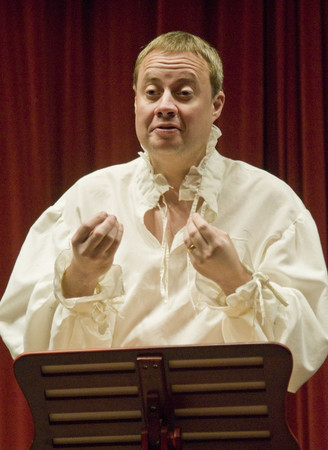
"He speaks contemporary English to the audience," says Dan Decker, artistic director of the Las Vegas Shakespeare Company, referring to Tuesday's one-man, one-night-only reading of "Shakespeare's Roses" at Summerlin's Starbright Theatre, starring, in his sole stage performance (hope he's got his Actors' Equity card), Bill Shakespeare.
"It's set in his retirement home in Stratford-upon-Avon."
The Bard playing bingo, flirting with hottie grandmas, doing wheelchair wheelies down the halls and scarfing down the fish-and-chips early bird specials?
Hardly. But conceptually, "Shakespeare's Roses," as authored by Decker, is nearly that radical. Structurally similar to monologue shows about Will Rogers and Mark Twain, "Roses" features the idolized playwright -- portrayed by actor Lincoln Hudson -- in his waning years, ruefully reflecting on his life while dying of syphilis, as most historians agree was his cause of death in 1616 at age 52. Beyond that, "Roses" treats history as a flexible foundation.
"It's all conjecture, and I'm a storyteller, so I don't need to stick to facts -- facts are stupid things, to quote Ronald Reagan," says Decker, whose company resists any rigid renderings of Shakespeare. Back in May, Decker produced a sort of speed-Shakespeare featuring 20-minute versions of Bard classics at Springs Preserve. At least then he was faithful to the actual -- if condensed -- scripts.
"I've done a lot of independent research on Shakespeare, and I came up with new insights into his biography that haven't appeared anywhere, and there have been whole libraries written about this guy," Decker says about a hybrid fact/fiction Shakespeare he describes as "funny, cynical, bitter, happy and loving."
Hudson, who co-stars in "Love" at The Mirage, has no qualms about playing a kind of blank-slate Bard. "What we know about the man could be written on the back of a matchbook," Hudson says, "so we have to go into the era to fill in the gaps, and that's what makes it wonderful to write about because a writer brings his own interpretation. He's not coming from any kind of agenda, he's not trying to say that Shakespeare was a gunrunner or that he was gay."
Clearly not the latter, as Decker inserts a mysterious woman into Shakespeare's life -- the fatal STD carrier he meets in London. "There's a conflict about it," Hudson says. "He's angry about catching syphilis, but the person he's caught it from is someone he's deeply in love with. While he's angry -- 'well, that's it, I'm screwed' -- in the end it's possible to be angry with someone but still love them in spite of what they've done."
Mostly, though, "Roses" chronicles an insecure Shakespeare thoroughly clueless about the worth of his work. Cherry-picking elements of his psyche from assorted sonnets and plays, as well as established histories, Decker interprets Shakespeare as a depressive who believes his life has been a mess, dying because of a woman he loved, and convinced he failed his father and never became a great writer, a theme Decker drew from one of his greatest plays.
"That's based on conjecture when you read plays like 'Hamlet,' about a son who can't do what his father wants him to," Decker says, noting that of the nearly 40 plays Shakespeare penned, most were cribbed from other playwrights and filtered through his vibrant verse. "He was stealing wholesale, but there were no copyright laws."
Illustrating his despair, Decker cites writer Ben Jonson, a Shakespeare competitor and onetime protege, whose fame far outdistanced the Bard's. Jonson published a complete volume of his works the year Shakespeare died. "That would've driven Shakespeare over the edge," Decker says. "Shakespeare's works weren't put together while he was alive, they were published in 1625. He would've died feeling like a failure."
Though astounding to contemplate now, the Bard wouldn't have even considered himself an artist, Hudson says. "Even though he creates this wonderful poetry, he's still taking original stories and making them poetic for the stage, and you get the sense he's not satisfied," Hudson says. "His private life he believes is a complete catastrophe, and it seeps into his professional life. He feels he's let people down who are closest to him."
Despite such self-loathing, Decker's Shakespeare finally emerges to discover the poetic voice that endures centuries later. "A question I asked myself as I wrote this was, 'Did Shakespeare know he was Shakespeare?' For 90 percent of the play, he is very human," Decker says. "He can't even remember what he wrote, he has to go into this pile on his desk. But by the end, the poetry just flows from him organically. He transcends and becomes the iconic Shakespeare."
That's when we'll forgive him all that thee-thy-thou jazz.
Contact reporter Steve Bornfeld at sbornfeld@ reviewjournal.com or 702-383-0256.
Preview
"Shakespeare's Roses"
7 p.m. Tuesday
Starbright Theatre, 2215 Thomas W. Ryan Blvd.
$12-$15 (232-1045)