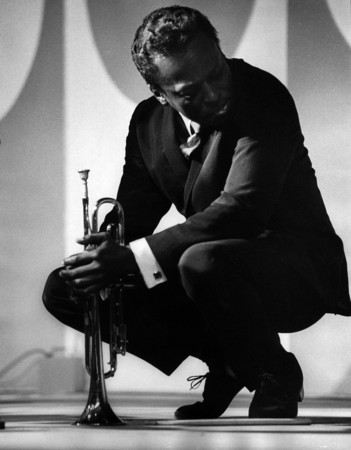
Born for the Horn

"When you're creating your own (music), man, even the sky ain't the limit."
-- Miles Davis
So cool that ice cubes envied him. So complex that Freud could've named a syndrome after him. So relentlessly creative that he came to stand for never standing still. So eclectic and influential that as a jazz musician, he was inducted into the Rock and Roll Hall of Fame.
A musical light known as the Prince of Darkness.
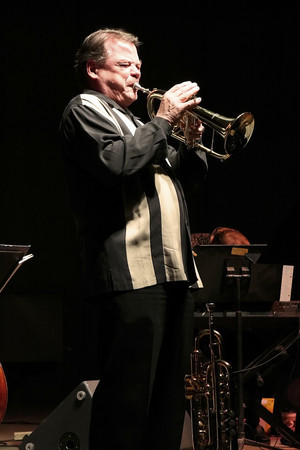
"Miles was the biggest influence on me as a musician," says trumpeter Walt Blanton. "I didn't try to copy Miles, that's not one of the brightest things to do because you end up sounding like a bad version. My concept of sound was more influenced by Miles than anybody else."
"You can discover more about a person in an hour of play than in a year of conversation."
Blanton expresses his appreciation for Davis' impact on his musical psyche tonight when his quintet assembles for the outdoor "Music of Miles Davis" concert, celebrating the late virtuoso at the Rainbow Library Amphitheatre.
"Sometimes you have to play a long time to be able to play like yourself."
Blanton will be backed by tenor saxophonist Dave Stambaugh, pianist Tony Branco, bassist Jeff Davis and drummer John Nasshan for the tribute. The evening's repertoire includes Davis staples such as "Seven Steps to Heaven," "So What," "My One and Only Love," "Bye Bye Blackbird," "Joshua" and "Blue in Green," off "Kind of Blue," Davis' landmark 1959 album -- and the best-selling jazz record ever, certified quadruple platinum last year.
"I'll play it first and tell you what it is later."
"From Charlie Parker to Prince -- it's just the whole cool nature of it," Blanton says about the career arc of Miles Davis, who teamed with iconic saxophonist Charlie "Bird" Parker at Harlem nightspots in the 1940s, and whose style is said to have inspired musicians up to The Purple One.
Through it all, he had no tolerance for phoniness.
"If they act too hip, you know they can't play (expletive)."
His signature, unmistakable sound was his bell-like, vibrato-free articulation on trumpet -- his childhood music teacher rapped his knuckles when vibrato crept into his playing -- and his signature attitude was an enormous appetite for experimentation.
"Do not fear mistakes. There are none."
With four albums hailed as jazz game-changers -- "Kind of Blue," "Birth of the Cool," "Sketches of Spain" and "Bitches Brew" -- Davis is exalted in jazz history as a perpetual innovator, at the vanguard of several styles, including cool jazz, hard bop, free jazz and fusion.
"Don't play what's there, play what's not there."
"He was continually evolving, and it wasn't a matter of reinventing himself, he just wanted to stretch to see if he could play in more contemporary styles," Blanton says.
"If you hear the early recordings on Blue Note and with (Thelonious) Monk and Art Blakey, getting into something so stylistic, it was the start of hard bop, a more aggressive kind of jazz. With his approach, it was sort of like there's bop, there's hard bop, and then there's Miles."
"I never thought the music called 'jazz' was ever meant to reach just a small group of people, or become a museum thing locked under glass like the other dead things that were once considered artistic."
Race was a complicated factor in Davis' life and career. He upset some black musicians by hiring white players -- spurning reverse racism called "Crow Jim" -- and enjoyed a longtime creative collaboration with white arranger Gil Evans.
"I don't care if a dude is purple with green breath, as long as he can swing."
However, he still harbored racial resentments. He often slammed "Uncle Tomism," claiming that while white musicians were only asked to play the music, black musicians were expected to be all-around entertainers -- dancing as well, and responding to shouted requests in clubs with a happy grin and compliance.
"We're not going to play the blues anymore. Let the white folks play the blues. They got 'em so they can keep 'em."
Davis triggered the fusion jazz movement when his revolutionary album "Bitches Brew" was released in 1970, featuring experimentation with electric instruments and distancing himself from traditional jazz in favor of a looser, rock-oriented approach.
But throughout his career, Davis complained that critics and jazz historians shortchanged him, sometimes on racial grounds.
"As long as I've been playing, they never say I done anything. They always say some white guy did it."
His mystique as the music's "Prince of Darkness" stemmed from a perceived moodiness, coupled with a whispery voice and a tendency to perform with his back to the audience.
"I read an interview with him and he said, 'Have you ever seen a conductor face the audience? I'm communicating with my band,' " Blanton recalls. "But it was all part of this illusion of this strange person, and I don't think he minded at all."
What he minded was disrespect.
"I don't dig people in clubs who don't pay the musicians respect. You ever see anybody bugging the classical musicians when they are on the job and trying to work?"
Eventually, respect and gratitude were bestowed without reservation on Miles Davis, who opened jazz up to numerous new directions without compromising artistic ideals.
"I ain't no entertainer and ain't trying to be one. I am one thing, a musician."
Contact reporter Steve Bornfeld at sbornfeld@ reviewjournal.com or 702-383-0256.
Preview
"The Music of Miles Davis" featuring the Walt Blanton Quintet
8 p.m. today
Rainbow Library Amphitheatre, 3150 N. Buffalo Drive
Free (507-3710)