‘Inglourious Basterds’

Kill your babies.
You might not be familiar with that phrase. Unfortunately, neither is Quentin Tarantino -- and the evidence is all over "Inglourious Basterds," the filmmaker's latest voyage to that cinematic neverland known as Planet Tarantino.
For writers, "kill your babies" serves as a warning against the kind of showboating that signals you're a bit too convinced of your own brilliance -- and a bit too eager to show it off.
Such self-indulgent excess often gets in the way of others sharing your exalted opinion of yourself (and your work).
For Tarantino, however, nothing exceeds like excess -- and "Inglourious Basterds" follows proudly in that tradition.
For lifetime members of Tarantino's fan club, that may be enough.
But for those of us who never ingested infectious amounts of Tarantino-flavored Kool-Aid -- not even during the "Reservoir Dogs"/"Pulp Fiction" heyday of the early '90s-- "Inglourious Basterds" proves, yet again, that Tarantino needs to kill a few babies along the way.
More's the pity, because there's a good movie -- maybe two -- inside all the blood-spattered fluff.
But that would require Tarantino to come down from the celluloid high he's been on for years and do something other than rip off (or, if you prefer, salute) the multiple movie genres his fevered brain has scrambled into one epic spoof/homage.
Clearly, it's too much work for Tarantino to bother creating characters who remotely resemble living, breathing beings, as he did in "Reservoir Dogs" and "Pulp Fiction." (Not surprisingly, "Jackie Brown's" all-too-human characters were created by someone else: novelist Elmore Leonard.)
Instead, he's more interested in making movies about movies -- often not very good movies, as in the case of "Inglourious Basterds," which was inspired (and we use the term loosely) by the 1978 spaghetti World War II movie "The Inglorious Bastards," about soon-to-be-court-martialed miscreants (including Bo Svenson and Fred "The Hammer" Williamson) on a suicide mission behind enemy lines.
"Inglourious Basterds," by contrast, plays like a demented mash-up of three different World War II subgenres: the brigade of misfits movie, the it's-personal revenge movie and the let's-get-Hitler-and-end-the-war movie.
Starting with the misfits-brigade subgenre, "Inglourious Basterds' " title troops are Jewish GIs eager to dispense kosher payback to the enemy during guerrilla raids "somewhere in Nazi-occupied France."
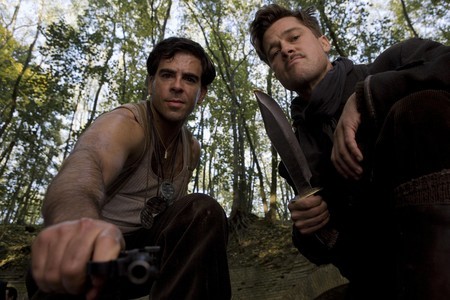
Their commander: Lt. Aldo Raine (a cartoonishly macho Brad Pitt), a tough-talkin', snuff-snortin' Tennessean who, true to his frontier forebears, likes to leave his Nazi victims an unmistakable calling card: missing scalps. (Those lucky few who survive an encounter with Aldo also receive a souvenir of his handiwork: a swastika gouged into their foreheads.)
But in "Inglourious Basterds," the Basterds aren't the only ones out for revenge.
In the movie's gripping opening scene, smilingly sinister Nazi Col. Hans Landa (Christoph Waltz) tracks down a Jewish family hiding beneath the floorboards of a neighbor's farmhouse and orders them machine-gunned.
Ah, but there's a sole survivor: intrepid teen Shoshanna Dreyfus (quietly intense Mélanie Laurent), who flees the scene. Four years later, she's in Paris, living under an assumed name and running a Paris movie house where she meets movie fan, and Nazi hero, Fredrik Zoller ("The Bourne Ultimatum's" Daniel Brühl), star of an upcoming propaganda movie celebrating his expertise in slaughtering Allied troops.
And when Zoller requests his movie's premiere be moved to her theater, a plot hatches in Shoshanna's mind.
But it's nothing the Brits haven't already plotted, as a British movie critic ("300's" dashing Michael Fassbender) who's fluent in German -- and German movies -- parachutes into France. There, he meets up with some of the Basterds to help glamorous German actress (and double agent) Bridget von Hammersmark (lovely and, for a change, lively Diane Kruger) infiltrate the premiere to dispatch various members of the German high command. Maybe even Heil Hitler himself.
Tarantino takes his own sweet time intertwining these three narrative strands, which means "Inglourious Basterds" spends much too much time spinning its wheels rather than racing from one parallel story to another.
In part, that's because the movie doesn't really treat its plot lines as anything more than a clothesline on which to hang numerous isn't-this-cool set pieces.
Some of them are sort of cool, to be sure, showcasing Tarantino's trademark tangy dialogue and flair for outrageous action; but what's striking the first time around becomes predictable and even a trifle annoying upon (repeated) repetition.
And while the movie's spaghetti Western-seasoned soundtrack sets an appropriately over-the-top mood -- with Shoshanna, Col. Landa and the Basterds as "The Good, the Bad and the Ugly," respectively -- the movie seems so stylized and devoid of flesh-and-blood humanity that the characters never really transcend their stereotypical origins.
Which isn't to say that some of them aren't enormously fun to watch, particularly Waltz (named best actor at this year's Cannes film festival), who imbues the urbane Col. Landa with an irresistibly smug man-you-love-to-hate energy.
He's cultured, canny, occasionally even honorable -- in marked contrast to the brutal, bloodthirsty Basterds.
They're the good guys, of course. It couldn't be otherwise during World War II on Planet Tarantino.
Contact movie critic Carol Cling at ccling@reviewjournal.com or 702-383-0272.
Carol Cling's Movie Minute
Review
"Inglourious Basterds"
153 minutes
R; strong graphic violence, profanity, brief sexual situations
Grade: C+
at multiple locations
Deja View
Perilous anti-Nazi missions inspire a variety of World War II adventures:
"The Guns of Navarone" (1961) -- Gregory Peck, David Niven and Anthony Quinn lead saboteurs assigned to knock out the title German gun emplacement.
"The Dirty Dozen" (1967) -- An Army major (Lee Marvin) trains convicted murderers (including Charles Bronson, Jim Brown and John Cassavetes) for a mass assassination of Nazi officers.
"The Devil's Brigade" (1968) -- A U.S. colonel (William Holden) new to combat molds American misfits and Canadian troops into a special forces unit.
"Play Dirty" (1968) -- In North Africa, a British oil executive (Michael Caine) clashes with higher-ups on a daring mission 400 miles behind German lines.
"Where Eagles Dare" (1968) -- A British agent (Richard Burton) and an American assassin (Clint Eastwood) rescue a captured U.S. general from a German stronghold.
-- By CAROL CLING