Suffering For Their Art

Alexandra Christian isn't a doctor, a physical therapist or an anatomy teacher. But when she talks about the strains, pains and other physical issues she has dealt with during her career as a ballet dancer, she certainly sounds like she could be.
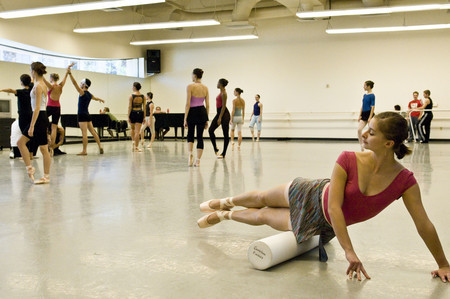
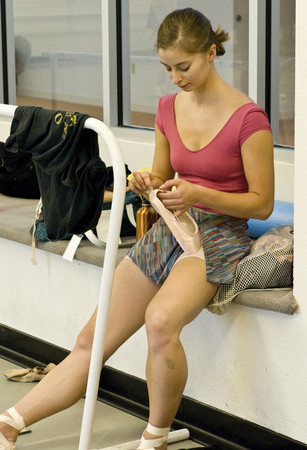
Tendinitis. Plantar fasciitis. Stress-related damage to the metatarsal of her left foot. ("That was upsetting," Christian recalls. "It was really the first thing I had ever gotten.") Plus general inflammation and soreness in her feet that Christian, a dancer with Nevada Ballet Theatre, keeps in check by soaking her feet in ice water 10 minutes a day.
"Other than that," Christian adds, "I've been pretty lucky."
Yet, at the same time, Christian also accepts the deliberate irony that lies at the foundation of all of the performing arts: If an artist does his or her job well, audience members never will see, let alone appreciate, the aches, pains and intense physical demands -- and the accompanying potential for injury -- to which artists expose their bodies in the service of art.
"I don't think people really see that," Christian says, "because our job is to make it look effortless."
Dancers. Singers. Musicians. The performers whose diverse array of skills make up any Cirque du Soleil show. All are, in reality, athletes to one degree or another and, like athletes, risk injury whenever they perform.
Dancers, for example, "need to have the greatest range of motion we can," says Dolly Kelepecz, who teaches Pilates and ballet in the University of Nevada, Las Vegas dance department.
Ballet, in particular, requires "an incredible range of motion," Kelepecz continues. "Probably 10 percent of people have that range of motion naturally. Everybody else has to create it, and when you start to create that, that's when you create injuries."
Most of the physical problems associated with ballet are relatively subtle and largely cumulative. Among them, Kelepecz says, are joint problems -- particularly knee and ankle problems -- rotator cuff and shoulder injuries, and head and neck strains.
But traumatic injuries also can occur. Christian recalls seeing, and hearing, a fellow dancer's anterior cruciate ligament -- one of the knee's key ligaments -- snap during rehearsal. "It's very loud," she says. "It sounds like a gunshot."
"I've been dropped a few times, and I've had various accidents where I slipped and landed a jump wrong," she adds. "That was one of the times I sprained my back."
Musicians also are subject to injuries and chronic medical problems, most of which involve "repetitive motion," says Richard McGee, chairman of the College of Southern Nevada fine arts department.
Among their possibilities: Tendinitis in string players from the stress of bowing and holding such instruments as cellos; neck, shoulder, arm and elbow pains in violinists; guitarists with carpal tunnel syndrome; and even mouthpiece-related overuse problems among brass players.
"God didn't build us to buzz our lips the way we have to when we are playing brass instruments," McGee explains. "I'm a trombone player, and a lot of brass players have serious injuries to the muscles around the lips."
Basically, McGee says, "playing any musical instrument at a high level is an incredibly physical experience."
Even using a baton. Because of the constant arm movements conducting requires, many conductors "run into shoulder problems," says McGee, who also is associate conductor of the Las Vegas Philharmonic. "I've heard of conductors who've actually gotten tennis elbow."
"I'm not saying we're athletic or anything," McGee says. "But there are physical ramifications."
Singers long have faced the malady known informally as "Vegas throat."
"Boy, I can name you lots of performers who really struggled with that in the old days," says McGee, who spent decades playing in orchestras along the Strip.
Dr. Susan Schwartz, a Las Vegas ear, nose and throat specialist, says Vegas throat is "basically a dry throat" that can be caused by environmental dryness, overdoing smoking or alcohol use, abusing the voice or employing "inappropriate vocal technique."
Dr. Robert C. Wang, chief of ear, nose and throat surgery at the University of Nevada School of Medicine, adds that Las Vegas' low humidity, compounded by heating and air conditioning -- which can dry out the lining of the vocal cords, affecting their ability to vibrate -- also is a contributor.
Singers with Vegas throat often "complain that they can't get through a performance without their voice cracking or giving way or becoming hoarse," he says. "So it seems to decrease the ability of the singer to give the same length performance day after day that they otherwise would be able to do in a more humid climate."
Meanwhile, perhaps nowhere in town is the link between physical athleticism and artistic sensibility more apparent than at Cirque du Soleil. Jay Mellette, director of performance medicine for Cirque shows in Las Vegas and Orlando, Fla., says the "broad spectrum" of skills Cirque performers offer "requires a broad spectrum of approaches to support them with."
"For example, we have full-time athletic trainers and physical therapists for every show," he says, along with outside massage therapists, Pilates instructors, strength and conditioning specialists and physicians who also work with performers.
The idea, Mellette says, is that "if we devote time and resources into prevention, what that does is, it improves the career longevity of artists, it reduces the amount of injuries they may face and, if they do get injured, it helps to improve their recovery time." Cirque performers can suffer from "chronic issues that are a result of repetitive movements," he says. "But we also have acute injuries, sprains and strains."
Mellette, who came to Cirque from professional soccer, has found that, from a medical and training standpoint, the pursuits have much in common, although one significant difference is that "in sports, we have the luxury of seasons."
A soccer player or athlete may take time off to rest and heal during the off-season. At Cirque, Mellette says, "we don't have that. We perform year-around. Here in Vegas, it's 10 shows a week and it's full go.
"That means we have to be creative, we have to be thorough and we have to put in place the proper resources to make sure we have the opportunity to provide the services to our performers, who aren't getting a break or an off-season.
For performers of any artistic discipline, injuries can be at least minimized by taking preventive measures. For example, Schwartz advises singers to drink plenty of fluids to keep the mucus secretions in their throats thin. Over-the-counter mucus-reducing preparations also may help, she adds, and "the key thing is to not use their voice when they're not actually entertaining.
Especially for artists in more athletic performing disciplines, conditioning can help to prevent injuries. For instance, Christian's fitness regimen includes frequent daily stretching, Pilates, Gyrotonics, kettle bell workouts and yoga, as well as taking vitamins and eating nutritiously.
And, for many disciplines, proper technique is key. Christian says Nevada Ballet Theatre Artistic Director James Canfield "really works us on having nice, correct technique to prevent injuries."
Similarly, McGee says, proper ergonomics -- learning how to hold an instrument property -- and learning proper playing technique are "huge for a young student learning to play an instrument."
In the end, audiences may never fully appreciate the aches and pains artists suffer in pursuit of their art. But Christian is OK with that.
"Some people say, 'Oh, that's hard work,' but they don't really understand how much work it is," she says. "But, to be honest, it's still kind of a fantastic job. It's so enjoyable, and all that stuff fades away."
Contact reporter John Przybys at jprzybys@reviewjournal.com or 702-383-0280.