‘Wait’ Watchers

And darkness falls upon the face of the stage. ... All of the stage. ... All of the scene. ... All of the climax.
B-L-A-C-K-N-E-S-S.
Must be an easy gig for the lighting designer.
"It's very dangerous, that scene," says Russ Benton, co-director of the thriller "Wait Until Dark," which opens today for a two-weekend, six-performance run at the College of Southern Nevada's BackStage Theatre. In that violent finale -- a face-off between a blind woman and sadistic thugs -- audience and actors are plunged into blackout conditions as the heroine turns her physical disability into a tactical advantage when the lights are doused in her apartment.
"We've got actors in kneepads and elbow pads because they're running into furniture, and poor Susy (lead actress Mary Foresta), her shins are all banged up."
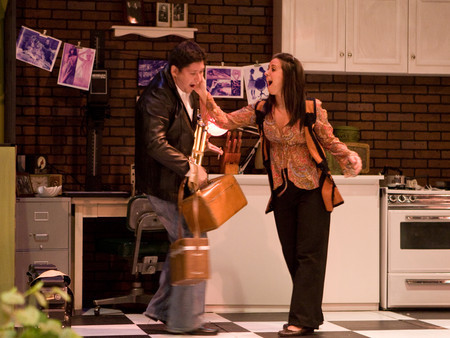
"Wait Until Dark" builds tension from the plight of Greenwich Village housewife Susy Hendrix, left sightless after a recent car wreck, who is targeted in her home by three goons searching for heroin hidden in a doll that her husband transported from Canada as a favor to a woman who was later murdered. When Susy rejects their explanation that her spouse has been implicated in that murder and she must cough up the drugged-up doll to protect him, mystery and mayhem ensue.
Yet "Wait Until Dark," at least for some, has become a dated curio piece. New York Times critic Ben Brantley, reviewing the 1998 Broadway revival, said the play now "comes across as a tediously contrived windup toy that yells 'Boo!' just before it runs down."
Benton understands the challenge of keeping it compelling for a contemporary audience.
"In this day and age, thrilling audiences is not the same as it was back when the play was written in 1966," Benton says. "They're savvier and desensitized to the subtleties employed back then. It's a matter of making it work today. You have to retrain the audience in the first 10 minutes about how the tone will be employed and fine-tune their sensibilities."
The cat-and-mouse mystery originally was staged on Broadway with a cast headlined by Lee Remick and Robert Duvall and directed by film giant Arthur Penn, the production eventually transferring to London's West End, starring Honor Blackman (Pussy Galore in "Goldfinger"). Adapted to the screen in 1967 with Audrey Hepburn and Alan Arkin, it lay dormant until a 1998 revival starring Marisa Tomei gained stage infamy for co-star Quentin Tarantino, the "Reservoir Dogs"/"Pulp Fiction" auteur who had last performed onstage in community theater as a teenager. Making his Broadway bow, Tarantino was roasted by critics for playing -- or trying to play -- a menacing thug, his performance described as "merely petulant, like a suburban teenager who has been denied the use of his father's Lexus for the night" in Brantley's review.
"He was so goofy looking in that," recalls Benton, who co-directs this production with Chris Mayse of the Atlas Theatre Ensemble. "In the film, it's Alan Arkin, and he's just creepy, with that late-'60s, Zodiac Killer thing about him. In our production, we have a gentleman who doesn't look menacing at all. In the first moments of the play, he's awkward, so you don't expect him to be what he really is later."
Prepping to play Susy, Foresta resisted the impulse to examine Hepburn's film performance -- for a while. "I purposely didn't watch it until after I felt I had my character down, then I thought it was safe," she says. "We're definitely playing it two different ways. I'm playing her more as a survivor."
Movie portrayals still factored into her interpretation, however. Two prominent acting cliches are playing blind and playing drunk and Foresta was determined to sidestep the pitfalls of the former. "I saw any movie that had any type of blind person in it, every one I could get my hands on," says Foresta, who then took her training into the real world.
"I got in touch with Blind Connect, which is a center here in Las Vegas, and a very nice man welcomed me at his home and I spent hours with him. I learned there's a difference, depending on how long you had your vision, for how you react," she says, pointing out that recently blinded people retain all their facial expressions -- a crucial detail for her performance -- while those with lifelong blindness have a "blankness" in the top halves of their faces.
"I wear contact lenses, so I took them out," Foresta says. "You ever stare at something so long that it blurs everything? I tried to do that to the point that I have to rely on my hearing."
And yet, some requirements of a sighted actress playing blind are a bit unnerving. "There's a scene where I smell smoke in the apartment and I have to make a mad dash for the staircase," she says. "It's hard because I can obviously see clearly where I'm going and I have to run at top speed into the railing. You see it and you're like, 'Nooo!' But you have to do it."
That's called suffering for your art. Not everyone does, though. While she's racing around a darkened, furniture-strewn stage evading killers in the "Wait Until Dark" climax, the lighting designer can catch a catnap.
Contact reporter Steve Bornfeld at sbornfeld@ reviewjournal.com or 702-383-0256.
Preview
"Wait Until Dark"
7:30 p.m. today and Saturday; 2 p.m. Sunday (through Aug. 23)
BackStage Theatre, College of Southern Nevada, 3200 E. Cheyenne Ave.
$10-$12 (651-5483)