‘Where the Wild Things Are’

Let the wild rumpus start!
Of course, it's not quite the wild rumpus that generations have shared, thanks to Maurice Sendak's imperishable 1963 kid-lit classic, "Where the Wild Things Are."
Expecting a feature-length movie to deliver the same whimsy, the same wonder, that Sendak creates in 338 words -- and 18 enchanting illustrations that say more than those words ever could -- dooms any live-action movie adaptation to instant failure.
But writer-director Spike Jonze's version is far from a failure.
Granted, it's not an ideal adaptation of what lots of people have long considered an "unfilmable" book. (A few of us -- probably too few -- remember the award-winning 1973 animated short, which ran about as long as it would take for you to read the story to your kids.)
The story this movie version tells, for all its flights of fancy, seems more grounded -- and, as a result, more prosaic -- than its source.
Until, and even after, it reaches its title destination, this "Where the Wild Things Are" unfolds in a decidedly modern setting, with a greater focus on contemporary conflicts.
As a result, this "Where the Wild Things Are" speaks more to the wild child inside us all, rather than the children (especially younger children) in the audience.
But never mind. They'll still recognize, and understand, what makes 9-year-old Max (played by the aptly named Max Records) give in to the power of the wild side.
Maybe if somebody would pay attention to him, he wouldn't be so hostile. But his big sister (Pepita Emmerichs) would rather side with her teenage pals than stick up for him when one of them crushes his snowbank igloo. His divorced mom (warm, careworn Catherine Keener) seems preoccupied with work -- and the welcome attentions of her new boyfriend (blink-and-you'll-miss-him Mark Ruffalo).
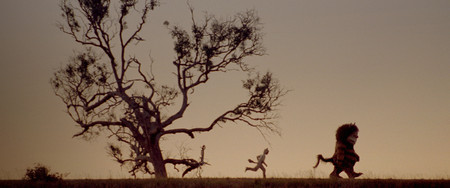
And when Max acts out in a manner that matches the white wolf outfit he loves to wear, he flees his mother's inevitable punishment, seeking refuge in a nearby forest -- and setting sail in a conveniently waiting boat, one that floats over stormy seas to a deserted island.
Ah, but it's not deserted at all.
It's populated by monsters -- outsize monsters with pointy claws and pointier teeth and the pointiest possible horns. They may be hungry monsters, but they wouldn't dream of eating Max. Not when they recognize him as a kindred spirit -- and crown him as their ruler.
King Max may be a wild thing, but he needs a family just as they do -- no matter how beastly that family might be.
As voiced by an all-star ensemble (led by James Gandolfini, Forest Whitaker, Chris Cooper, Paul Dano, Lauren Ambrose and Catherine O'Hara), these monsters mope around at least as much as they rampage, giving Max (and those of us in the audience) the chance to observe their group dynamics.
In expanding Sendak's brief but perceptive tale, Jonze and co-writer Dave Eggers can't possibly hope to match the original's profound simplicity. (Who could?)
They can, however, expand on the notion that imagination provides a welcome refuge from painful realities. (Just ask Alice -- or Dorothy -- about their journeys through the looking glass or along the yellow brick road, respectively.)
Unlike those action-packed journeys, however, Max's sojourn seems at least as philosophical as physical, considering the ways in which his monster pals claw and squabble for attention -- echoing his own behavior back home.
Rendered as oversize puppets (courtesy of Jim Henson's Creature Shop), Max's monster pals seem a bit less fanciful than their storybook counterparts. Yet their low-tech look adds to the movie's heartfelt human touch.
Jonze's touch, meanwhile, is everywhere, from the visually inventive opening sequence (arguably the movie's most powerful section) to the matter-of-fact way he addresses the most outlandish occurrences. (Hey, they're no more outlandish than the ones Jonze explored a decade ago in his feature debut, "Being John Malkovich.")
Throughout, Records' angelic countenance provides crucial contrast with his bratty antics, enabling him to embody the mischievous Max -- half angel, half imp. And all kid.
As for the monsters, they're a vivid group, from the crabby, blabby Judith (who else but garrulous O'Hara) to the hulking, sulking Carol (voiced, with a touch of melancholy menace, by Gandolfini), a giant-size stand-in for Max's absent father.
Ambrose's world-weary tolerance, Dano's rueful frustration and Cooper's gentle, long-suffering resignation also shine through.
Separately and together, they're a monstrously endearing bunch. And they help make "Where the Wild Things Are" at least as wise as it is wild.
Contact movie critic Carol Cling at ccling@reviewjournal.com or 702-383-0272.
Review
"Where the Wild Things Are"
100 minutes
PG; mild thematic elements, adventure action, brief profanity
Grade: B
at multiple locations
Deja View
Maurice Sendak's "Where the Wild Things Are" is only the latest in a long line of children's literary favorites brought to the screen. A few memorable predecessors:
"The Wizard of Oz" (1939) -- A twister blows Kansas kid Dorothy Gale (Judy Garland) over the rainbow to Oz in this classic musical version of L. Frank Baum's all-American fairy tale.
"A Little Princess" (1995) --When her father disappears in combat, Sara Crewe (Liesel Matthews) goes from pampered student to boarding-school servant in director Alfonso Cuaron's magical adaptation of Frances Hodgson Burnett's beloved novel.
"The Iron Giant" (1999) -- "Incredibles" director Brad Bird's entrancing animated adaptation of Ted Hughes' tale about a boy who befriends a robot (voiced by Vin Diesel) from outer space.
"Charlie and the Chocolate Factory" (2005) -- Director Tim Burton takes on Roald Dahl's tasty tale of a little boy (Freddie Highmore) who wins a tour of the title candy palace, run by the endlessly eccentric Willy Wonka (Johnny Depp).
"Coraline" (2009) -- The adventurous title character (voiced by Dakota Fanning) discovers a strange alternate world in an adaptation of Neil Gaiman's tale from stop-motion animation wizard Henry Selick.
-- By CAROL CLING