‘Mad’ to the Bone

Banks, brokers, bonuses.
Three epithets in contemporary, recessionary America.
Which makes a 65-year-old French play remarkably relevant.
"I think of it as classical theater because it really is addressing issues -- the misguided, self-serving powerful individuals of the world who are trying to control it with money and power and corruption," says Doug Baker, director of "The Madwoman of Chaillot," opening today for a three-weekend run at the College of Southern Nevada's BackStage Theatre.
Penned in 1943 by Jean Giraudoux, one of France's foremost dramatists between the two world wars, and adapted into a 1969 film starring Katharine Hepburn, the now-infrequently performed "Madwoman" has been variously described as a poet satire, a comedy-drama, an allegory, a fantasy, a fable and a farce.
Though written when France was occupied by the Nazis, the piece was admired by both critics and audiences of the era for its poke-in-the-eye attitude toward the establishment -- any establishment. "There's no mention of (Nazis) in the play, it just mentions the generalities of corruption and power and greedy behavior and what its consequences are," Baker says. "I felt that's sort of what we're going through right now, so it might be kind of important."
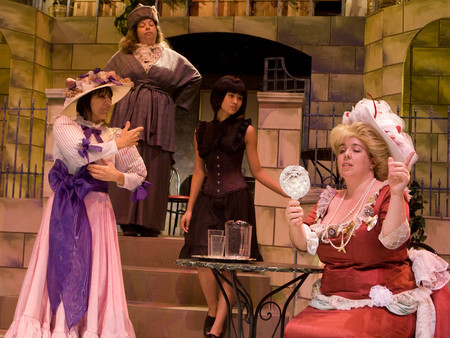
Rife with humor and whimsy, "Madwoman" focuses on a motley collection of cafe denizens, vagabonds and street urchins led by the quirky titular madwoman, Countess Aurelia of Chaillot, and her three batty old friends, as they form a ragtag resistance against a prospector and a capitalist cabal hell-bent on drilling for oil beneath the Parisian streets.
There's even a mad tea party in the second act.
"I am the leader of the group," says Jennifer Jacovelli, who portrays Aurelia. "She's very headstrong, she's very confident, but she's also trapped in her own little romantic world. Every so often, she'll go off on a little tangent about how wonderful and romantic life is, then she comes back. But none of the madwomen are delusional."
"Mad" in this play's context is high praise. "She's eccentric because she lives in innocence, that is what she promotes and nothing else," Baker says. "They're madwomen in that they don't conform to what society is. They've found what's important in their own lives, and that's what they are conforming to. They're only mad in that they have a different set of values that others may not hold as important."
With a robust, all-student cast of 27, Baker is mining "Madwoman" for educational value. "I try to pick shows that will challenge the political norm," Baker says. "I'm not interested in entertainment per se, but to challenge students to think of what the circumstances are in their own lives and give them dramatic license to express themselves within the culture happening to them, as well as entertain an audience."
Banks that don't pay back billions in bailouts, corporate kingpins who board private jets to Washington, D.C., to claim poverty, golden parachutes for CEOs departing their corner office suites, unapologetic bonuses shelled out to well-heeled employees as modestly paid workers throughout the country fear for their jobs, Bernie Madoff -- the contemporary parallels are numerous and unnerving.
"All of that will ring true because in the very first scene, it's the kind of material they're talking about, the president, the broker, the baron, the prospector are all talking about taking advantage of the public and losing their humanity for greed," Baker says. "The audience will fall in love with the innocence and joy of the main characters, but they will certainly draw conclusions about where they stand in terms of the economic crisis and the war and how these things are tied together."
Near the play's end, Baker deploys a dramatic device to enhance the point. Students portraying avaricious corporate predators will don clear masks.Though their faces will be visible, the effect is of all appearing alike, suggesting the soullessness of the monolithic power structure. "It's in the same way that we don't know who they are out there that are getting bonuses and running businesses, they all look the same to us, they don't have a focus on what's really important in humanity," Baker says.
"It's a very stylized play, it's not realism. So many of the characters who are losing their humanity are focused on one aspect of their characters -- their money, their beauty, they've found purpose in only one thing. And then the urchins and the madwomen actually are whole in that they are embracing all of the world, trying to see the world in a beautiful light."
Such is a play that suggests insanity is the truest form of sanity.
Contact reporter Steve Bornfeld at sbornfeld@ reviewjournal.com or 702-383-0256.
Preview
"The Madwoman of Chaillot"
7:30 p.m. today, Saturday and 2 p.m. Sunday (through Nov. 22)
Backstage Theatre at the College of Southern Nevada, 3200 E. Cheyenne Ave.
$10-$12 (651-5483)